Captyx is the only business broker and M&A Advisor with performance guarantees and can build your business so it actually sells.

Business Valuations Built for Real World Transactions

A business valuation should do more than give you a number.

It should help you understand what your business is worth, why it is worth that amount, what buyers may actually pay, what lenders may support, and what can be done to improve value before a transaction.

Our team has completed thousands of valuations for business owners, entrepreneurs, private equity groups, family offices, M&A Advisors, business brokers, CPAs, attorneys, and many more. 

Valuation for Every Application

Business Valuations That Make Sense

Our business valuation services are designed for owners, buyers, investors, private equity groups, search funds, business brokers, M&A advisors, investment banks, and acquisition teams who need more than a simple rule of thumb.

We build valuations that make sense in the real world.

Because ultimately, a business sells when someone is interested in buying it, has the ability to pay for it, believes the opportunity is worth the risk, and sees a valuation that makes sense for everyone involved.

Not fantasy math.
Not inflated expectations.
Not a number designed to make someone feel good for five minutes and disappointed for six months.

A proper valuation creates clarity.

It helps sellers understand where they stand.
It helps buyers understand what they are paying for.
It helps lenders understand what can be financed.
It helps advisors structure a transaction that can actually close.

Captyx has completed thousands of business valuations across a wide range of industries, deal sizes, buyer types, and transaction structures. Our valuation work has been trusted by top industry leaders, M&A advisors, business brokers, investment banks, search funds, private equity groups, entrepreneurs, family offices, and strategic buyers.

LEGITIMATE TESTIMONIALS

Our Valuations are Trusted by Banks, CPAs, Attorneys, & M&A Pros Worldwide (Yours is Free)

“We've utilized the Captyx team more than a few times and have always been pleased with the detail and accuracy of their work.”

Alva Edision

M&A Advisor

“All of our acquisitions start with Captyx valuations and go to market analyses. We trust their insight and experience.”

Ron Sheldon

Market Capital Group

“We've relied on the Captyx team for the past 8 years and trust them to work with our clients and advisors.”

Peter Shao

M&A Advisor

“Where other firms use calculators and slide-rules, Captyx actually justifies market positions for us.”

Becca Peterson

M&A Attorney

“We review hundreds of deals per month. When we want the right presentation we always go to Captyx.”

Richard Smith

Acquisition Analyst
Thousands of valuations completed

How Captyx Values Businesses For Acquisitions

There is no single valuation method that works perfectly for every business.

Different businesses require different approaches depending on profitability, assets, growth, risk, financing, and buyer demand.

Captyx may use multiple valuation methods to produce a more complete and realistic picture of business value.

Below are five of the most common valuation approaches we use.

Discounted Cash Flow valuation, often called DCF, is a forward looking method used to estimate the present value of a business based on future cash flow. In simple terms, DCF asks: How much cash is this business expected to generate in the future, and what is that future cash worth today? This valuation method is especially useful for businesses with predictable revenue, strong growth opportunities, recurring income, or clear expansion potential. A DCF valuation may consider: Future revenue growth, Projected profit margins, Operating expenses, Capital expenditures, Working capital needs, Risk profile, Discount rate, Terminal value, and Future cash flow generation. DCF analysis can be helpful because buyers are not only buying what a business did yesterday. They are buying what they believe it can do tomorrow. However, DCF models are only as useful as the assumptions behind them. Overly optimistic projections can create unrealistic valuations. Conservative assumptions may undervalue a strong growth opportunity. Captyx helps build DCF models grounded in reality, market data, and buyer expectations.

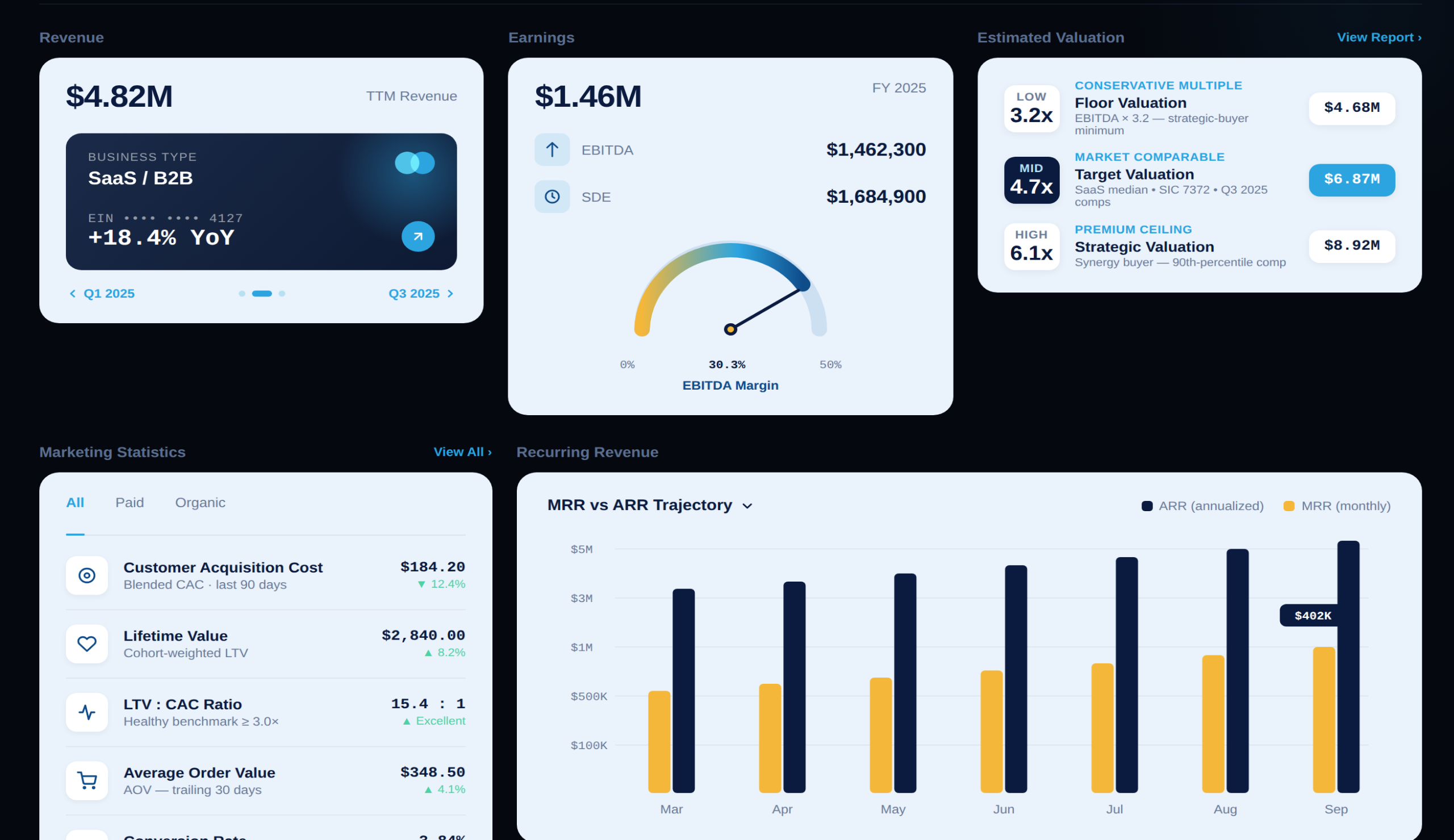
Cash flow multiple valuation is one of the most common approaches used in mergers and acquisitions, especially for profitable small businesses, lower middle market companies, and service businesses. This method typically values a company based on a multiple of adjusted EBITDA or seller discretionary earnings. EBITDA stands for earnings before interest, taxes, depreciation, and amortization. Seller discretionary earnings, often called SDE, is commonly used for smaller owner operated businesses and may include owner compensation and certain discretionary expenses. For example, a company with $1 million in adjusted EBITDA may be valued at a multiple of earnings depending on the industry, growth rate, risk, and buyer demand. But not all cash flow is valued equally. A business with strong recurring revenue, clean financials, a management team, low customer concentration, and consistent growth may receive a higher multiple. A business with messy books, heavy owner dependency, declining revenue, weak systems, or customer concentration may receive a lower multiple.

Asset based valuation focuses on the value of a company’s tangible and intangible assets. This method is especially relevant for asset heavy businesses where equipment, inventory, vehicles, property, contracts, or intellectual property represent a significant portion of value. Asset based valuation may consider: Machinery and equipment, Vehicles, Inventory, Real estate, Technology, Intellectual property, Customer lists, Contracts, Licenses, Patents, Working capital, Liquidation value, and Replacement cost. This valuation method is commonly used for manufacturing companies, construction businesses, transportation companies, equipment intensive service businesses, and other asset heavy operations. Asset based valuation can help establish a floor value for a business. However, assets alone do not always determine what a business will sell for. A company with valuable equipment but weak earnings may still struggle to attract buyers at a premium. A company with fewer assets but strong recurring cash flow may command a stronger valuation. Captyx looks at asset value in the context of total business value and buyer demand.

Market value analysis compares a business to other similar businesses that have sold or are currently being evaluated in the market. This approach helps answer the question: What are buyers paying for similar companies right now? Market comparable valuation may consider: Recent comparable transactions, Industry multiples, Buyer demand, Geography, Company size, Profitability, Growth rate, Deal structure, and Industry trends. For example, HVAC, plumbing, roofing, healthcare, home services, water treatment, and specialty B2B services have attracted significant buyer interest in recent years. When buyer demand is strong, valuation multiples can rise. However, market comparables must be used carefully. No two businesses are exactly alike. A company with similar revenue may have completely different profitability, operations, customer concentration, growth potential, or risk. Captyx uses market comparables as one part of a broader valuation process, not as a shortcut. The goal is to understand where your business fits in the current acquisition market and what would make it more competitive.

A valuation must make sense not only to the buyer and seller, but also to lenders. This is where debt capacity and DSCR analysis become critical. DSCR stands for Debt Service Coverage Ratio. It measures whether a business generates enough cash flow to support acquisition debt payments. In simple terms: Can the business afford the debt required to buy it? Many acquisitions involve financing. This may include bank financing, SBA loans, seller financing, private credit, or leveraged buyout structures. If the business cannot support the debt load, the transaction may fail even if the buyer and seller agree on price. Debt capacity analysis may evaluate: Available cash flow, Debt service requirements, Interest rates, Loan terms, Working capital needs, Seller financing, Buyer equity contribution, SBA financing limits, Lender requirements, and Risk adjustments. This approach is especially important for owner operated businesses, search fund acquisitions, private equity deals, SBA backed transactions, and leveraged acquisitions. Captyx uses DSCR analysis to help determine what a buyer may realistically be able to pay and finance. This makes the valuation more practical and helps avoid deal structures that collapse later.

Why Business Valuations Matter

Most business owners eventually ask the same question.

What is my business worth?

But the better question is this:

What would a real buyer be willing to pay for my business, and what would need to be true for that number to increase?

That is where Captyx business valuation services become different.

A business valuation is not just about revenue, profit, or an industry multiple. It is about the entire story a buyer sees when evaluating risk and opportunity.

If those answers are unclear, valuation suffers.

If those answers are strong, valuation improves.

This is why a proper valuation is essential for business owners who are thinking about selling, planning for an exit, buying a business, raising capital, preparing for succession, evaluating a partner buyout, or trying to understand how to increase enterprise value.

A strong valuation provides direction.

It shows what the business is worth today.
It shows what is holding value back.
It shows what buyers may care about most.
It shows which improvements may increase the outcome.
It helps owners make better strategic decisions.

Without this clarity, owners often go to market with the wrong expectations and lose valuable time.

Who We Work With

Valuation

Each industry has different valuation drivers.

An HVAC company may be valued heavily on recurring maintenance agreements, technician retention, dispatch efficiency, and lead flow.

A manufacturing company may depend more on equipment value, customer concentration, production capacity, gross margins, and backlog.

A professional services firm may be evaluated based on client retention, management depth, recurring revenue, and owner dependency.

A technology enabled services business may be valued based on scalability, automation, customer acquisition cost, recurring revenue, and margin expansion.

Captyx understands these differences because we have worked across many transaction types and industries.

SELL YOUR BIGGEST ASSET

Why Businesses Trust Captyx

If you are planning to sell your business, a Captyx valuation helps you understand what buyers may realistically pay and what can be done to improve the outcome.

Our valuation process helps sellers answer:

What is my business worth today?
What would buyers like or dislike about my business?
What type of buyer may pay the most?
What issues could hurt my valuation?
What improvements should I make before going to market?
How long might a sale take?
What deal structures are realistic?

A seller who understands value is better prepared to negotiate.

Why Captyx Valuations Are Different

Captyx valuations are different because they are built for transactions, not theory.

We understand that businesses sell when value makes sense to all parties.

That includes the seller, the buyer, the lender, and sometimes investors, partners, or acquisition committees.

Our valuation approach combines:

Thousands of completed valuation projects
Real M&A transaction experience
Buyer behavior insight
Market research
Financial analysis
Operational review
Deal structure understanding
Value enhancement strategy

This gives owners and stakeholders a more complete picture of value.

Not just what the business is worth.

But what can be done to improve it.