


TL;DR:
- Earn-outs are contingent payments based on a business meeting performance targets after closing, often used in small business M&A deals. Sellers should focus on clear metric definitions, operating covenants, and dispute resolution clauses to protect their value throughout the measurement period. Good drafting and active engagement can prevent common disputes and maximize final earn-out payments.
An earn-out is a portion of the purchase price paid only after closing, contingent on the acquired business meeting agreed performance targets during a defined measurement period. This structure appears in roughly one in four private-target deals, making it one of the most common tools in small business M&A. Buyers use earn-outs to limit overpayment risk when future performance is uncertain. Sellers use them to capture full value when a buyer won’t pay upfront for projected growth. Understanding how earn-outs work in small business deals is the difference between a clean exit and years of post-closing conflict.
How earn-outs work in small business deals
An earn-out is the industry term for what many owners call “deferred performance pay.” KPMG describes earn-outs as a post-completion mechanism that adjusts total deal consideration based on measured operating performance after closing. The agreement sets the earn-out period, the performance metric, and the calculation method.
The core logic is straightforward. A buyer believes your business is worth $2 million today. You believe it will generate enough to justify $2.8 million. An earn-out lets you close at $2 million upfront and earn the remaining $800,000 if the business hits agreed targets over the next two years. Neither side has to walk away from the deal over a valuation disagreement.

Measurement periods typically run 1–3 years, starting at closing. Shorter periods favor sellers because less can go wrong. Longer periods give buyers more confidence in the data but expose sellers to more operational risk under new ownership.
How are earn-outs structured?
The earn-out portion of a deal typically represents a meaningful share of total consideration. The median earn-out sits around 34% of deal value in small business transactions, though the practical range runs from 15% to 30% in most deals. That is a significant amount of money to leave contingent on post-closing events you may not fully control.
Choosing the right performance metric
Revenue is the preferred metric in most small business earn-outs. Revenue is harder to manipulate than EBITDA because a buyer cannot easily reduce it through accounting choices or cost allocations. EBITDA earn-outs create disputes when buyers increase overhead, change depreciation methods, or allocate corporate costs to the acquired entity. If you accept an EBITDA earn-out, the agreement must define every line item precisely.
Common metrics used in earn-out agreements:
- Revenue: Total gross or net revenue from defined business lines
- EBITDA: Earnings before interest, taxes, depreciation, and amortization
- Gross profit: Revenue minus cost of goods sold
- Customer retention: Number or percentage of customers retained post-close
- Milestone-based: Specific events like regulatory approval or contract execution
Capped vs. tiered payment structures
KPMG notes that earn-out payments can be structured as capped targets or tiered scales. A capped structure pays the full earn-out only if you hit one specific number. A tiered structure pays partial amounts for partial achievement. Sellers strongly prefer tiered structures because they eliminate the all-or-nothing risk of missing a single threshold by a small margin.
| Structure | How it pays | Best for |
|---|---|---|
| Capped target | Full payment at one threshold | Buyers seeking certainty |
| Tiered/scaled | Partial payment at multiple levels | Sellers reducing binary risk |
| Milestone-based | Payment on specific events | Deals with non-financial targets |
Payment timing after the measurement period
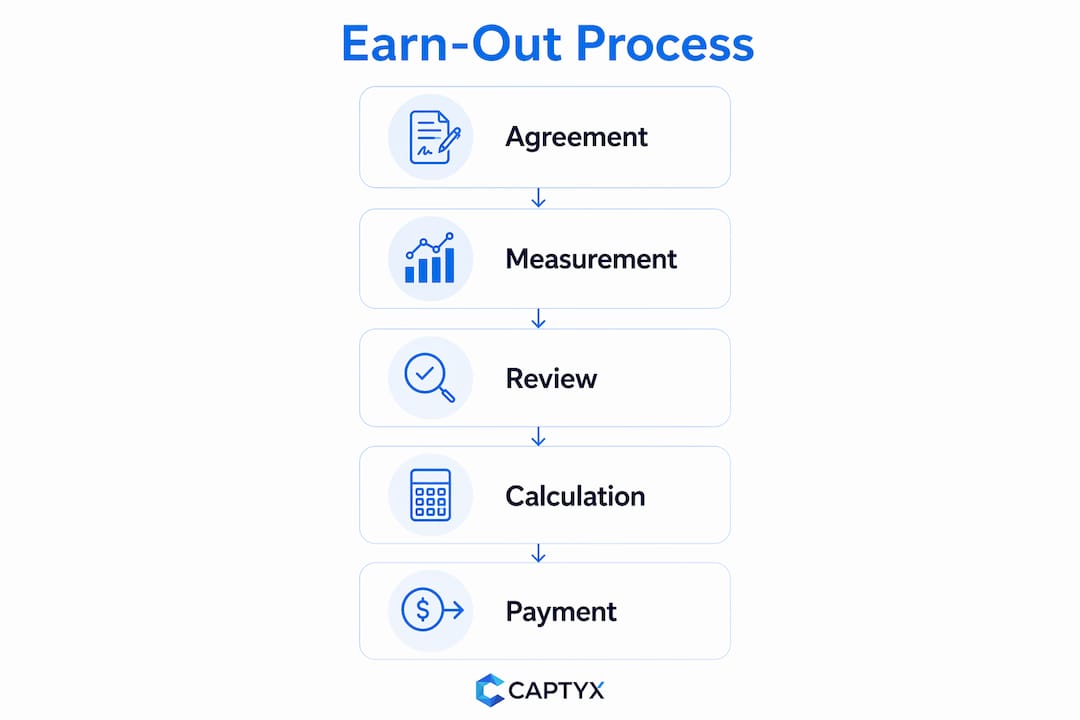
Davis Wright Tremaine details a standard post-period timeline: buyers take 60–90 days to calculate the earn-out after the measurement period ends, then sellers receive 30–60 days to review the calculation. A negotiation window follows if the seller disputes the figures. This timeline matters because it defines your window to catch errors and challenge underpayment.
Pro Tip: Negotiate the seller review period to at least 45 days. Thirty days is rarely enough time to audit financial records and consult an accountant before the dispute window closes.
What protections do sellers need during the earn-out period?
Seller protections are the most negotiated and most overlooked part of earn-out agreements. Once you close, the buyer controls the business. Without written protections, a buyer can make operational decisions that legally reduce your earn-out without breaching the contract.
The foundation is an operating covenant requiring the buyer to run the business in the ordinary course consistent with past practices. That baseline language is necessary but rarely sufficient on its own.
Stronger protections to negotiate before signing:
- Staffing restrictions: Buyer cannot eliminate key sales or operational roles without seller consent during the earn-out period.
- Marketing spend floors: Buyer must maintain minimum marketing investment to protect revenue generation.
- Capital investment commitments: Buyer cannot defer maintenance or investment that would degrade business performance.
- Customer and revenue diversion restrictions: Buyer cannot redirect customers or contracts to affiliated entities.
- Accounting method consistency: Buyer must use the same accounting methods as pre-close to prevent metric manipulation.
Seller information rights
Well-drafted earn-outs include specific seller access rights to financial records and key personnel during the review period. Without these rights, you cannot verify the buyer’s calculation or identify errors within the contract timeline. Insist on monthly or quarterly financial reporting during the measurement period, not just a final calculation at the end.
Dispute resolution procedures
Earn-out disputes can last years without clear arbitration clauses. The standard resolution mechanism is a neutral independent accountant who reviews disputed calculations and issues a binding determination. This is faster and cheaper than litigation. The agreement should name the selection process for the accountant and set a timeline for their ruling.
Pro Tip: Specify that the independent accountant must be a nationally recognized firm with no prior relationship to either party. Vague language here creates delay when you need resolution fast.
What causes earn-out disputes and how do you avoid them?
Earn-out disputes are common. The sources are predictable, which means most are preventable with careful drafting.
- Ambiguous metric definitions. If the agreement says “revenue” without defining which revenue lines, which customers, or which accounting standard applies, the buyer and seller will interpret it differently.
- Buyer operational discretion. Buyers often retain broad rights to manage the business post-close. Without operating covenants, they can make decisions that reduce earn-out metrics without technically breaching the contract.
- Timing and accounting disputes. Revenue recognition timing, cost allocation methods, and intercompany charges all affect EBITDA earn-outs. Define them explicitly.
- Offset rights. Some buyers include provisions allowing them to offset indemnity claims against earn-out payments. This gives buyers a financial incentive to raise post-closing claims. Negotiate hard limits on offset rights.
- Acceleration clauses. If the buyer sells the business during the earn-out period, what happens to your unpaid earn-out? An acceleration clause triggers full payment on a change of control. Without it, a buyer can sell the business and your earn-out disappears.
“Courts emphasize good faith and fair dealing in earn-out enforcement, limiting buyer abuse even under discretionary controls.” — Reed Smith, Delaware courts analysis
Delaware courts actively scrutinize buyer conduct and limit bad-faith avoidance of earn-out payments, even when contracts grant buyers broad operational discretion. This is meaningful legal protection. It does not replace good drafting, but it does mean courts will not ignore a buyer who deliberately tanks performance to avoid paying you.
How do earn-outs fit into your overall exit strategy?
Earn-outs bridge valuation gaps by linking deferred consideration to future performance, which transfers a portion of risk back to the seller. That risk transfer is the price you pay for a higher total deal value. Understanding this trade-off is central to any serious small business exit strategy.
Earn-outs are one of several deferred payment tools available in small business deals. Each serves a different purpose:
| Structure | Primary purpose | Seller risk |
|---|---|---|
| Earn-out | Bridge valuation gap on growth | High: tied to post-close performance |
| Seller note | Finance part of purchase price | Medium: credit risk on buyer |
| Escrow holdback | Cover post-close indemnity claims | Low: time-limited, defined amount |
| True-up | Adjust for working capital at close | Low: mechanical calculation |
Earn-outs carry the highest seller risk of any deferred structure. They also offer the highest potential upside. A seller note pays a fixed amount regardless of performance. An earn-out can pay significantly more if the business outperforms targets.
To negotiate earn-outs effectively in small business sales:
- Push for revenue metrics over EBITDA to reduce manipulation risk
- Insist on tiered payment structures rather than single-threshold caps
- Negotiate operating covenants and information rights before agreeing to any earn-out amount
- Understand how buyers value your business before accepting their earn-out proposal
- Include acceleration clauses for change-of-control events during the measurement period
Sellers who treat earn-out drafting as a secondary concern after agreeing on headline price consistently leave money on the table. The earn-out mechanics are where deals are won or lost after closing.
Key Takeaways
Earn-outs require precise metric definitions, strong operating covenants, and clear dispute resolution terms to protect seller value after closing.
| Point | Details |
|---|---|
| Earn-out definition | A contingent payment tied to post-closing performance, paid only if agreed targets are met. |
| Measurement period | Typically 1–3 years starting at close; shorter periods reduce seller exposure to buyer decisions. |
| Metric selection | Revenue metrics reduce manipulation risk compared to EBITDA in small business deals. |
| Seller protections | Operating covenants, information rights, and arbitration clauses are non-negotiable safeguards. |
| Dispute prevention | Precise definitions, tiered payment structures, and acceleration clauses prevent most post-close conflicts. |
The part most sellers get wrong about earn-outs
Most sellers spend 90% of their negotiation energy on the headline price and treat the earn-out terms as fine print. That is a serious mistake. The earn-out mechanics determine whether you actually collect what you agreed to.
I have seen sellers accept vague revenue definitions because they trusted the buyer’s intentions. Intentions do not hold up in arbitration. What holds up is the contract language. The time to negotiate operating covenants, information rights, and dispute resolution procedures is before you sign, not after you notice the numbers look wrong.
The other mistake I see constantly is accepting EBITDA as the earn-out metric because the buyer insists on it. Buyers prefer EBITDA because they control the cost structure post-close. A buyer can hire additional staff, allocate corporate overhead, or change depreciation schedules, and every one of those decisions reduces your EBITDA earn-out legally. Revenue is cleaner. Fight for it.
Stay actively engaged during the measurement period. Review the monthly financials the agreement entitles you to. Ask questions early. Disputes that surface in month three are far easier to resolve than disputes you raise after the final calculation arrives. The sellers who collect their full earn-outs are the ones who treated the measurement period as an active obligation, not a waiting game.
— Tucker
Captyx advisory for earn-out negotiations
Earn-out agreements are among the most complex documents in a small business sale. Getting the terms right requires both M&A experience and a clear picture of what your business is actually worth before you sit across from a buyer.

Captyx has advised on and closed over 225 business sales, including deals where earn-outs made up a significant portion of total consideration. The firm’s advisors know which earn-out structures protect sellers and which ones quietly transfer value to buyers. If you are preparing for a sale and want to understand your options before entering negotiations, start with a free business valuation to anchor your position. For sellers who want full advisory support through the earn-out negotiation process, Captyx’s M&A advisory services cover deal structuring, metric selection, covenant drafting, and dispute prevention from start to close.
FAQ
What is an earn-out in a business sale?
An earn-out is a contingent portion of the purchase price paid after closing only if the business meets defined performance targets during a set measurement period. KPMG describes it as a post-completion mechanism that adjusts total deal consideration based on measured operating results.
How long does an earn-out period typically last?
Earn-out periods typically run 1–3 years, starting at the closing date. Shorter periods reduce the seller’s exposure to buyer operational decisions that could affect performance metrics.
What metrics are used to measure earn-out performance?
Revenue and EBITDA are the most common earn-out metrics in small business deals. Revenue is generally preferred by sellers because it is harder for buyers to reduce through post-close accounting or cost allocation decisions.
How common are earn-outs in small business acquisitions?
Earn-outs appeared in about 24% of private-target deals in 2025, making them a standard tool in small business M&A rather than an unusual or aggressive structure.
What happens if a buyer and seller dispute the earn-out calculation?
Most well-drafted earn-out agreements require the dispute to go to a neutral independent accountant for binding resolution. Davis Wright Tremaine recommends sellers negotiate clear arbitration procedures and access to financial records before signing to avoid costly litigation.


