


TL;DR:
- Private equity’s exit strategies focus on increasing business value and structuring ownership transfers for maximum seller benefit. Owners can choose from options like IPOs, strategic sales, secondary buyouts, and recapitalizations, each with different implications. Early preparation, including financial hygiene and management strength, significantly improves chances for a favorable exit within three to seven years.
Private equity’s role in exit strategies is to increase business value and create structured ownership transitions that maximize what sellers walk away with. PE firms acquire businesses, grow them through operational and financial improvements, and exit within 3 to 7 years to realize returns for their investors. For small business owners, understanding how this process works is the difference between leaving money on the table and closing the deal of a lifetime. Industry benchmarks like EBITDA multiples, quality of earnings audits, and governance standards all shape how PE buyers evaluate and eventually exit your business.
What exit routes do private equity firms use?
Private equity firms use four primary exit routes: initial public offerings (IPOs), strategic sales, secondary buyouts, and recapitalizations. Each route produces different outcomes for the original owner, and knowing the differences helps you negotiate smarter.

IPO (Initial Public Offering)
A PE firm takes the portfolio company public, selling shares on a stock exchange. This route works best for large, high-growth businesses with clean financials and institutional-grade reporting. Owners who retain equity going into the IPO can benefit significantly, but the process is slow, expensive, and subject to market timing.
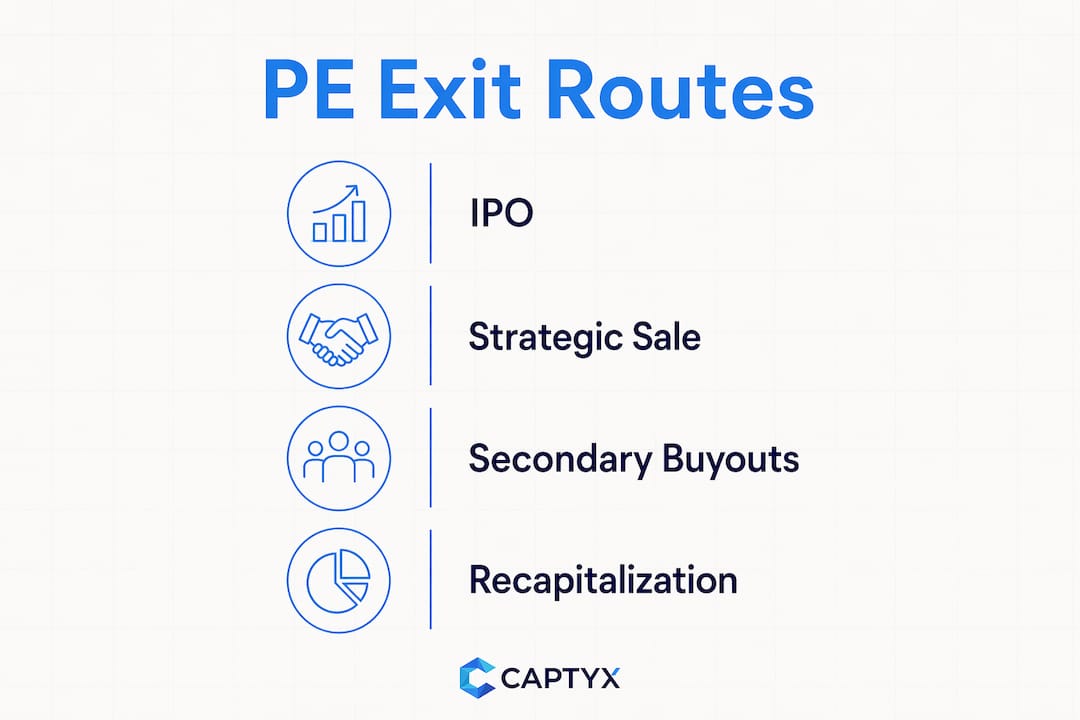
Strategic sale
The PE firm sells the business to a corporate buyer, often a larger competitor or a company seeking to enter a new market. Strategic buyers typically pay the highest prices because they value synergies. This is the most common exit route for mid-market businesses and often produces the cleanest break for the original owner.
Secondary buyout
The PE firm sells the business to another PE firm. This is common when the business is not yet ready for a strategic sale but has grown enough to attract institutional interest again. Owners with rollover equity can benefit from a second round of value creation.
Recapitalization
The PE firm restructures the company’s capital, often pulling out cash through debt while retaining ownership. Owners who sold a partial stake can receive a liquidity event without a full exit. This is a useful option when the business is performing well but market conditions do not favor a full sale.
- IPOs deliver the highest potential upside but require the most preparation and carry market risk.
- Strategic sales produce the fastest, cleanest exits with the highest average purchase prices.
- Secondary buyouts extend the value creation timeline and suit businesses mid-growth.
- Recapitalizations provide partial liquidity without ending PE ownership.
Pro Tip: If you are considering a partial sale to a PE firm, clarify upfront which exit route they prefer. A firm that favors IPOs will run your business very differently than one that targets strategic sales.
How does private equity add value before exit?
PE firms increase business value through four core levers: EBITDA growth, recurring revenue development, management team strengthening, and financial documentation quality. Each lever directly affects the exit multiple you receive.
-
EBITDA growth. PE firms cut costs, improve margins, and add revenue streams to grow earnings before interest, taxes, depreciation, and amortization. Platform companies typically receive 5–8x EBITDA valuations at exit, while add-on acquisitions command 4–7x. Growing EBITDA by even $500,000 can add several million dollars to the final sale price.
-
Recurring revenue development. PE firms pay premiums for predictable, recurring revenue. Recurring revenue can increase valuation multiples 3–5x compared to project-based revenue. That gap is enormous. If your business runs on one-time contracts, a PE owner will work to convert customers to subscription or retainer models before exit.
-
Management team depth. PE firms build out leadership so the business does not depend on one person. A company where the owner handles sales, operations, and finance is a liability to any buyer. PE owners hire or develop a management layer that can run the business independently.
-
Quality of earnings audits. Clean, audited financials are non-negotiable in a PE exit. The 2026 market demands audit-ready documentation because lenders are more selective and buyers are more cautious. A quality of earnings report removes ambiguity and protects the agreed purchase price through due diligence.
Pro Tip: Start treating your financials like a PE firm will scrutinize them, even if you are years away from a sale. Clean books today mean fewer surprises and a stronger negotiating position later.
PE firms also use roll-up strategies to increase exit multiples by combining smaller businesses into a larger platform. As an add-on acquisition, your business benefits from the platform’s higher valuation multiple at exit, even if you sold at a lower multiple initially.
What should owners do to prepare for a PE exit?
Preparation for a private equity exit starts at least two to three years before you plan to sell. Owners who wait until they receive an offer are already behind.
The most critical benchmarks PE firms evaluate are:
- EBITDA threshold. Most PE firms require at least $1M EBITDA for platform deals. Below that, you are an add-on candidate, which means a lower multiple and less negotiating leverage.
- Customer concentration. Customer concentration above 15% increases the risk of deal failure or triggers punitive earn-outs. Diversifying your customer base before approaching PE buyers protects your valuation.
- Management team readiness. PE buyers want to see a team that can operate without the owner. Document roles, responsibilities, and processes so the business runs on systems, not on you personally.
- Predictable revenue. Shift from project-based billing to retainer or subscription models wherever possible. Predictable cash flow commands higher multiples and reduces buyer risk.
- Financial hygiene. Separate personal and business expenses, maintain accrual-based accounting, and get a quality of earnings review before going to market.
The 2026 private credit market is tighter, with lenders focused on downside protection and asset durability. That means PE firms are more selective about which businesses they acquire and how they structure deals. Owners who arrive at the table with clean financials and diversified revenue have a clear advantage.
Pro Tip: Check whether your business qualifies as a sale-ready business before engaging PE buyers. Knowing your gaps early gives you time to fix them.
Working with an M&A advisor who understands PE transactions is not optional at this stage. The preparation process requires expertise in financial structuring, buyer positioning, and deal negotiation that most owners do not have in-house.
What deal structures appear in private equity exits?
PE exits involve complex deal structures that directly affect how much cash you receive at closing and how long you remain involved in the business. The three most common structures are earn-outs, rollover equity, and partial sales.
| Structure | What it means | Owner impact |
|---|---|---|
| Earn-out | A portion of the purchase price is paid after closing, tied to performance targets | Ties 10–30% of the price to future results; extends financial risk post-sale |
| Rollover equity | The seller reinvests a portion of sale proceeds back into the new entity | Retains upside in the next exit; aligns seller with PE firm’s growth goals |
| Partial sale | The owner sells a minority or majority stake but retains some ownership | Provides immediate liquidity while keeping a share of future value |
| Full exit | The owner sells 100% of the business at closing | Maximum immediate liquidity; no future upside or involvement |
Earn-outs are common when there is a valuation gap between what the buyer and seller believe the business is worth. They shift risk to the seller by making part of the payment contingent on hitting revenue or EBITDA targets after closing. Negotiate earn-out metrics carefully. Vague targets create disputes.
Rollover equity is often called the “second bite at the apple.” You sell your business to a PE firm, reinvest a portion of the proceeds into the new entity, and then benefit again when the PE firm exits. Partial business sales work similarly, giving you liquidity now while keeping you invested in future growth.
One detail owners consistently underestimate: PE ownership requires governance shifts and ongoing involvement for 3 to 5 years post-close. You will transition from running the business to reporting to a board, meeting institutional standards, and operating within a defined governance structure. That shift is significant and worth understanding before you sign.
Key Takeaways
Private equity exits reward owners who prepare early, maintain clean financials, and understand the deal structures that determine how much they actually receive at closing.
| Point | Details |
|---|---|
| Exit timing is fixed | PE firms target exits within 3–7 years, so owners must align their planning to this window. |
| EBITDA drives valuation | Platform deals require at least $1M EBITDA; higher EBITDA directly increases your exit multiple. |
| Customer concentration is a deal risk | Concentration above 15% triggers earn-outs or kills deals; diversify before approaching buyers. |
| Deal structure affects real payout | Earn-outs, rollover equity, and partial sales each change how much cash you receive at closing. |
| Preparation starts years early | Owners who clean up financials and build management depth two to three years out get better terms. |
Why most owners misread what PE actually wants
I have worked with enough business owners approaching PE exits to know the most common mistake: they think PE firms want a great product. They do not. PE firms want a great system. The business that wins a PE deal is the one where the owner can step away for 90 days and revenue does not drop.
The second mistake is treating the deal structure as a formality. Earn-outs and rollover equity are not just financial instruments. They are signals about how much the buyer trusts your projections. If a PE firm insists on a large earn-out, they are telling you they do not fully believe your numbers. That is a negotiation signal, not a standard term.
The third mistake is ignoring the post-close reality. PE ownership requires institutional governance and ongoing involvement for years. Owners who expect to cash out and disappear are often surprised by the reporting requirements and board oversight that come with the deal. Understanding your exit options before you sit across from a PE firm is not preparation. It is protection.
The owners who get the best outcomes start preparing three years out, not three months. They fix customer concentration, build management depth, and get their financials audit-ready before the first conversation with a buyer. That preparation is what separates a good exit from a great one.
— Tucker
How Captyx positions owners for PE exits
Selling to a private equity firm is one of the most complex transactions a business owner will face. Captyx has guided owners through over 225 business sales, including deals with PE buyers, and the firm’s process is built around the same criteria PE firms use to evaluate acquisitions.

Captyx helps owners assess their business valuation, identify gaps in financial documentation, and position their company to attract serious PE interest. The firm’s M&A advisory services cover deal structuring, negotiation, and transaction management from first conversation to closing. If you are considering a PE exit in the next two to three years, the time to start preparing is now. Reach out to Captyx M&A advisory to build a plan that puts you in the strongest possible position.
FAQ
What is the role of private equity in exit strategies?
Private equity firms acquire businesses, grow their value through operational and financial improvements, and exit within 3–7 years through IPOs, strategic sales, or secondary buyouts. Their role is to maximize enterprise value and provide structured liquidity for all stakeholders.
How long does a private equity exit take?
PE exits typically occur) within 3 to 7 years of the initial investment. The timeline depends on market conditions, business performance, and the firm’s target return.
What EBITDA do I need to attract a PE buyer?
Most PE firms require at least $1M EBITDA for platform deals. Businesses below that threshold may qualify as add-on acquisitions, which carry lower valuation multiples.
What is rollover equity in a PE deal?
Rollover equity means the seller reinvests a portion of sale proceeds back into the new entity after closing. It gives the seller a stake in the business’s next exit, often called the “second bite at the apple.”
How does customer concentration affect a PE deal?
Customer concentration above 15% increases the risk of deal failure or triggers punitive earn-outs. PE buyers view concentrated revenue as a fragility that threatens post-acquisition performance.


