


For most US small and lower-middle-market sellers, Captyx is the strongest alternative to Generational.com — built on numerous closed transactions, outcome-linked fees, and a named deal lead on every engagement. If you’re evaluating sites like generational.com or looking for a direct replacement, the shortlist breaks into four categories:
- Full-service M&A advisory firms (Captyx, Lincoln International) for sellers who want a named advisor managing the deal start to finish
- Regional business brokers (Sunbelt Business Brokers, Transworld Business Advisors, VR Business Brokers, Murphy Business Brokers) for Main Street and lower-middle-market transactions
- Industry M&A boutiques for sector-specific deals where deep buyer networks matter more than geographic reach
- Online marketplace platforms for sellers comfortable with a self-directed process and lower fees
Two factors separate good alternatives from bad ones: fee alignment (success-based models keep advisors motivated to close) and named deal lead transparency (you should know exactly who runs your transaction).
Table of Contents
- How do these Generational.com alternatives compare at a glance?
- How we selected and compared these alternatives
- How do you pick the right alternative to Generational?
- What does each alternative actually offer, and when should you pick one?
- What should you expect when selling with an M&A advisor?
- Key Takeaways
- What sellers keep getting wrong about choosing an advisor
- Captyx is built for sellers who want a real alternative
- Sources and further reading
How do these Generational.com alternatives compare at a glance?
| Provider / Category | Best For | Typical Deal Size | Service Type | Fee Model | Geographic Reach | Transparency |
|---|---|---|---|---|---|---|
| Captyx | Small to lower-middle market; outcome-focused sellers | $500K–$10M+ | Full M&A advisory + brokerage | Success-based; milestone-linked | National (US) | Named deal lead; 225+ disclosed transactions |
| Sunbelt Business Brokers | Main Street businesses | $500K–$5M | Business broker | Commission on close | Regional/national franchise network | Franchise model; varies by office |
| Transworld Business Advisors | Small business buyers and sellers | $500K–$3M | Business broker | Commission on close | Franchise; broad US coverage | Varies by franchisee |
| VR Business Brokers | Small to mid-size businesses | $500K–$5M | Business broker | Commission on close | Regional offices | Varies by office |
| Murphy Business Brokers | Small to lower-middle market | $500K–$10M | Business broker + advisory | Commission; some retainers | Regional/national | Varies by broker |
| Lincoln International | Mid-market and large transactions | $50M+ | Investment bank / M&A advisor | Retainer + success fee | Global | Named deal team; published deal history |
| Generational Equity | Middle-market sell-side | — | M&A advisory | Upfront retainer + success fee | National | Complaint history documented |
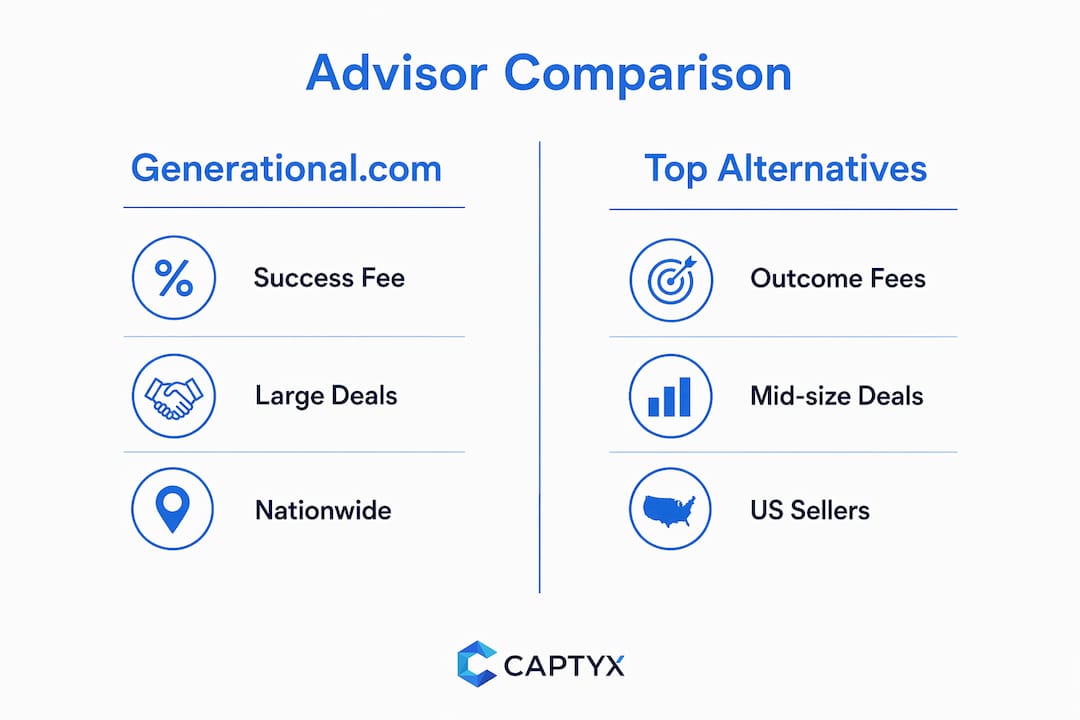
Best for small sellers ($500K–$5M): Captyx or a regional broker like Sunbelt. Best for large mid-market deals ($50M+): Lincoln International. Best value for outcome alignment: Captyx, where fees tie to closing milestones rather than upfront retainers.
Two questions to ask in your first discovery call with any of these firms:
- Who will run this deal day-to-day, and can I meet that person before signing?
- Can you provide a full fee breakdown in writing, including what is and isn’t refundable?
How we selected and compared these alternatives
The shortlist reflects six criteria weighted for small and lower-middle-market US sellers:
- Fee transparency: Is the full fee structure disclosed before signing? Are retainers refundable or milestone-linked?
- Named deal lead: Does a specific, named advisor manage the transaction, or does it get handed to a junior team?
- Proven track record: Are deal counts and case studies published and verifiable, not just marketing claims?
- Off-market capability: Can the firm source buyers outside public listings, protecting confidentiality?
- Tech and data room security: Does the firm use secure virtual data rooms and documented cybersecurity practices?
- Industry credentials: IBBA (International Business Brokers Association) or M&A Source membership signals minimum professional standards.
Public company profiles and industry directories provided category-level context. Legal reporting, BBB complaint records, and Captyx’s internal outcomes informed the trust-signal weighting. For small and lower-middle-market sellers, fee alignment and named deal leads received the heaviest weight because those two factors most directly affect final sale price and seller experience.
How do you pick the right alternative to Generational?
Start with these six criteria, then use the checklist below to stress-test any advisor in a pitch call.

Selection criteria: deal leadership clarity, fee structure and alignment, documented track record, buyer network depth, confidentiality practices, and the tech stack used for data rooms and reporting.
Questions to ask in the first call:
- Who will manage this transaction day-to-day? Can I speak with that person before I sign?
- Please send me a sample engagement letter before our next call.
- Can you name three recent, similar transactions and provide a reference for each?
- What portion of your fee is refundable if the deal doesn’t close?
- How do you protect confidential business information during marketing?
- What data room platform do you use, and have you had a third-party security audit?
Red flags to walk away from:
- Large non-refundable upfront retainers with no clear deliverables tied to them
- Vague team assignments (“our team will handle it”) with no named advisor
- No verifiable references or published case studies
- Pressure to sign at the first meeting or seminar
- Documented complaint patterns around fee disclosures or valuation claims
Trust signals to insist on: published case studies with deal specifics, written fee disclosure before signing, a named deal lead you’ve met, and at least two verifiable seller references.
Pro Tip: Negotiate retainer language before you sign anything. Retainers in M&A disputes commonly run $50,000–$70,000 and are often structured as non-refundable. Push for milestone-linked fees or a partial refund clause if defined deliverables aren’t met by a set date.
What does each alternative actually offer, and when should you pick one?
Captyx
Captyx built the systems many brokers now use to prepare businesses for sale, then refined them across many closed transactions, including businesses the founders sold themselves. That direct seller experience shapes how they approach buyer feedback and pre-sale value improvement.
- Pros: Named deal lead on every engagement; outcome-linked fees; real-time buyer feedback used to improve sale positioning; national US reach; strong track record for small to lower-middle-market sellers.
- Cons: Not the right fit for very large transactions ($50M+) that require full investment-banking infrastructure
- When to call: You want a named advisor, transparent fees, and a proven system for maximizing sale value before going to market. Selling a professional services business is a particular strength.
Regional business brokers (Sunbelt, Transworld, VR, Murphy)
These franchise networks cover most US markets and handle the bulk of Main Street transactions. Quality varies significantly by individual office and broker, so vetting the specific person matters more than the brand name.
- Pros: Wide geographic coverage; established buyer databases; lower entry barriers for smaller deals
- Cons: Franchise model means inconsistent quality; junior brokers may handle your deal; limited off-market capability
- When to call: Your business is valued under $3M and you need local market knowledge and a buyer pool fast.
Industry M&A boutiques
Boutiques focused on a single sector (healthcare, technology, manufacturing) bring deep buyer networks that generalist brokers can’t match. The tradeoff is narrower geographic reach and often higher minimum deal sizes.
- Pros: Sector-specific buyer relationships; higher likelihood of strategic buyer interest; specialized valuation expertise
- Cons: Higher minimums; fewer options if your industry is niche within their niche
- When to call: Your business has strong strategic value to a specific type of acquirer and you want a firm that knows those buyers by name.
Lincoln International
Lincoln operates at the upper end of the market. If your deal is north of $50M, Lincoln’s global reach and named deal teams are worth the retainer. For anything smaller, the fee structure and minimum engagement size make it impractical.
- Pros: Global buyer network; published deal history; named senior deal teams
- Cons: Minimum deal sizes exclude most small and lower-middle-market sellers
- When to call: You’re running a $50M+ transaction and need cross-border buyer access.
What should you expect when selling with an M&A advisor?
The process for a lower-middle-market deal typically runs 6–12 months from signed engagement to close. Here’s how it breaks down:
- Valuation and positioning (4–8 weeks): The advisor builds a Confidential Information Memorandum (CIM) and establishes a price range based on financials, market comps, and strategic value.
- Buyer marketing (8–16 weeks): Outreach to strategic and financial buyers, both on-market and off-market. Confidentiality agreements signed before any disclosure.
- Buyer diligence (4–12 weeks): Qualified buyers review the data room; the advisor manages information flow and protects sensitive details.
- Negotiation and LOI (2–6 weeks): Letter of Intent negotiated; deal structure finalized.
- Closing (4–8 weeks): Legal documentation, final diligence, and funds transfer.
On fees: most advisors charge a success fee of 5–10% for smaller deals, sometimes with a retainer credited at close. The concern with some firms is the non-refundable retainer structure. Retainers in M&A disputes have commonly been cited at $50,000–$70,000, paid upfront with no refund if the deal doesn’t close. Milestone-linked fee structures protect you from paying for outcomes that never arrive.
On confidentiality: a data breach settlement tied to Generational Equity resolved with a $275,000 fund, covering ordinary losses up to $300 and extraordinary losses up to $3,500. Ask any advisor for proof of a recent third-party security audit or SOC review before sharing financial records.
Key Takeaways
The strongest Generational.com alternatives for US sellers prioritize named deal leads, outcome-linked fees, and verifiable track records over marketing claims and seminar-style sales pitches.
| Point | Details |
|---|---|
| Named deal lead is non-negotiable | Always meet the specific advisor who will run your transaction before signing anything. |
| Fee alignment protects your outcome | Push for milestone-linked or success-based fees; non-refundable retainers of $50,000–$70,000 carry real risk. |
| Verify track records independently | Published deal counts and case studies matter more than marketing claims; check BBB and legal records. |
| Data security requires proof | Ask for a third-party audit or SOC review before sharing financials with any advisor. |
| Captyx for small to lower-middle market | Captyx’s many closed transactions and outcome-linked model make it the recommended starting point for most US sellers. |
What sellers keep getting wrong about choosing an advisor
Most sellers spend too much time comparing brand names and not enough time asking who will actually answer the phone on a Tuesday when a buyer goes cold. The brand on the letterhead doesn’t close your deal. The individual advisor does.
The pattern that shows up repeatedly in legal reporting around firms like Generational Equity is straightforward: sellers were impressed at the seminar, signed quickly under pressure, paid a large upfront retainer, and then found themselves working with a junior team they’d never met. The documented complaints aren’t about the concept of M&A advisory. They’re about the gap between who sold the engagement and who ran it.
The firms that consistently produce better outcomes share one trait: the person who pitches you is the person who works your deal. That’s a simple standard, and it’s the right one to hold every alternative to.
Fee structure is the second thing most sellers get wrong. A success-based fee keeps your advisor motivated through the hard months of a deal. A large non-refundable retainer does the opposite. Understanding why business valuation matters before you engage anyone gives you a baseline to evaluate whether an advisor’s fee is proportionate to the value they’re actually adding.
Captyx is built for sellers who want a real alternative
Captyx isn’t a franchise network or a seminar-to-retainer funnel. It’s a firm that built the preparation systems many brokers now use, then applied them across 225+ closed transactions, including businesses the founders sold themselves. That experience shows up in how deals are structured, how buyer feedback gets used to improve sale positioning, and how fees are tied to outcomes rather than upfront commitments.

If you’re a US seller with a business valued between $500K and $10M, the right next step is a free business valuation to establish your baseline. From there, you can review Captyx’s M&A advisory and brokerage services and decide whether the fit is right before any commitment. No seminar required.
Sources and further reading
The following sources were used to verify facts in this article. Each is worth reviewing directly before signing with any advisor.
- Generational Equity BBB Business Profile: Check complaint history, response patterns, and resolution rates. Look for recurring themes around fee disputes or communication breakdowns.
- Generational Equity Lawsuit: Full Legal Breakdown (USA Legal Journal): Detailed legal analysis of complaint patterns, including alleged misrepresentation and pressure sales tactics. Useful for understanding what red flags look like in practice.
- Generational Equity Lawsuit Updates: Settlement & Claims (Rightful Advice): Covers the data breach settlement ($275,000 fund), retainer dispute context, and post-settlement remediation steps. Read this before sharing financials with any advisor.
- Generational Group on Mergr: Independent deal history and M&A team profile. Cross-reference any firm’s claimed transaction count against third-party records like this.
- Generational Group on PitchBook: Company profile including affiliates, sector focus, and founding history. Useful for verifying firm structure and ownership.
- Is Generational Group Legit? (BusinessBrokerFinder): Consumer Q&A with pragmatic legitimacy checks. Treat as a starting point, not a final verdict; corroborate with documented case studies and direct references.
- FTC and State AG pages: For regulatory context on M&A advisory practices, the FTC’s consumer protection resources and your state Attorney General’s office are the primary sources. No advisor should object to you consulting them before signing.


