


TL;DR:
- Databases transform scattered market signals into prioritized, deal-ready targets, enabling faster closing times.
- Modern intelligence-led sourcing, combined with document-aware CRMs and staged disclosures, significantly reduces deal cycles.
Databases turn raw market signals into a prioritized pipeline of acquisition targets and deal-ready documentation. That single shift, from scattered firmographic data to scored, monitored, and gated workflows, is what separates a 90-day close from an 18-month grind.
- Speed sourcing and qualification: Integrated intelligence platforms compress target identification from months to weeks by aggregating public filings, ownership signals, and hiring data into ranked lists.
- Protect confidentiality: Document-aware CRMs gate sensitive materials behind NDA status and proof-of-funds verification, so sellers never expose financials to unqualified buyers.
- Proven outcomes: Captyx has closed 225+ business sales by combining targeted off-market sourcing with staged disclosure workflows, a model built on the same database-driven principles this guide covers.
Table of Contents
- What role do databases play in business acquisition?
- How does intelligence-led sourcing find the right targets?
- Why your M&A CRM must be document-aware
- How databases feed diligence and valuation
- U.S. data governance: what controls should you require?
- What are the real risks of relying on databases?
- Practical checklist for buyers and sellers
- How Captyx applies these systems in practice
- How databases support post-acquisition integration
- How databases support U.S. regulatory compliance
- How databases keep deal teams aligned
- How analytics shape negotiation and deal structure
- Key Takeaways
- Where M&A data tooling is heading
- Captyx brings these systems to your sale or acquisition
- Useful sources and further reading
What role do databases play in business acquisition?
Every M&A transaction touches at least five distinct system categories, each doing a different job.
| Category | Primary Function | Best For |
|---|---|---|
| Market intelligence platforms | Target identification, signal monitoring | Mid-market buyers, PE firms |
| CRM / deal pipeline tools | Relationship tracking, stage gating | All deal sizes |
| Public registries and filings | Ownership verification, lien checks | All deal sizes |
| Virtual data rooms (VDRs) | Staged document disclosure, audit trails | Lower-middle market and up |
| Data warehouses / analytics | Benchmarking, financial modeling | Mid-market and above |
Discovery platforms pull from web crawling, job boards, and ownership databases to surface targets that never list publicly. CRMs manage the buyer-seller relationship from first contact through LOI, tracking NDA status, call logs, and document requests in one place. Public registries, including Secretary of State filings and IRS records, verify ownership history and flag liens before a dollar changes hands. VDRs control exactly which buyer sees which document and when. Analytics stacks sit underneath all of it, turning raw feeds into comps and benchmarks.
Key capabilities to look for across these categories:
- Keyword and NAICS-code filters for target searches
- Automated signal monitoring with email alerts
- Contact verification and direct-dial enrichment
- API or webhook integrations between CRM and VDR
The evolution from database-driven to intelligence-led sourcing marks the real generational divide: older tools gave you a list; modern platforms give you a ranked, monitored watchlist.
How does intelligence-led sourcing find the right targets?
Intelligence-led sourcing combines multi-source data and predictive models to score and rank targets by acquisition probability, before those owners ever raise their hand. That distinction matters because the best deals, the ones with motivated sellers and clean books, rarely appear on public listing sites.
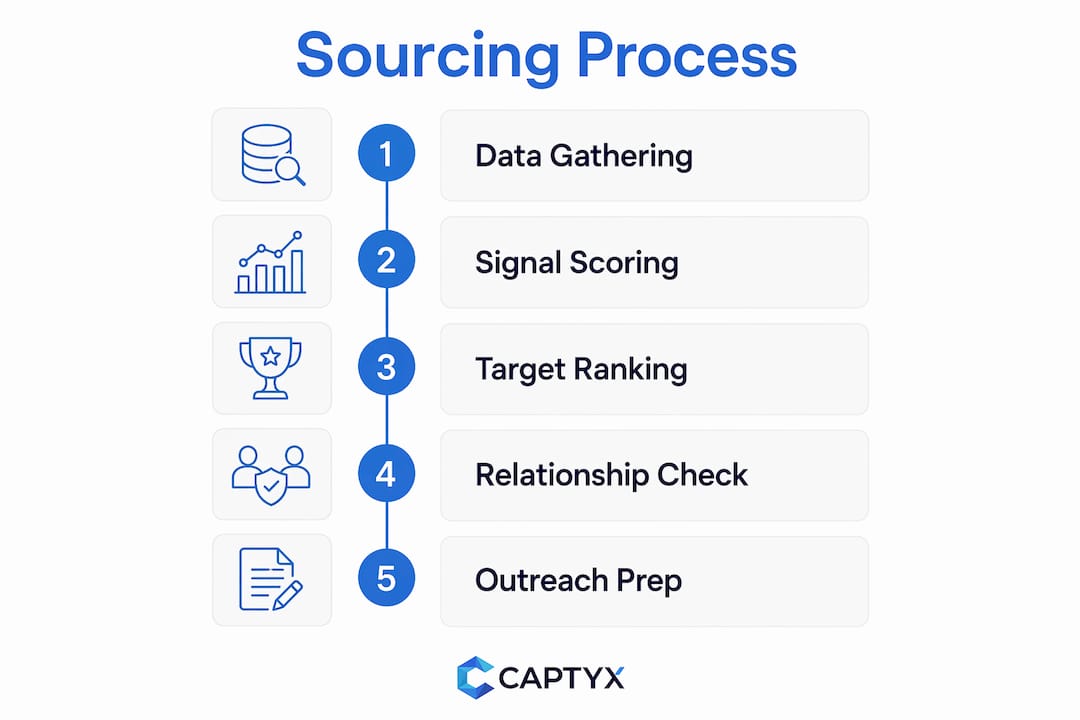
The input layer draws from public filings, job postings, ownership-change records, revenue slowdowns, and advisor-engagement signals. A scoring engine then weights those inputs against buyer-specific criteria: industry, geography, revenue band, and ownership structure. The output is a continuously updated watchlist with alerts when a target’s signal profile changes.
Concrete signals worth monitoring:
- Founder age or announced retirement
- Sudden hiring freeze or key-person departure
- Unusual financing activity or refinancing
- Drop in job postings tied to growth roles
- Advisor or attorney engagement in public records
Firms that combine integrated intelligence platforms with disciplined sourcing report 40–50% faster deal cycles and substantially higher bid success rates. Registry-first approaches are especially useful for owner-operated SMEs that commercial databases frequently miss.
Pro Tip: Validate every scored signal with a relationship check before outreach. A hiring freeze might mean contraction, or it might mean the owner just promoted internally. One phone call separates a false positive from a live deal.
Why your M&A CRM must be document-aware
A document-aware CRM links buyer qualification status to controlled disclosure, so sensitive materials only move when commitment thresholds are met. A standard sales CRM tracks calls and emails. An M&A CRM tracks NDA status, LOI terms, proof-of-funds verification, and VDR access levels, all in the same record.
Required integration points between CRM and VDR:
- NDA status field that triggers VDR role assignment automatically
- Proof-of-funds capture before full financials are released
- LOI date and terms recorded in the deal record
- Stage timestamps for audit and indemnity purposes
- Expiring document links that revoke access after a set period
Experienced advisors use tiered VDR access: a Confidential Information Memorandum for early-stage interest, summarized financials for serious inquiries, and full raw data only after LOI submission. That three-tier structure protects the seller at every step while keeping qualified buyers moving forward.
A CRM that tracks NDA status, LOI terms, and diligence requests materially reduces renegotiation risk because nothing falls through the cracks between stages.
Pro Tip: Automate NDA delivery and countersignature via e-signature integration. Manual NDA handling is the single most common source of disclosure errors in small and lower-middle-market deals.
How databases feed diligence and valuation
Valuation and diligence rely on verified financial feeds, ownership history, customer and contract data, and market benchmarks, all drawn from databases rather than seller-provided spreadsheets alone.

| Data Feed | Typical Use in Diligence or Valuation |
|---|---|
| Secretary of State / registry filings | Owner tenure, cap table, lien checks |
| Payroll and HR signals | Headcount trends, key-person dependency |
| Invoicing and AR aging | Revenue verification, customer concentration |
| Transaction comps databases | EBITDA multiples, deal structure benchmarks |
| Tax records (IRS filings) | Revenue consistency, tax liability exposure |
How to verify data quality before relying on it:
- Cross-match at least two independent sources for every material figure
- Require primary documents (tax returns, bank statements) to back database-derived numbers
- Run sample inquiries with customers or vendors to validate contract data
- Use a Quality of Earnings analysis to reconcile database signals against actual financials
Database and schema assessment before executing an acquisition prevents integration failures that erode deal value post-close.
U.S. data governance: what controls should you require?
Safe M&A data handling requires documented access controls, NDA gating, encryption at rest and in transit, and auditable trails tied to user roles. In a U.S. context, that means aligning with SEC filing requirements for public-company targets and maintaining IRS-consistent records for tax support, without treating either as a substitute for legal counsel.
Controls to demand from any advisor or platform:
- Tiered VDR access matched to deal stage
- Role-based permissions with named user accountability
- Watermarked document copies for all downloads
- Immutable audit logs showing who accessed what and when
- Expiring links that auto-revoke after a defined period
Audit trails are not just a compliance formality. In contested transactions, an immutable log of who accessed which document and when can determine whether a seller has grounds to void a deal or pursue indemnity. Require it before you open the data room, not after.
This section is operational guidance, not legal advice. Consult qualified legal counsel for questions specific to your transaction and jurisdiction.
What are the real risks of relying on databases?
Databases speed discovery but create specific risks: stale data, false positive signals, sample bias, and over-reliance on predictive models that were trained on different market conditions.
- Stale records — Mitigation: cross-source verification and direct contact confirmation before outreach.
- False positive signals — Mitigation: human triage with an intro call before committing advisor time.
- Sample bias — Mitigation: supplement commercial databases with registry-first searches for owner-operated businesses.
- Model overfitting — Mitigation: ask vendors how frequently their scoring model is retrained and on what data.
- Integration cost underestimation — Mitigation: budget for API setup, data cleaning, and staff training before go-live.
Subscription and integration costs for intelligence platforms and VDRs vary widely by deal size and feature set. The relevant question is not whether the cost is high but whether faster cycles and higher win rates justify it for your volume.
Practical checklist for buyers and sellers
- Define your acquisition thesis: industry, revenue band, geography, and ownership type.
- Subscribe to or request a scored target list filtered to your criteria.
- Verify ownership and contact data against Secretary of State records before outreach.
- Automate NDA delivery and countersignature before sharing any materials.
- Tier VDR content: CIM first, summarized financials after NDA, full data after LOI.
- Require primary-document backup (tax returns, bank statements) for every valuation input.
- Capture LOI terms and stage timestamps in the CRM record immediately upon receipt.
- Plan post-close integration dashboards before signing, not after.
Pro Tip: Use the CRM to log data provenance, who added each record and when. That audit trail supports post-close integration and protects both parties if indemnity questions arise.
How Captyx applies these systems in practice
Captyx integrates a deal CRM with tiered VDR workflows to shorten sale cycles and reduce late-stage renegotiation. The process runs in three operational phases:
- Target identification and outreach: Off-market sourcing using firmographic filters and ownership signals to find buyers matched to the seller’s business profile. Captyx’s done-for-you sourcing service handles this end to end.
- Staged disclosure and LOI gating: NDA-triggered VDR access releases the CIM first, then summarized financials, then full diligence materials only after a signed LOI.
- Diligence automation and buyer matching: Document requests tracked in the CRM, primary-doc verification required for all valuation inputs, and buyer qualification confirmed before full data room access opens.
225+ businesses sold. Captyx’s track record reflects a process built on the same database-driven, document-aware workflows that this guide describes, not on guesswork or generic listing sites.
How databases support post-acquisition integration
Post-close, databases shift from sourcing tools to integration monitors. A data-schema inventory completed during diligence, mapping primary keys across the buyer’s and target’s systems, determines whether integration runs as a parallel operation, a phased migration, or a full cutover. The choice of migration strategy should match the acceptable recovery time and data-loss tolerance for the combined business.
Customer databases from the acquired company often hold the most immediate value: contact records, contract terms, and purchase history that the buyer can activate on day one. Evaluating those assets during diligence, rather than after close, compresses the time needed to realize customer synergies.
How databases support U.S. regulatory compliance
In U.S. acquisitions, databases serve a direct compliance function. Secretary of State registries confirm entity status and officer history. IRS records support tax liability verification. For transactions that cross Hart-Scott-Rodino thresholds, deal databases help track filing deadlines and document the competitive analysis the FTC or DOJ may request.
Maintaining a clean, timestamped record of every document exchanged during diligence also protects both parties if a regulatory review opens post-close. That record lives in the VDR audit log, which is why immutable logging is a non-negotiable feature, not an optional add-on.
How databases keep deal teams aligned
A shared CRM and VDR eliminate the version-control problems that slow most deals: multiple spreadsheets, email threads with conflicting document versions, and advisors working from different buyer lists. When every team member, attorney, accountant, and advisor works from the same system of record, status updates happen in real time rather than in weekly calls.
Role-based permissions mean each team member sees only what their stage and function require. Attorneys see executed NDAs and LOI drafts. Accountants access financial data rooms. Buyer-side advisors see the CIM and approved diligence materials. That structure keeps communication tight and reduces the risk of premature disclosure.
How analytics shape negotiation and deal structure
Data analysis in business acquisition gives buyers a defensible anchor for price and structure. Comparable transaction databases provide EBITDA multiples for the target’s industry and size band, so a buyer walking into a negotiation knows whether the seller’s ask is at market, above it, or below it.
Analytics also inform deal structure. Customer concentration data from the target’s AR aging might justify an earnout rather than a full cash close. Headcount trends might support a working-capital adjustment. Revenue verification from cross-matched data feeds reduces the seller’s ability to inflate trailing twelve-month figures. The negotiation shifts from a conversation about opinions to a conversation about evidence.
Key Takeaways
Databases convert dispersed market and firmographic signals into prioritized acquisition targets and deal-ready documentation, and the advisors who build that infrastructure close faster and renegotiate less.
| Point | Details |
|---|---|
| Intelligence-led sourcing wins | Integrated platforms report 40–50% faster deal cycles versus list-only approaches. |
| CRM must be document-aware | Require NDA gating, LOI capture, and VDR role assignment in a single connected system. |
| Tiered VDR access protects sellers | Release CIM first, summarized financials after NDA, full data only after LOI. |
| Verify every database figure | Cross-match two sources and require primary documents for all valuation inputs. |
| Captyx applies this end to end | Captyx’s 225+ closed sales reflect a process built on targeted sourcing and staged disclosure workflows. |
Where M&A data tooling is heading
The next two to three years will push predictive signals deeper into the SME market, where registry-first discovery is already outperforming commercial databases for owner-operated businesses. CRM-to-VDR automation will tighten further, with NDA countersignature, access gating, and audit logging happening in seconds rather than hours. For owners, that shift has a practical implication: the advisor who brings a proprietary, monitored watchlist to the table is structurally advantaged over one who relies on public listings. Negotiation timing will increasingly favor buyers and sellers who know a target’s transaction readiness before a formal process begins. Primary-document verification will become the baseline expectation, not a premium service, as AI-generated financials make unverified data riskier to rely on.
Captyx brings these systems to your sale or acquisition
Captyx applies the full stack described in this guide: off-market buyer sourcing using firmographic and ownership signals, staged VDR disclosure tied to NDA and LOI status, and real-time buyer feedback that sharpens your business’s market position before a deal closes. With 225+ businesses sold, the process is tested, not theoretical.

If you are preparing to sell or actively acquiring, the right next step is a valuation that reflects what buyers will actually pay, grounded in the same data benchmarks this guide describes. Get your free business valuation from Captyx and see where your business stands before you enter the market.
Useful sources and further reading
- How Private Market Intelligence Platforms Are Transforming Deal Sourcing — Evidence on sourcing velocity and bid success rates from intelligence platform adoption.
- Best Tools for Private Equity Deal Sourcing in 2026 | Synergy AI — Covers the shift from database-driven to intelligence-led sourcing and registry-first discovery.
- Broker’s Tech Stack: CRM, VDR, APIs, and Drip Campaigns | BizTrader — Practitioner guidance on integrating CRM, VDR, and automation for confidentiality and speed.
- Key Considerations for Database Management During M&A | AWS Database Blog — Technical framework for schema assessment, data mapping, and migration strategy selection.
- OpenClaw Business Broker Guidance on Tiered Access — Practical breakdown of CIM-only, summarized, and full-data VDR tiers.
- Captyx Buy-a-Business and Proof Pages — Captyx’s sourcing methodology and track record for buyers entering the market.
- Captyx Done-For-You Off-Market Deal Sourcing — Service detail on how Captyx runs targeted, database-driven buyer outreach for sellers.


