


TL;DR:
- Running a structured sell-side auction maximizes business sale price and certainty of close through a five-phase process. Proper preparation, stakeholder management, and maintaining competitive tension significantly improve valuation outcomes, often exceeding 15–30 percent compared to informal sales.
Running a competitive M&A sale process, formally called a structured sell-side auction, is the single most reliable way to maximize both price and certainty of close when selling a business. The playbook has five phases: (1) prepare (financial cleanup, CIM, data room), (2) market and outreach (long list, teasers, NDAs), (3) IOIs and rounds (indicative bids, shortlisting), (4) diligence and negotiation (LOI to SPA), and (5) sign and close (regulatory filings, working capital true-up, transition). Structured processes achieve 15–30 % higher valuations than informal or negotiated sales, and a well-prepared management presentation alone can add 10–20 % to the final price. The typical mid-market timeline runs several months from advisor engagement to closing. Before anything else, run a sell-readiness checklist and select an advisor who will design the auction format around your specific buyer universe.
-
Phase 1 — Prepare: 4–12 weeks; financial statements, CIM, data room, valuation work
-
Phase 2 — Market and outreach: 4–8 weeks; teaser distribution, NDA execution, CIM delivery
-
Phase 3 — IOIs and rounds: 2–4 weeks per round; indicative bids, shortlist to management presentations
-
Phase 4 — Diligence and negotiation: 4–8 weeks; LOI, confirmatory diligence, SPA negotiation
-
Phase 5 — Sign and close: 3–8 weeks; regulatory filings, consents, closing mechanics
Table of Contents
- How does a competitive sell-side auction process work, phase by phase?
- What should you prepare before going to market?
- How do you source buyers and design the bidder funnel?
- How do you run bid rounds and collect IOIs effectively?
- How do you manage diligence, negotiate the SPA, and close?
- How do you compare offers beyond headline price?
- Who should be on your deal team, and what do advisors cost?
- How does Captyx’s buyer-feedback method improve sale outcomes?
- Key Takeaways
- Why disciplined auctions outperform negotiated sales in practice
- Captyx runs the competitive sale process for you
- Useful sources and further reading
How does a competitive sell-side auction process work, phase by phase?
A sell-side auction follows a deliberate sequence designed to keep multiple buyers competing simultaneously, which is what drives price. The moment you allow the process to become bilateral, you lose the leverage that competition creates.
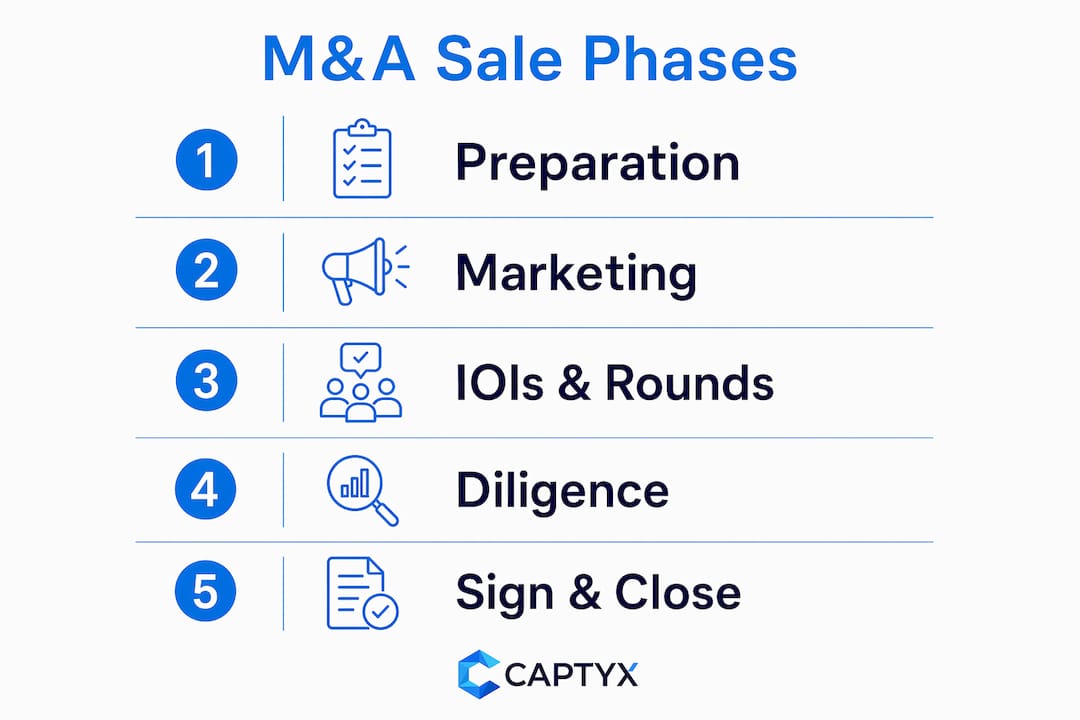
Phase 1: Preparation (weeks 1–12)
This is where most of the value is built or destroyed. You are producing the Confidential Information Memorandum (CIM), organizing the virtual data room (VDR), completing financial reconciliations, and running a preliminary valuation to calibrate your reserve expectations. Weak preparation is the most common reason deals reprice during diligence.
Phase 2: Marketing and outreach (weeks 8–16)
Your advisor distributes a blind teaser to a long list of potential buyers. Interested parties sign an NDA and receive the CIM. The funnel narrows: a mid-market process might send many teasers, execute dozens of NDAs, and deliver multiple CIMs before collecting indicative offers.

Phase 3: IOIs and rounds (weeks 14–22)
Buyers submit Indications of Interest (IOIs) with a price range, proposed structure, and financing plan. Your advisor shortlists several strong bidders for management presentations, then requests final bids (Letters of Intent, or LOIs) from the top few. Keeping at least three competitive bidders through management presentations is the practical floor for maintaining price tension.

Phase 4: Diligence and negotiation (weeks 20–32)
The selected bidder enters confirmatory due diligence under an LOI. This is where the SPA is negotiated in parallel. Exclusivity is granted only after you have secured strong pre-exclusivity protections in the LOI.
Phase 5: Sign and close (weeks 28–40)
Regulatory filings, third-party consents, working capital true-up mechanics, and transition planning all run concurrently. The deal signs when all conditions are satisfied.
Auction type comparison
| Auction Type | Buyer Universe | Best For | Tradeoff |
|---|---|---|---|
| Broad auction | many buyers | Maximum price discovery | High confidentiality risk, management burden |
| Targeted auction | several to a few dozen buyers | Mid-market balance of price and confidentiality | Moderate management distraction |
| Limited / negotiated | very few buyers | Speed, confidentiality, relationship-driven | Lower price tension, weaker leverage |
For most mid-market sellers, a targeted auction hitting 10–25 pre-screened buyers is the right default. It preserves competitive tension while keeping management distraction manageable and confidentiality risk low.
Pro Tip: Send teasers to all buyers in the same distribution window, on the same day, with the same response deadline. Simultaneous distribution prevents any single buyer from learning they are the only one being approached, which is what sustains bidding tension through the process.
What should you prepare before going to market?
Preparation is the highest-return phase of the entire process. Starting 12–24 months before your target go-to-market date gives you time to fix the issues that buyers will use to reprice your deal during diligence. Well-prepared businesses sell faster, at higher multiples, and with fewer price reductions than those that enter the market unpolished.
Pre-sale document checklist
- Three years of audited or reviewed financial statements, plus year-to-date management accounts
- EBITDA reconciliation with add-back schedule and supporting documentation
- Cap table, ownership structure, and any outstanding options or warrants
- Customer contracts, concentration analysis, and renewal schedules
- Intellectual property registrations, licenses, and any pending disputes
- Organizational chart with key employee retention agreements
- Historical KPIs, pipeline data, and forward-looking financial model
- Material vendor contracts, real estate leases, and regulatory permits
Addressing ways to increase business valuation before you go to market is not cosmetic. Buyers pay multiples of EBITDA, so every dollar of defensible earnings improvement compounds directly into enterprise value.
Sample CIM outline
| Section | What to Cover |
|---|---|
| Executive summary | Business overview, investment highlights, ask |
| Market and growth thesis | TAM, competitive position, growth vectors |
| Financial performance | Revenue, EBITDA, margins, working capital trends |
| Customer analysis | Concentration, retention, contract terms |
| Operations | Processes, technology, scalability, key dependencies |
| Management team | Bios, tenure, post-close availability |
| Value drivers and risks | Upside cases, identified risks, and mitigants |
Data room structure
A clean VDR signals to buyers that management is organized and diligence will be efficient. Use a consistent folder hierarchy: Financials, Legal, Customers, Operations, HR, IP, and Real Estate. Set tiered permissions so sensitive employee data or key customer names are released only after deeper engagement. Maintain a Q&A log so all buyer questions and answers are visible to every participant simultaneously. That prevents information asymmetry and reduces the risk of a buyer claiming they were misled.
Pro Tip: Run a mock diligence session before go-to-market. Have your advisor or counsel ask the 20 hardest questions a buyer will ask. Every answer you cannot give cleanly is a future price chip.
How do you source buyers and design the bidder funnel?
The quality of your buyer list determines the ceiling on your price. A long list built from only the obvious names leaves money on the table. Your advisor should mine four buyer categories: strategic acquirers (competitors, adjacent-market players, customers, suppliers), financial sponsors (private equity firms, family offices, search funds), special-situations buyers (carve-out specialists, turnaround funds), and international strategics where relevant.
Buyer prioritization criteria
Screen the long list against five dimensions before any outreach:
- Strategic fit: Does this buyer have a clear rationale for the acquisition?
- Financing readiness: Does the buyer have committed capital or a credible financing plan?
- Closing certainty: What is their track record of completing deals at this size?
- Regulatory risk: Does the combination create antitrust exposure or require foreign investment review?
- Cultural fit: Will management and employees transition effectively?
Targeted auctions typically shortlist several to a few dozen buyers from a long list that can range widely depending on sector and deal size. The shortlisting decision is not just about who will pay the most. A buyer who bids 10% higher but has a 40% chance of retrading or failing to close is worth less than a slightly lower bid from a credible, well-capitalized acquirer.
Teaser and NDA workflow
The teaser is a one-to-two-page anonymous summary that describes the business without identifying it. It should cover the industry, revenue and EBITDA range, growth profile, and the reason for sale. The goal is to generate enough interest to get an NDA signed, nothing more.
| Step | Action | Timing |
|---|---|---|
| Long list finalized | Advisor and seller approve buyer universe | Week 1–2 |
| Teaser distributed | Simultaneous distribution to all targets | Week 3–4 |
| NDA execution | Interested parties sign and receive CIM | Weeks 4–6 |
| CIM delivered | Full book sent to NDA signatories | — |
| IOI deadline | Standardized indicative bids due | Week 8–10 |
Buyer scorecard concept
Rank each buyer on a simple scorecard before management presentations: strategic fit (1–5), financing certainty (1–5), regulatory risk (1–5, inverted), cultural fit (1–5), and track record (1–5). This gives you a structured basis for deciding which bidders to advance even when their IOI prices are close. Centralizing all communications through your advisor prevents buyers from working around the process, which is where leakage and collusion risk concentrates.
How do you run bid rounds and collect IOIs effectively?
The mechanics of bid collection are where process discipline pays off most directly. Sloppy bid management lets buyers anchor low, compare notes, or slow-walk the timeline until competition fades. Process control is the seller’s primary leverage: by managing information flow, timelines, and standardizing bid formats, you shape buyer behavior toward higher prices and cleaner terms.
IOI vs. LOI: what each should contain
An IOI (Indication of Interest) is non-binding and submitted early in the process. A well-structured IOI request should ask for:
- Indicative enterprise value range and implied multiple
- Proposed deal structure (asset vs. stock, merger)
- Financing plan (equity, debt, seller note if any)
- Key diligence areas and preliminary assumptions
- Proposed timeline to LOI and close
- Brief buyer background and deal team
An LOI (Letter of Intent) is submitted after management presentations and is substantially more specific. It should include a definitive price, proposed SPA structure, exclusivity request, and a detailed diligence plan. The LOI is the document you negotiate before granting exclusivity.
Round structure options
- Single-round: Buyers submit final bids directly. Faster, but you sacrifice the price-improvement dynamic of a second round. Best for highly competitive processes where you have strong conviction on the buyer universe.
- Two-round (indicative then final): The standard for mid-market. Round one collects IOIs and narrows to 3–6 finalists. Round two collects LOIs after management presentations. This is where the 10–20% management presentation premium gets captured.
- Staged narrowing: Three or more rounds, typically used for large or complex transactions. Adds time but maximizes price discovery when the buyer universe is large and heterogeneous.
Bid evaluation checklist
- Price and implied multiple relative to your valuation range
- Cash at close vs. deferred consideration (earn-outs, seller notes)
- Conditionality: financing contingencies, regulatory approvals, MAC clauses
- Certainty of funding: committed equity, signed debt commitment letters
- Timeline to close
- Seller representations and warranties scope
- Reference checks on buyer’s prior acquisitions
For extension requests, set a firm policy upfront: one extension of no more than five business days, granted only when the requesting buyer provides a substantive reason. Unlimited extensions signal weakness and invite buyers to wait each other out.
How do you manage diligence, negotiate the SPA, and close?
Confirmatory due diligence begins the moment the LOI is signed and exclusivity is granted. The exclusivity period typically runs 45–90 days, and once you grant it, your leverage drops sharply. That is why the LOI negotiation matters as much as the price negotiation.
Diligence workflow
- Grant VDR access in tranches: start with financials and legal, hold back sensitive HR and customer data until the buyer demonstrates serious intent
- Route all buyer questions through a centralized Q&A log visible to your counsel
- Assign a single point of contact on the seller side to prevent management distraction
- Flag deal-killer issues proactively rather than waiting for buyers to find them; surprises discovered late reprice deals more severely than issues disclosed early
- Track open items against a diligence checklist and set weekly deadlines for buyer responses
SPA negotiation priorities for sellers
The goal is to maximize cash at close and minimize post-closing exposure. A seller-friendly SPA checklist focuses on:
- Maximize upfront cash: push back on earn-outs and seller notes; every dollar deferred is a dollar at risk
- Cap indemnity: target 10–20% of enterprise value as the indemnity cap where possible
- Shorten survival periods: aim for 12–18 months on general reps; fraud and fundamental reps survive longer by convention
- Prefer locked-box pricing: locked-box is seller-friendly because it fixes the price at a historical balance sheet date, eliminating post-close adjustments; completion accounts are buyer-friendly because the price adjusts to the actual closing balance sheet
- Limit reps and warranties scope: negotiate carve-outs for known issues disclosed in the data room
- Warranty and indemnity (W&I) insurance: increasingly common in mid-market deals; it shifts indemnity risk to an insurer, which can unlock a cleaner exit for the seller
Pro Tip: Negotiate the LOI as carefully as the SPA. The exclusivity period, the scope of permitted diligence, and the MAC clause definition are all set at the LOI stage. Giving ground there is much harder to recover in the SPA.
Closing checklist
- Regulatory filings (HSR Act if applicable, state-level approvals)
- Third-party consents (key customer contracts, landlord consents, change-of-control provisions)
- Working capital peg and true-up mechanics agreed and documented
- Escrow and holdback amounts funded
- Transition services agreement (TSA) executed if needed
- Management retention agreements in place
- Closing statement prepared and reviewed by both sides
How do you compare offers beyond headline price?
Price is the number everyone looks at first, but it is rarely the number that matters most. A higher headline price with a financing contingency, a broad MAC clause, and a 20% earn-out is often worth less in practice than a slightly lower all-cash offer with clean terms.
Offer scorecard template
| Criterion | Weight | What to Assess |
|---|---|---|
| Headline price / implied multiple | — | Enterprise value vs. your valuation range |
| Cash at close | 25% | Upfront cash as a percentage of total consideration |
| Conditionality | 20% | Financing contingencies, regulatory approvals, MAC scope |
| Financing certainty | 10% | Committed equity, signed debt letters |
| Timeline to close | 10% | Weeks to close from LOI |
| Seller protections | 5% | Indemnity cap, survival periods, W&I coverage |
Adjust the weights based on your priorities. If speed matters more than price, increase the weight on timeline and financing certainty and reduce the headline price weight. If you are concerned about post-close liability, shift weight toward seller protections.
Non-price items affect total deal value more than most sellers expect. A 10% earn-out tied to revenue targets that require the buyer’s cooperation to hit is not the same as 10% cash. A seller note at below-market interest rates has a present value below its face value. Tax treatment of the consideration structure (asset vs. stock sale) can shift net proceeds by several percentage points.
Pro Tip: When one bid is higher on price but weaker on certainty, ask the lower bidder to improve their price before you make a final decision. The existence of a competing offer is your best negotiating tool, and you do not need to disclose the competing price to use it effectively.
Who should be on your deal team, and what do advisors cost?
The deal team is not a cost center. It is the mechanism through which you capture the value the process creates. Understaffing the team or hiring the wrong advisor is one of the most common mistakes when selling a business.
Roles to hire
- Lead advisor (investment banker or business broker): Runs the process, builds the buyer list, manages communications, and negotiates on your behalf. The role of investment banks in mid-market exits includes buyer sourcing, CIM preparation, and bid management. For lower mid-market deals, an experienced business broker with a strong buyer network serves the same function.
- Corporate counsel (M&A attorney): Negotiates the LOI and SPA, manages reps and warranties, and handles closing mechanics. Do not use a generalist; hire a transactional attorney with M&A experience at your deal size.
- Tax and accounting advisor: Structures the transaction for tax efficiency, prepares the quality of earnings (QoE) report if required, and advises on consideration structure.
- Financing advisor (if needed): Relevant if you are selling to a PE-backed buyer or if the deal involves a rollover equity component.
Typical fee structures
- Success fee: The standard for advisors and brokers. Mid-market success fees typically range from 2–5% of transaction value, with the percentage declining as deal size increases. Some structures use a Lehman or double-Lehman formula.
- Retainer: A monthly fee paid during the engagement, often credited against the success fee at close. Retainers range widely and are not publicly listed for most advisory firms.
- Legal and accounting: Billed hourly or on a fixed-fee basis for defined work products (QoE, SPA review). Budget separately from advisory fees.
Advisor vetting checklist
Run a “beauty parade” with several advisors before selecting one. Request written proposals that include an indicative valuation range, a proposed buyer universe, team composition, and a process timeline. Focus on three questions:
- Track record: How many comparable transactions have they closed in the last three years, and can they provide references?
- Team seniority: Who specifically will run your deal day-to-day, and what is their experience level?
- Buyer network: Can they demonstrate relationships with the buyers most likely to pay a premium for your business?
Red flags to watch for: opaque or vague buyer lists, a senior pitch team that hands the deal to junior staff after signing, unrealistic valuation estimates designed to win the mandate, and the absence of a written process plan with defined milestones.
How does Captyx’s buyer-feedback method improve sale outcomes?
Most sellers prepare their CIM and marketing materials in isolation, then discover during buyer conversations that their positioning missed the mark. Captyx’s approach runs that process in reverse: prototype the materials, take them to a selected group of buyers or advisors before the formal launch, collect structured feedback, fix the gaps, and then run the auction.
The feedback loop works in four steps:
- Prototype: Draft the teaser and CIM with your advisor, including the growth thesis and key value drivers
- Pre-market outreach: Share materials with 5–10 trusted buyers or sector advisors under NDA before the formal process launches
- Structured feedback collection: Ask specific questions about what is unclear, what concerns them, and what would increase their conviction
- Remediation: Fix the top three “sellability” weaknesses identified, tighten the CIM narrative, and anticipate the diligence questions that came up
This approach directly addresses the most common source of price erosion: surprises discovered during diligence that the seller could have disclosed and explained upfront. When buyers find issues themselves, they reprice aggressively. When sellers disclose and contextualize the same issues, the impact on price is far smaller.
Captyx has applied this method across numerous completed transactions, including businesses the firm’s own principals have sold. The feedback loop also helps sellers understand what makes a business sellable from the buyer’s perspective rather than the seller’s, which is a fundamentally different and more useful frame.
Pro Tip: Use buyer feedback to build a “pre-diligence” document that addresses the top five concerns before buyers even ask. Distributing it with the CIM signals confidence and reduces the number of diligence questions, which shortens the timeline and reduces the risk of deal fatigue.
Key Takeaways
A structured, advisor-led competitive auction consistently produces higher prices and cleaner terms than any informal or bilateral sale process, provided the seller enters the market well-prepared and maintains competitive tension through management presentations.
| Point | Details |
|---|---|
| Structured processes outperform | Advisor-led auctions achieve 15–30 % higher valuations than informal or negotiated sales. |
| Preparation is the highest-return phase | Starting 12–24 months early and fixing sellability gaps before go-to-market reduces diligence repricing. |
| Maintain three competitive bidders | Keep at least three qualified buyers competing through management presentations to preserve price tension. |
| Evaluate offers on more than price | Score each bid on cash at close, conditionality, financing certainty, timeline, and seller protections. |
| Captyx’s feedback loop | Captyx’s pre-market buyer-feedback method, refined across 225+ transactions, tightens positioning before the auction launches. |
Why disciplined auctions outperform negotiated sales in practice
The conventional wisdom in M&A circles is that a “relationship-driven” sale to a known buyer is cleaner and faster than a full auction. Sometimes that is true. More often, it is a rationalization for avoiding the hard work of running a real process.
What I have seen consistently is that sellers who skip the auction format because they have a preferred buyer in mind end up negotiating against themselves. The preferred buyer knows they are the only one in the room. They slow-walk diligence, find issues to reprice, and push for seller-friendly terms to erode. The seller, having already mentally committed to the deal, accepts concessions they would never have accepted if three other buyers were still at the table.
The discipline of a structured auction is not just about generating competing bids. It is about changing the psychology of every buyer in the process. When a buyer knows others are competing, they move faster, they ask fewer low-value diligence questions, and they are less likely to retrade on price. That behavioral shift is worth more than the incremental bid from the second-best buyer.
Confidentiality management matters here too. Leakage, whether to employees, customers, or competitors, is one of the fastest ways to destroy value mid-process. Centralizing all communications through the advisor, using tiered data-room access, and enforcing NDA terms consistently are not bureaucratic formalities. They are the practices that keep the process from collapsing before you get to LOI.
Captyx runs the competitive sale process for you
Selling a business at full value requires more than a good pitch deck. It requires a process that creates genuine competition, surfaces the right buyers, and protects your position from the first teaser to the final wire transfer.

Captyx brings the full advisory stack to mid-market sellers: business valuation, CIM preparation, off-market buyer sourcing, confidential listings, and deal execution through close. The buyer-feedback preparation system, built from more than 225 completed transactions, means your business enters the market positioned to win, not positioned to be repriced. Whether you are 12 months from a planned exit or ready to move now, the right starting point is a clear-eyed valuation. Request your free business valuation from Captyx and get a realistic picture of what your business is worth and what it would take to run a process that captures that value. If you want to understand whether a broker or advisor is the right fit for your situation, this guide on using a broker to sell lays out the honest tradeoffs.
Useful sources and further reading
The following resources expand on the core topics covered in this guide:
- The Complete Sell-Side M&A Process: A Step-by-Step Guide for Business Owners — Detailed walkthrough of the sell-side funnel, timeline benchmarks, and valuation impact of structured processes. Used throughout this article for timeline and valuation data.
- How M&A Teams Run a Competitive Sale Process — Practical breakdown of process control mechanics, buyer funnel metrics, and IOI standardization. Used for buyer outreach and bid management sections.
- Thomson Reuters: M&A Due Diligence Guide — Authoritative overview of due diligence scope, documentation standards, and legal risk management in M&A transactions.
- FINRA — Regulatory background on broker-dealer registration requirements relevant to M&A advisors and intermediaries operating in the United States.
- How to Sell Your Business: A Comprehensive Guide — Captyx’s full seller walkthrough, covering preparation through closing for business owners at every stage of readiness.
- What Makes a Business Sellable: Owner’s Guide — Captyx’s sellability framework, useful for the pre-market readiness assessment described in the preparation phase.
- 9 Ways to Increase Business Valuation Before You Sell — Specific, owner-focused tactics for improving EBITDA and multiple before going to market.


