Televangelist social media influencers are polluting the market with mis-information about buying legitimate businesses. It’s more important than ever to have qualified representation when selling your business.
Tucker Pool, CEO
Let me tell you about a business that didn’t sell.
Great business. Seven figures in revenue, solid margins, happy customers. The owner had been building it for twelve years and was ready for his exit.
Listed it on a Tuesday. By Friday, it had thirty-seven inquiries.
Sounds like a success story, right? Here’s the problem: thirty-five of those “buyers” had no money, no plan, and no clue what they were doing. They’d watched some YouTube guru explain how to “buy businesses with no money down” and figured they’d give it a shot.
The seller spent three months getting yanked around by wannabes who couldn’t qualify for a car loan, let alone buy his life’s work. By the time we found the two legitimate buyers buried in that pile, he was exhausted, frustrated, and ready to take the first lowball offer that came along.
This is the new reality of business sales, and it’s getting worse every day.
The Tire-Kicker Invasion
Social media has convinced every wannabe entrepreneur that buying an existing business is their shortcut to riches. They’ve memorized the buzzwords. They know how to sound serious on a phone call. Some even have slick presentations about their “acquisition strategy.”
What they don’t have is money. Or experience. Or any real intention of actually closing a deal.
These people will burn weeks of your time, request your most sensitive information, and then disappear when you ask for proof of funds. They’re playing fantasy football with your business, and you’re the one paying the price.
The solution isn’t to hide from the market—it’s to make your business so obviously legitimate that only serious buyers can keep up.
What Separates the Players from the Pretenders
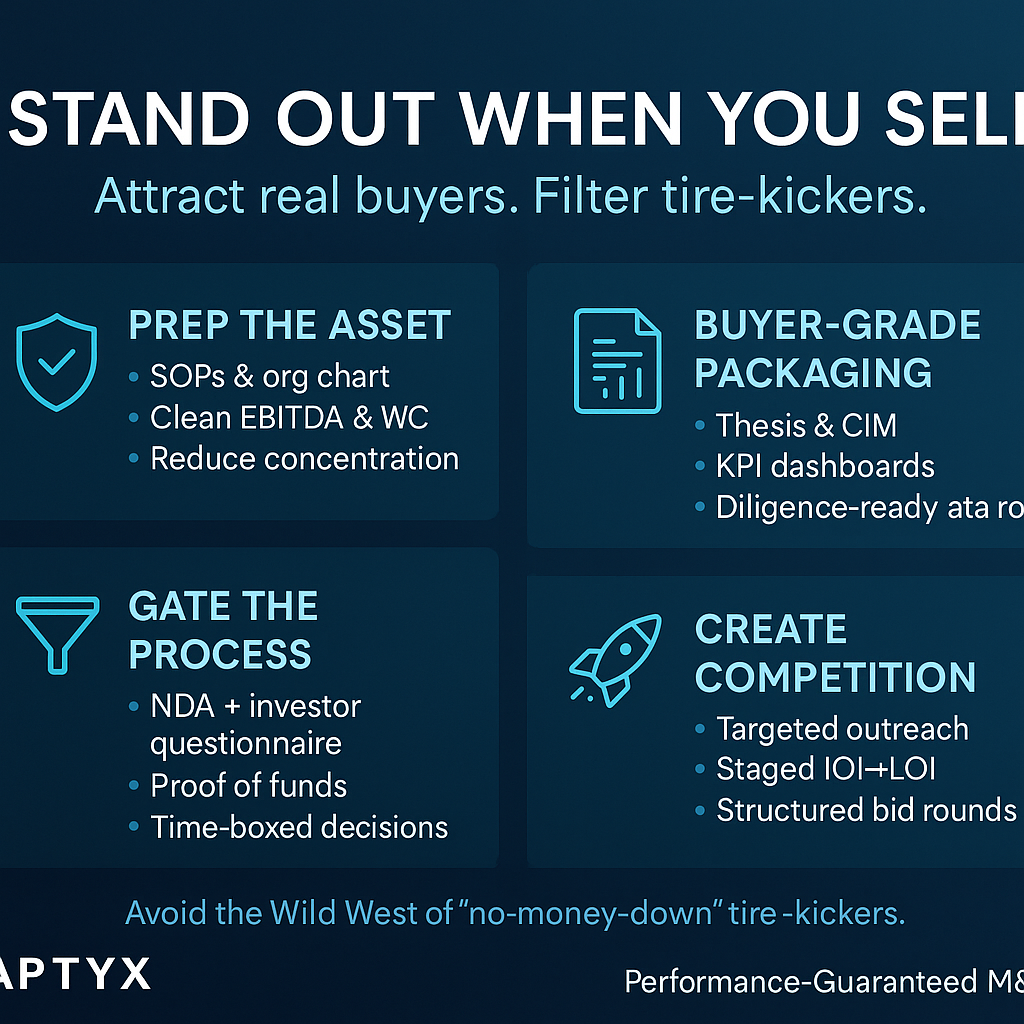
I’ve noticed something interesting over the years. The businesses that sell quickly and for top dollar all share the same four characteristics. More importantly, these are exactly the things that make tire-kickers lose interest and move on to easier targets.
First, the business runs without the owner. I mean really runs, not just survives. The owner can take a two-week vacation without checking in every day. Key employees know their jobs and do them well. Processes are documented, not just stuck in someone’s head.
Serious buyers love this because it means they’re buying a machine, not a hobby. Tire-kickers hate it because they can’t negotiate themselves into the “stay for two years and teach me everything” deal they were hoping for.
Second, the financials tell a clean story. No creative add-backs that require a degree in forensic accounting to understand. No customer concentration that would make your banker nervous. No working capital disasters hiding in the background.
Real buyers can underwrite clean numbers quickly. Pretend buyers get overwhelmed when they realize they actually have to understand the business they claim they want to own.
Third, everything is packaged professionally. The investment thesis makes sense. The data room doesn’t look like it was organized by a hurricane. The KPIs are current and actually mean something.
Professional buyers appreciate professionalism because it speeds up their process. Amateur buyers get intimidated because they realize they’re not equipped for the real thing.
Fourth, there’s a proven growth plan. Not dreams and wishes, but actual data showing what works and what doesn’t. Marketing channels that deliver predictable results. Sales processes that convert. Expansion ideas with real budgets and timelines attached.
Legitimate acquirers pay premiums for predictability. Hopeful optimists wanted to figure it out as they went along.
How to Build a Moat Around Your Deal
The trick isn’t just having these four elements—it’s using them as a filter system that weeds out the time-wasters before they waste your time.
Start by requiring proof of funds before anyone sees detailed information. Not eventually, not “we’re working on financing,” but actual bank statements or committed capital letters upfront. You’d be amazed how quickly this eliminates the YouTube crowd.
Create a structured process with clear timelines. Tell buyers they have two weeks to submit an initial offer, period. No extensions, no “we just need a few more days.” Serious buyers work within professional timelines. Dabblers always need more time.
Ask specific questions early. What’s their integration plan? How are they going to fund growth? What’s their experience with businesses like yours? Listen for actual answers, not regurgitated blog post content.
Most importantly, run a competitive process. Nothing scares away pretenders like knowing they’re up against real competition. When multiple qualified buyers are bidding, the fantasists usually excuse themselves from the process.
The Three-Month Reality Check
Here’s what preparing properly actually looks like, because most sellers think they can wing this part.
Month one: Get your house in order. Document your key processes. Clean up your financials. Figure out what your business is actually worth and why someone should care.
Month two: Build your materials like a professional. Investment thesis that makes sense. Data room that doesn’t embarrass you. KPIs that tell your story clearly.
Month three: Launch with discipline. Target the right buyers, not just anyone with a pulse. Require proof of funds. Run a structured process with real deadlines.
This isn’t glamorous work, but it’s what separates successful exits from never-ending time sucks.
Beyond Just Price
Here’s something most sellers get wrong: they think it’s all about who offers the highest number.
The best buyers compete on more than just price. They offer certainty—larger deposits, shorter due diligence periods, fewer contingencies. They minimize your risk with rep and warranty insurance and reasonable working capital adjustments. They have plans for your team and your growth.
When you’ve positioned yourself properly, you get to choose between multiple strong offers instead of hoping someone, anyone, will make you a decent proposal.
The Hard Truth
Most business sales fail not because the business isn’t valuable, but because the seller didn’t do the work to prove that value to people who matter.
You can list your business on ten different platforms and get a hundred inquiries, but if ninety of them are from people who couldn’t buy a used car, you’re actually worse off than if you’d gotten five calls from qualified buyers.
The market is crowded, but it’s crowded with noise. Cut through the noise by being undeniably professional, and the right buyers will find you.
Better yet, they’ll pay you what you’re worth.
Start Where You Are
If you’re thinking about selling in the next year or two, start this preparation now. Not when you’re ready to go to market—now.
Document one critical process this week. Clean up one financial mess this month. Build one piece of your investment thesis this quarter.
The businesses that sell well don’t get lucky. They get prepared.
And in a market full of pretenders, preparation is your competitive advantage.
When you’re ready to get serious about your exit, we specialize in building the four pillars that attract real buyers while filtering out the time-wasters. Because your business deserves better than becoming someone’s side project.