


TL;DR:
- A buy-sell agreement valuation sets the price for transferring ownership interests during trigger events like death or disability. Using a clear, current, and defensible valuation method, such as independent appraisal, prevents costly disputes and tax issues. Owners should regularly update the valuation and involve qualified professionals to ensure effective business succession planning.
A buy-sell agreement valuation is the contract clause that sets the price and method for transferring a business ownership interest when a triggering event occurs. Those events include death, disability, retirement, or a partner deadlock. Without a clear valuation clause, ownership transitions become expensive legal battles. The IRS, courts, and state regulators all expect a defined, defensible process. This guide explains what is a buy-sell agreement valuation, which methods work best for small businesses, and how to keep your agreement current so it protects everyone at the table.
What is a buy-sell agreement valuation?
A buy-sell agreement valuation is the formal process of determining what a departing owner’s business interest is worth at the moment a triggering event fires. The industry term for this document is a “buyout agreement” or “business succession agreement,” and the valuation clause is its financial core. Get it wrong, and you hand the surviving partners and the departing owner’s estate a conflict with no clean resolution.

The valuation clause does three things. It names the method used to calculate value. It sets the standard of value, most commonly Fair Market Value as defined by the IRS. It also specifies who performs the calculation and when. Defining the valuation process before any trigger event fires is the single most effective way to prevent litigation.
The importance of buy-sell agreements becomes obvious the moment you consider what happens without one. A surviving partner and a deceased owner’s spouse will almost always disagree on price. One wants to pay as little as possible; the other wants as much as possible. A predefined valuation clause removes that conflict before it starts.
What are the common valuation methods used in buy-sell agreements?
Three primary valuation methods appear in buy-sell agreements: fixed price, formula-based, and independent professional appraisal. Each carries distinct trade-offs that depend on your business size, complexity, and how often partners are willing to revisit the agreement.
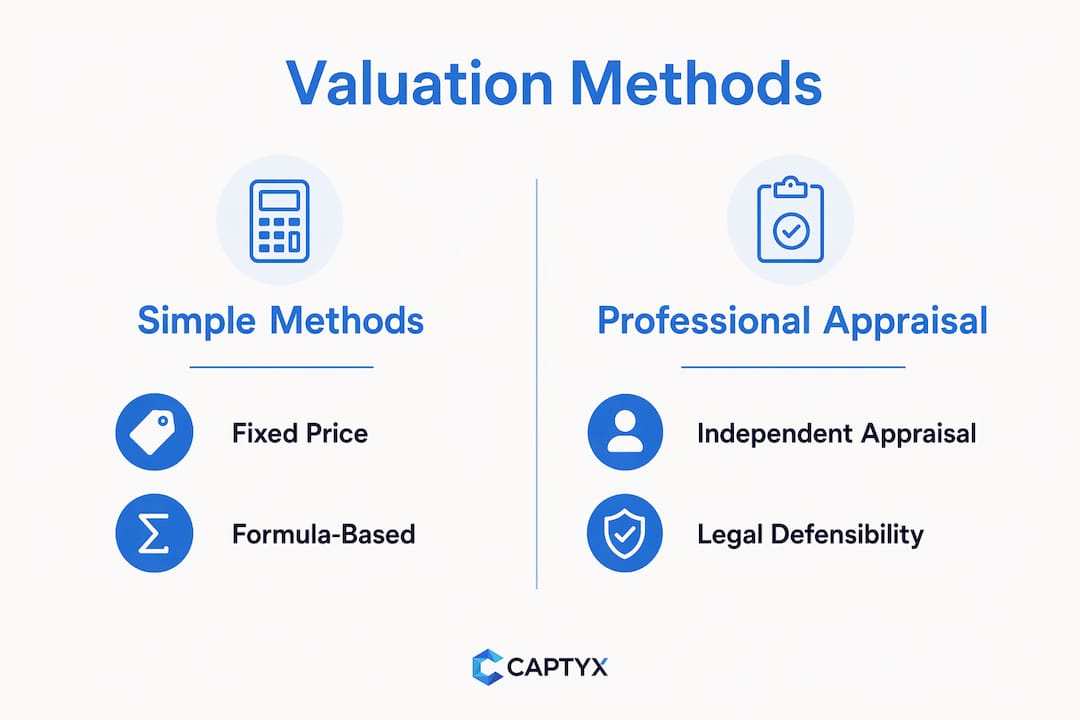
Fixed price method
The fixed price method sets a specific dollar amount in the agreement itself. Partners agree on a number, write it in, and move on. The appeal is simplicity. The risk is that the number goes stale the moment business conditions change. A company worth $2 million today may be worth $4 million in three years, and a fixed price written today will shortchange the departing owner’s estate.
Formula-based valuation
The formula method calculates value using a predetermined equation, often a multiple of EBITDA (earnings before interest, taxes, depreciation, and amortization) or a multiple of annual revenue. For example, a service business might use 4x EBITDA as its formula. This approach provides predictability and updates automatically as earnings change. The limitation is rigidity: the formula may not capture intangible value like customer relationships or brand reputation.
Independent professional appraisal
A professional appraisal is the most defensible method. Qualified appraisers use income, market, and asset-based approaches depending on the business type and available data. The income approach applies EBITDA multiples to projected cash flows. The market approach compares recent sales of similar businesses. The asset-based approach calculates net asset value. Courts and the IRS favor this method because it reflects current conditions and follows accepted methodology.
| Method | Simplicity | Stays current | Legal defensibility |
|---|---|---|---|
| Fixed price | High | No | Low |
| Formula-based | Medium | Partially | Medium |
| Independent appraisal | Low | Yes | High |
Pro Tip: If your business earns more than $1 million annually or has multiple owners, use independent appraisal. The cost of a qualified valuation is far less than the cost of a dispute.
What key components should a buy-sell agreement valuation clause include?
A valuation clause that lacks specificity creates the exact problem it was designed to prevent. Lack of clarity in valuation clauses frequently leads to litigation during ownership transfers triggered by death, disability, or deadlock. Every clause needs six defined elements to hold up under pressure.
Standard of value. Fair Market Value (FMV) is the IRS standard and the most common choice. It assumes a hypothetical willing buyer and seller, neither under pressure to transact. Fair Value, used in some state statutes, may reflect a pro rata share of total business value without applying discounts. The choice between FMV and Fair Value directly affects whether discounts for lack of marketability or minority interest apply. That difference can shift the final number by 20% or more.
Valuation date. The clause must specify exactly when value is measured. Common options include the date of the triggering event, the date notice is given, or the last fiscal year end. Each choice produces a different number in a volatile market.
Level of value. A controlling interest commands a premium over a minority interest. The clause must state which level applies to avoid arguments about whether a 30% stake is valued as a controlling block or a minority position.
Appraiser qualifications and selection. Name the credentials required: Certified Valuation Analyst (CVA), Accredited Senior Appraiser (ASA), or Certified Business Appraiser (CBA). Specify how the appraiser is selected, whether by mutual agreement, by a professional organization, or by a named arbitrator.
Adjustment mechanics. The clause should address how debt, working capital, and capital expenditures adjust the final number. Without this, two appraisers using the same method can produce wildly different results.
Dispute resolution. Define what happens when parties disagree on the appraised value. A common approach uses a third appraiser whose value falls between the two competing opinions.
Essential elements to include in every valuation clause:
- Standard of value (Fair Market Value or Fair Value)
- Valuation date and triggering event definitions
- Level of value (controlling vs. minority interest)
- Required appraiser credentials and selection process
- Adjustment mechanics for debt and working capital
- Discounts and premiums that apply or are excluded
- Dispute resolution process and timeline
Reviewing common mistakes in ownership transitions shows that vague valuation clauses rank among the most costly errors small business owners make.
How often should buy-sell agreement valuations be updated and why?
Industry best practices recommend updating valuations at least annually, or immediately following any major business change. That recommendation exists because a stale valuation creates three distinct risks: tax exposure, funding shortfalls, and unfair buyout terms.
The tax risk is concrete. IRS Section 2703 allows the IRS to disregard a buy-sell agreement’s price if it does not reflect fair market value at the time of a taxable event. An outdated fixed price can trigger estate tax on a value far higher than the buyout price, leaving the estate with a tax bill it cannot pay.
The funding risk is equally serious. Most buyouts are funded by life insurance or disability insurance policies. If the business has grown significantly since the policy was written, the insurance payout will not cover the buyout obligation. The surviving partners then face a cash shortfall at the worst possible moment.
| Triggering event | Recommended update timing |
|---|---|
| Annual review cycle | Every 12 months |
| Significant earnings shift | Within 90 days |
| New owner or partner added | Before closing |
| Major acquisition or divestiture | Immediately |
| Litigation or regulatory change | Within 60 days |
Pro Tip: Schedule your valuation update at the same time as your annual tax planning meeting. Your CPA and attorney are already reviewing the numbers, and coordinating saves time and reduces the chance of missing a material change.
Understanding why business valuation matters for sellers reinforces why regular updates are not optional. A business that has grown its revenue by 40% in two years carries a fundamentally different value than the number written into a three-year-old agreement.
What practical steps can small business owners take to implement effective valuations?
The most important step is defining the valuation process before any triggering event occurs. Waiting to negotiate value after a trigger fires creates direct conflicts of interest. The buyer wants a lower price; the seller wants a higher one. A predefined clause removes that negotiation entirely.
Involve a qualified valuation professional from the start. Courts and the IRS rarely accept informal valuations such as owner estimates or broker opinions. A credentialed appraiser produces a report that can withstand legal and tax scrutiny. The cost of that report is a fraction of the cost of a contested buyout.
Integrate the valuation clause with your funding strategy. If life insurance funds the buyout, the policy face value must match the current business value. Review both the agreement and the policy together every year.
Best practices for drafting and maintaining your valuation clause:
- Draft the clause before any partner relationship changes
- Use a credentialed appraiser (CVA, ASA, or CBA) for the initial valuation
- Tie insurance policy amounts to the current appraised value
- Include a mandatory review trigger for earnings changes above a defined threshold
- Build a dispute resolution mechanism directly into the clause
- Store signed copies with your attorney and update them after every review
A comprehensive guide to selling your business shows how buy-sell agreements connect directly to exit planning. Owners who treat their buyout agreement as a living document consistently achieve cleaner, faster ownership transitions.
Key Takeaways
A buy-sell agreement valuation is only as effective as the clarity, currency, and legal defensibility built into its valuation clause.
| Point | Details |
|---|---|
| Define the method early | Choose fixed price, formula, or appraisal before any trigger event occurs. |
| Use qualified appraisers | Courts and the IRS reject informal valuations; credentials like CVA or ASA are required. |
| Update at least annually | Stale valuations create IRS Section 2703 tax risk and insurance funding gaps. |
| Specify the standard of value | Fair Market Value and Fair Value produce different outcomes due to discount treatment. |
| Build in dispute resolution | A named third-appraiser process prevents litigation when parties disagree on value. |
What I’ve learned from watching valuation clauses fail
Most buy-sell agreement disputes I have seen were not caused by bad intentions. They were caused by a clause that everyone signed and then forgot about for a decade. The business grew, the partners aged, and the agreement sat in a drawer collecting dust while the gap between the written price and the real value widened every year.
The uncomfortable truth is that a fixed price written in 2015 for a $1.5 million business is not just stale. It is a liability. The surviving partner gets a bargain. The departing owner’s family gets shortchanged. And the IRS may still assess estate tax on the actual fair market value, not the contract price. Everyone loses except the attorneys.
Independent appraisals feel expensive until you compare them to the cost of a contested buyout. I have watched businesses spend more on litigation over a disputed valuation than the appraisal would have cost every year for a decade. The math is not close.
The owners who handle this well treat the valuation clause like a financial statement. They review it every year, update it when the business changes materially, and coordinate it with their insurance coverage. They also involve their attorney and CPA in every review, not just when something goes wrong.
If you are a small business owner with a partner, the question is not whether you need a buy-sell agreement. You do. The question is whether the one you have actually reflects what your business is worth today. If you cannot answer that with confidence, the clause is not doing its job.
— Tucker
How Captyx supports your business valuation and exit planning

Captyx has sold over 225 businesses and built the systems that most brokers and M&A advisors rely on to prepare companies for sale. That experience translates directly into buy-sell agreement planning: knowing what buyers actually pay for a business is the foundation of any defensible valuation.
If you need a starting point, Captyx offers a free business valuation estimate that gives you a grounded number to work from. For owners ready to take the next step, the Captyx M&A advisory services team works with you to align your valuation, your agreement, and your exit timeline. A clear valuation today prevents a costly dispute tomorrow.
FAQ
What is a buy-sell agreement valuation in simple terms?
A buy-sell agreement valuation is the process defined in a business ownership contract that determines the price paid when one owner’s interest is transferred due to death, disability, retirement, or another triggering event.
Which valuation method is best for a small business?
Independent professional appraisal is the most defensible method because courts and the IRS accept it. Formula-based valuation using EBITDA multiples works well for businesses with stable, predictable earnings.
How often should a buy-sell agreement valuation be updated?
Industry best practices call for updates at least annually and immediately after any major business change, such as a significant earnings shift, a new partner, or an acquisition.
What is the difference between Fair Market Value and Fair Value?
Fair Market Value assumes a hypothetical willing buyer and seller and typically includes discounts for minority interest or lack of marketability. Fair Value, used in some state statutes, may reflect a pro rata share of total business value without those discounts.
Can an owner estimate their own business value for a buy-sell agreement?
No. Courts and the IRS reject owner estimates and informal broker opinions. A qualified appraiser holding credentials such as CVA, ASA, or CBA must perform the valuation for it to withstand legal or tax scrutiny.


