


TL;DR:
- Selling to a private equity firm involves a structured transaction with partial cash proceeds and rollover equity retention. Preparation takes 12–24 months, including financial cleanup, management building, and operational documentation, to meet strict deal thresholds. Running a competitive sale process with multiple buyers maximizes value, while understanding deal structure and post-sale involvement secures better terms.
Selling to a private equity firm is defined as a structured transaction where a business owner receives a partial cash exit combined with rollover equity, typically retaining 20–30% ownership while staying involved for 3–5 years post-close. The industry term for this transaction type is a “sponsored buyout,” and understanding its mechanics separates owners who maximize their exit from those who leave money on the table. The private equity acquisition process is more demanding than a standard business sale. It rewards preparation, competitive positioning, and clear-eyed negotiation over every deal term.
What do private equity firms look for when acquiring businesses?
Private equity firms apply strict financial screens before engaging any target. The EBITDA floor for platform deals is $1 million, meaning firms that want to serve as the anchor investment in a PE portfolio must clear that threshold. Businesses generating $500,000–$1 million in EBITDA are still attractive as add-on acquisitions, bolt-ons that a PE firm folds into an existing platform company.
Revenue above $3 million is the second major screen. Below that level, transaction fees and overhead make the deal economics unfavorable for most PE buyers. That threshold is not arbitrary. It reflects the cost structure of running due diligence, legal review, and integration.
Recurring revenue is the third driver. Recurring revenue above 30% of total revenue earns a meaningful valuation premium because it signals predictability. PE firms model future cash flows to service acquisition debt, so a business with subscription contracts or long-term service agreements is far more bankable than one dependent on one-time project revenue.
- EBITDA: $1M minimum for platform deals; $500K for add-ons
- Revenue: $3M or above preferred
- Recurring revenue: 30%+ of total revenue for premium valuation
- Market fit: Industry must align with the PE firm’s existing portfolio thesis
- Management depth: A team that can operate without the owner present
Pro Tip: Before approaching any PE buyer, pull your trailing twelve-month EBITDA and calculate your recurring revenue percentage. If either number misses the screen, fix it before you start outreach. Buyers remember the first number you show them.
How to prepare your business to sell to a private equity firm
Preparation is where most owners underestimate the work required. Successful preparation takes 12–24 months to professionalize the business and build a management team capable of operating independently. That timeline is not conservative. It reflects the real work of making a business buyer-ready.
Follow this sequence to prepare effectively:
-
Clean up your financials. Produce three years of audited or reviewed financial statements. Eliminate personal expenses run through the business. Recast your EBITDA to show true earnings. Buyers will do this themselves during due diligence, so do it first and control the narrative.
-
Commission a quality of earnings report. A third-party QofE report, prepared by an independent accounting firm, validates your EBITDA recast and flags issues before buyers find them. It signals institutional readiness and reduces buyer risk perception.
-
Build a management team. PE buyers stress test companies by simulating owner absence to assess management strength. Your team must be able to run the business for at least 30 days without you. If it cannot, buyers will discount the price or walk away.
-
Document your operations. Create standard operating procedures for every critical function. An information memorandum, the formal document describing your business to buyers, requires this level of operational detail.
-
Reduce customer concentration. A single customer representing more than 20% of revenue is a red flag. Diversify before going to market.
-
Grow recurring revenue. Convert project-based clients to retainer or subscription arrangements wherever possible. Every percentage point above 30% recurring revenue adds to your valuation multiple.
For owners in service industries, Captyx has specific guidance on preparing a professional services business for a PE transaction, including financial cleanup and documentation frameworks.
Pro Tip: Start your preparation 18 months before your target close date. The first six months will surface problems you did not know existed. You need time to fix them before buyers arrive.

How does a competitive private equity sale process work?
A competitive sale process is the single most effective way to maximize price and terms. Advisors distributing teasers to 30–80 potential buyers create competitive tension that drives valuations higher. No single buyer negotiating alone will offer what a room full of competing buyers will.
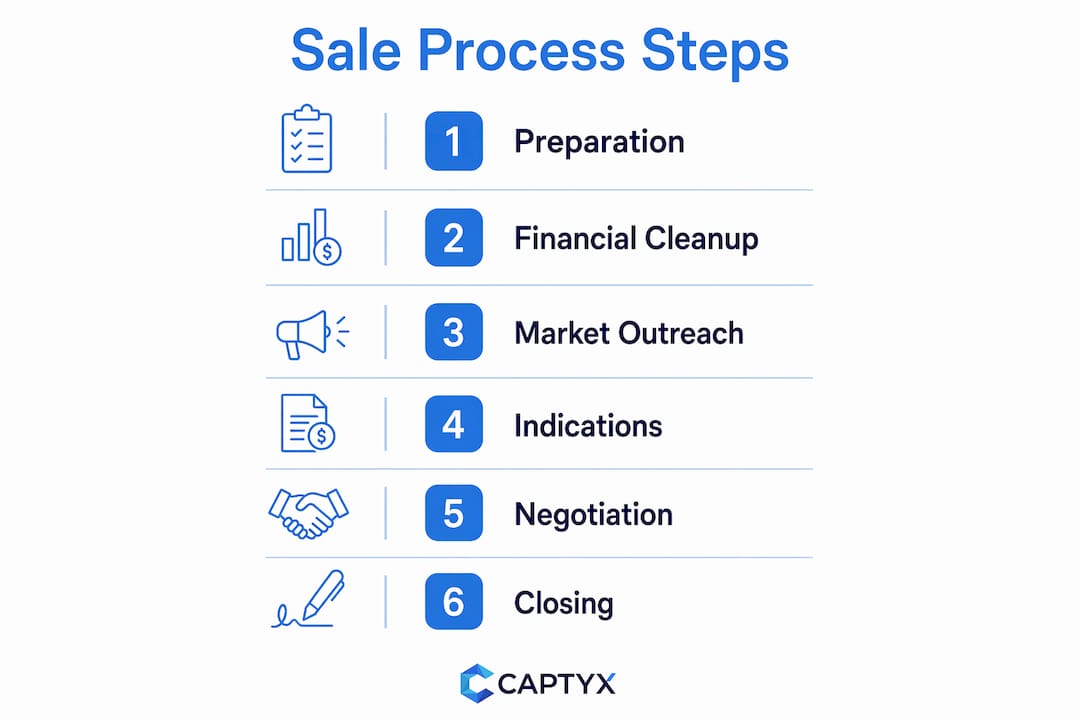
The process follows a defined sequence:
- Teaser distribution: A one-page anonymous summary goes to 30–80 qualified PE firms and strategic buyers. Interested parties sign an NDA to receive the full Confidential Information Memorandum (CIM).
- CIM review: Buyers study the CIM and submit Indications of Interest (IOIs), non-binding letters stating a preliminary valuation range and deal structure.
- Management presentations: The top IOI submitters meet your team in person or virtually. This is where buyers assess the management depth they are buying.
- Letter of Intent (LOI): The strongest buyer submits a binding LOI with a price, structure, and exclusivity period. You negotiate and sign.
- Due diligence: The buyer conducts financial, legal, and operational review. This phase typically runs 60–90 days.
- Closing: Definitive agreements are signed and funds transfer.
The exclusivity period in the LOI is a critical negotiating point. Sellers should push for 45–60 days rather than 60–90. Shorter exclusivity keeps other buyers engaged and preserves your leverage if the lead buyer tries to retrade the price during diligence.
| Phase | Typical Duration |
|---|---|
| Preparation and financial cleanup | 6–12 months |
| Market outreach and IOI collection | 6–10 weeks |
| Management presentations | 2–4 weeks |
| LOI negotiation and signing | 1–2 weeks |
| Due diligence | 60–90 days |
Pro Tip: Never go to market without a formal process managed by an experienced M&A advisor. A solo approach to one buyer eliminates the competitive tension that produces premium pricing.
What deal structures should you expect when selling to private equity?
Deal structure is where sellers often get surprised. PE transactions typically deliver 70% cash proceeds at close with 20–30% retained as rollover equity in the new entity. That rollover is not a concession. It is a second bite at the apple. When the PE firm exits in 3–5 years, your retained equity participates in the upside.
The key structural elements to understand and negotiate:
- Cash at close: The majority of your proceeds, subject to working capital adjustments and escrow holdbacks.
- Rollover equity: Your retained ownership stake in the post-close entity. Negotiate the percentage carefully. Higher rollover means more upside but less immediate liquidity.
- Earn-outs: Contingent payments tied to future performance milestones. Earn-outs bridge valuation gaps but carry execution risk. Treat them as uncertain income, not guaranteed proceeds.
- Seller note: Occasionally, part of the purchase price is structured as a note you hold, paid over time. This is less common in PE deals than in owner-to-owner transactions.
- Post-close role: Most PE buyers expect the seller to stay involved for 3–5 years. Define your role, compensation, and decision-making authority in the LOI before exclusivity begins.
PE buyers purchase a repeatable system rather than just current earnings. That means they will install formal reporting, governance committees, and institutional oversight. Sellers who resist this shift create friction that damages the relationship and can trigger earn-out disputes.
Pro Tip: Align your post-close goals with your deal terms before you sign the LOI. If you want to exit fully in two years, negotiate that timeline explicitly. Assumptions made verbally rarely survive closing.
Common mistakes to avoid when selling to private equity
Most failed or undervalued PE transactions share the same root causes. Recognizing them early protects your outcome.
- Starting too late. The full process takes 12–18 months from preparation through close. Owners who begin six months before their target date arrive at market unprepared.
- Weak management depth. If your business cannot operate without you for 30 days, buyers will price that risk into their offer or walk away entirely.
- Ignoring market timing. Interest rate environments, sector valuations, and PE fundraising cycles all affect multiples. Selling into a favorable cycle matters.
- Accepting long exclusivity. A 90-day exclusivity period gives buyers time to retrade and lets competing buyers go cold. Push back.
- Misaligned exit expectations. Sellers who expect a full exit and no post-close involvement often clash with PE buyers who need operational continuity. Clarify this before signing.
- Going to market alone. Owners who approach buyers directly without an advisor consistently achieve lower valuations and worse terms than those who run a competitive sale process.
“The sellers who get the best outcomes are the ones who treat the sale as a business project, not a personal negotiation. They prepare early, run a process, and let competition do the work.”
Pro Tip: Stay flexible on deal structure while staying firm on price. Buyers often use structure, earn-outs, escrows, and rollover percentages to reduce effective price. Know your walk-away number on each term before negotiations begin.
Key Takeaways
Selling to a private equity firm requires meeting strict financial thresholds, preparing your business 12–24 months in advance, and running a competitive process with multiple buyers to achieve the best price and terms.
| Point | Details |
|---|---|
| Meet PE financial screens | Clear $1M EBITDA for platform deals and $3M revenue before approaching buyers. |
| Prepare 12–24 months early | Build management depth, clean financials, and recurring revenue before going to market. |
| Run a competitive process | Distribute teasers to 30–80 buyers through an advisor to create pricing tension. |
| Negotiate exclusivity carefully | Push for 45–60 day exclusivity in the LOI to keep competing buyers engaged. |
| Understand rollover equity | Expect 20–30% rollover and align your post-close role with deal terms before signing. |
What I have learned from watching owners sell to private equity
The owners who walk away with the best outcomes share one trait: they treated the sale as a business project, not a personal milestone. They started early, hired experienced advisors, and let the process create competition rather than relying on a single relationship.
The most common misconception I see is that PE firms are passive capital sources. They are not. PE buyers expect institutional oversight and formal governance from day one. Sellers who understand this going in adapt quickly. Those who expect to keep running the business the way they always have create conflict that erodes value and poisons the post-close relationship.
The rollover equity conversation is where I see the most anxiety. Owners fixate on the cash at close and treat the rollover as a risk. Flip that thinking. The rollover is often where the real wealth is created, especially when the PE firm has a strong track record of growing and exiting portfolio companies. Understand their exit history before you sign anything.
The mid-market sale timeline is longer than most owners expect and more demanding than any other business project they will run. Respect that reality, and you will be prepared for what comes.
— Tucker
Captyx advisory for your private equity sale
Captyx has built the systems and processes that most M&A advisors use to prepare businesses for sale. With over 225 completed transactions, including businesses Captyx has sold on its own behalf, the firm brings real-world experience to every engagement.

For owners preparing to sell business to private equity, Captyx provides valuation analysis, financial preparation consulting, and full sale process management. Start with a free business valuation estimate to understand where your business stands today. When you are ready to run a process, Captyx’s advisory team manages buyer outreach, negotiation, and due diligence coordination so you can focus on running the business while the sale moves forward. Learn more about working with a broker and whether that structure fits your transaction.
FAQ
What EBITDA do I need to sell to a private equity firm?
Private equity firms require a minimum EBITDA of $1 million for platform acquisitions and will consider businesses with $500,000–$1 million in EBITDA as add-on targets. Below $500,000, most PE buyers will not engage.
How long does a private equity sale take?
The full process takes 12–18 months, including 6–12 months of preparation and roughly six months of active market outreach, management presentations, and due diligence. Rushing the preparation phase consistently produces lower valuations.
What is rollover equity in a PE deal?
Rollover equity is the ownership stake you retain in the business after the PE firm acquires it, typically 20–30% of the new entity. It gives you a second liquidity event when the PE firm exits, usually 3–5 years after closing.
Do I have to stay involved after selling to private equity?
Most PE buyers expect the seller to remain involved for 3–5 years post-close to support growth and transition. Your specific role, authority, and compensation should be negotiated and documented in the Letter of Intent before exclusivity begins.
Why should I use an advisor to sell to private equity?
Advisors running competitive processes with 30–80 buyers consistently produce higher valuations and better terms than owners negotiating directly with a single buyer. The advisor fee is almost always recovered through improved deal pricing.


