


TL;DR:
- Business acquisition financing combines loans, buyer equity, and seller financing, primarily repaid by the acquired company’s cash flow. The main funding sources are SBA 7(a), conventional loans, seller notes, and mezzanine debt, with DSCR as a critical approval metric. Successful deals depend on accurate deal structuring, thorough financial preparation, and choosing experienced lenders, especially those with Preferred Lender Program status.
Business acquisition financing is the structured use of loans, buyer equity, and seller financing to fund the purchase of an existing business, with the acquired company’s cash flow serving as the primary repayment source. Most small business buyers combine an SBA 7(a) loan, a personal down payment, and a seller note to cover the full purchase price. The critical underwriting metric lenders use is the Debt Service Coverage Ratio (DSCR), which measures whether the business generates enough cash flow to service all debt after closing. Understanding how business acquisition financing works before you approach a lender is the difference between a deal that closes and one that falls apart at the finish line.
What are the main types of business acquisition financing?
The four primary funding sources for buying a business are SBA loans, conventional bank loans, seller financing, and mezzanine debt. Each carries different costs, timelines, and risk profiles. Most small business acquisitions use a combination of two or three of these sources layered together.

SBA 7(a) loans
The SBA 7(a) program is the dominant financing tool for small business acquisitions. SBA 7(a) loans carry terms up to 10 years, rates tied to Prime plus a spread (currently approximately 7.75% to 11.5%), and require a minimum 10% down payment, with loan amounts capped at $5 million. The SBA does not lend directly. It guarantees a portion of loans issued by approved banks and credit unions, which reduces lender risk and allows buyers to access favorable terms they could not get otherwise. Every owner holding 20% or more equity must sign a personal guarantee, meaning personal liability for the full loan balance if the business defaults after exhausting its assets.
Conventional bank financing
Conventional acquisition financing requires 20% to 40% down payments and shorter loan terms of 5 to 10 years. The trade-off is speed. Qualified borrowers can close in 30 to 45 days compared to the 60 to 90 days typical for SBA deals. Conventional loans suit buyers with strong balance sheets who want to avoid SBA program requirements and can absorb the higher equity injection.
Seller financing
Seller financing fills the gap between the senior loan and the purchase price. Seller notes typically cover 5% to 10% of deal value and carry 3 to 7 year repayment terms. They are subordinated to the senior lender, meaning the bank gets paid first. A “full standby” seller note, where the seller receives no principal or interest during the SBA loan term, can actually count toward the buyer’s equity injection, reducing the cash you need at closing.
Mezzanine and subordinated debt
Mezzanine debt sits between senior debt and equity in the repayment hierarchy. It carries higher interest rates (often 12% to 20%) to compensate lenders for the subordinated position. Most small business acquisitions under $5 million do not require mezzanine financing, but it becomes relevant in larger deals where the buyer wants to minimize equity injection while the senior lender caps its exposure.
| Financing type | Down payment | Typical term | Closing speed |
|---|---|---|---|
| SBA 7(a) | 10% minimum | Up to 10 years | 60 to 90 days |
| Conventional bank | 20% to 40% | 5 to 10 years | 30 to 45 days |
| Seller financing | Varies (gap coverage) | 3 to 7 years | Flexible |
| Mezzanine debt | Minimal | 3 to 7 years | 45 to 60 days |
How do lenders evaluate acquisition financing applications?
Lenders approve or reject acquisition deals based on one foundational question: does the business generate enough cash flow to cover all debt payments after you buy it? The answer lives in the DSCR.
SBA lenders require a DSCR of approximately 1.15x to 1.25x, meaning the business’s operating cash flow must exceed total annual debt service by at least 15% to 25%. If annual debt payments total $100,000, the business needs to produce at least $115,000 in adjusted cash flow to qualify. That buffer exists because lenders know post-acquisition performance rarely matches projections exactly.
The cash flow lenders use is not the raw number from the income statement. Underwriters adjust EBITDA by normalizing owner compensation, removing non-recurring expenses, and accounting for working capital changes to arrive at the true cash available for debt service. A business showing strong profits on paper can still fail underwriting if those profits depend on an unusually low owner salary or one-time revenue events.
Beyond DSCR, lenders evaluate four additional factors:
- Credit score. Most SBA lenders want a personal credit score above 680. Some Preferred Lenders will go lower with compensating factors, but below 650 significantly narrows your options.
- Industry experience. Lenders favor buyers with direct experience in the target industry. No prior experience does not disqualify you, but it raises the risk profile and may require a larger down payment.
- Collateral. SBA loans require collateral when available, including business assets and personal real estate. The SBA will not decline a loan solely for insufficient collateral, but lenders will note the gap.
- Business valuation. The lender orders an independent business appraisal to confirm the purchase price is supported by the business’s earnings. Overpaying relative to cash flow is a fast path to denial. Understanding how buyers value businesses before you negotiate the purchase price gives you a significant advantage here.
Pro Tip: Work with a lender that holds SBA Preferred Lender Program (PLP) status. PLP lenders have delegated authority to approve SBA loans in-house without waiting for SBA review, which can cut two to four weeks off your closing timeline.
Underwriting timelines typically run three to six weeks for SBA deals once the lender has a complete package. Incomplete financials and unclear deal assumptions are the top causes of delays, not lender capacity.
What does a typical acquisition financing capital stack look like?
The capital stack is the layered structure of funding sources that together cover 100% of the purchase price. Each layer has a different cost, repayment priority, and risk level.
A standard small business acquisition capital stack looks like this:
| Layer | Typical percentage | Source |
|---|---|---|
| Senior debt | 70% to 80% | SBA 7(a) or conventional bank loan |
| Buyer equity | 10% to 20% | Cash down payment |
| Seller note | 5% to 10% | Seller financing |
| Mezzanine debt | 0% to 10% | Specialty lender (larger deals) |
The capital stack is structured so senior debt sits at the top of the repayment priority. If the business struggles, the bank gets paid before the seller and before any mezzanine lender. This priority structure is why seller notes carry higher interest rates than senior debt and why sellers sometimes resist them.
The standby seller note rule is one of the most underused tools in small business acquisitions. As of 2026, the SBA allows a full standby seller note to count toward the buyer’s equity injection, with the buyer still required to contribute at least 5% in cash. This means a buyer purchasing a $1 million business could potentially close with $50,000 in cash, a $100,000 standby seller note counting as equity, and an SBA loan covering the remaining $850,000. That structure dramatically reduces the capital barrier for qualified buyers.
Post-close cash flow is where many buyers get into trouble. Stacking too much debt against a business with thin margins leaves no room for a slow month, a key employee departure, or an unexpected capital expense. The senior lender’s underwriting position sets the parameters for every other layer in the stack, which is why getting the senior debt right is the most important structural decision in the deal.
Pro Tip: Model your post-close cash flow at 80% of the business’s historical revenue before you finalize the capital stack. If the debt payments are still covered at that level, your structure is defensible. If they are not, renegotiate the purchase price or increase the seller note.
How long does acquisition financing take and what are the main steps?
SBA 7(a) acquisition loans typically close within 60 to 90 days from the time a complete application is submitted. Conventional financing can close in 30 to 45 days. Seller-only financing deals can close in two to three weeks if both parties are motivated and legal documentation is straightforward.
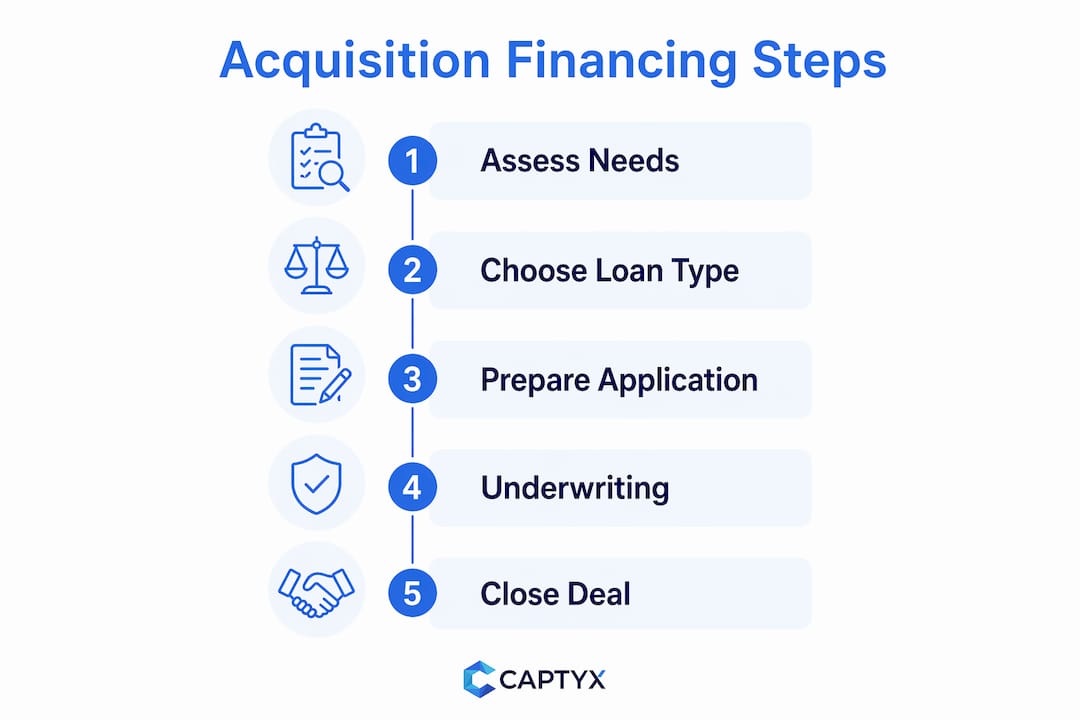
The process breaks into five stages:
- Financial preparation (weeks 1 to 2). Gather two to three years of business tax returns, financial statements, and a seller’s discretionary earnings calculation. Assembling complete financials upfront is the single most effective way to prevent underwriting delays. Incomplete packages are the leading cause of extended timelines.
- Financing structure (weeks 2 to 3). Determine your capital stack. Decide how much equity you are injecting, whether you need a seller note, and which loan program fits the deal. This is also when you approach lenders and collect term sheets.
- Lender application and underwriting (weeks 3 to 7). Submit your full package to the chosen lender. Underwriting involves DSCR analysis, business appraisal, credit review, and deal structure confirmation. Expect back-and-forth requests for additional documentation.
- SBA guarantee approval (weeks 6 to 9, SBA deals only). For non-PLP lenders, the package goes to the SBA for guarantee approval after internal underwriting. PLP lenders skip this step entirely, which is why Preferred Lender status matters.
- Closing (weeks 8 to 12). Legal documents are drafted, title work is completed, and funds are disbursed. The business appraisal order date, completeness of the financial package, and any exclusivity period pressure all affect whether you hit the early or late end of this range.
The most common delays are missing tax returns, discrepancies between reported income and bank deposits, and purchase price adjustments that require a new appraisal. Buyers who work with experienced M&A advisors or DSCR-qualified lenders move through underwriting faster because they know what the lender needs before the lender asks for it.
Key takeaways
Business acquisition financing works by layering senior debt, buyer equity, and seller financing to cover the purchase price, with DSCR as the metric that determines whether the deal is fundable.
| Point | Details |
|---|---|
| DSCR is the make-or-break metric | Business cash flow must cover debt payments by 1.15x to 1.25x for SBA approval. |
| SBA 7(a) is the primary tool | Terms up to 10 years, 10% minimum down, rates from 7.75% to 11.5% as of 2026. |
| Seller notes reduce cash needed | A full standby seller note can count as equity, letting buyers close with as little as 5% cash down. |
| Capital stack order matters | Senior debt gets paid first; seller notes and mezzanine debt are subordinated and carry higher rates. |
| Preparation drives timeline | Complete financials and a clear acquisition narrative cut weeks off the underwriting process. |
What I’ve learned about acquisition financing after 225 deals
Most buyers walk into acquisition financing thinking the hard part is getting approved. It is not. The hard part is structuring a deal where the business can actually service the debt after you own it.
I have seen buyers get SBA approval on deals that were structurally broken from day one. The DSCR cleared the threshold on paper, but only because the underwriter used the seller’s best year and the buyer’s optimistic projections. Twelve months post-close, the business was struggling to make loan payments because no one stress-tested the cash flow at a realistic operating level.
The standby seller note rule is genuinely underused. Buyers who know about it negotiate harder on seller financing terms and close with significantly less cash out of pocket. Sellers who understand it are often more willing to participate because the note structure is clearly defined and the SBA program gives them a credible repayment framework.
My consistent advice: choose a PLP lender before you choose a deal. The lender relationship shapes everything downstream, from how your financials are interpreted to how quickly you can move when a seller has competing offers. A lender who has closed 50 SBA acquisition deals will catch structural problems early. A lender doing their third acquisition deal will find them at closing.
Clean financials and a credible acquisition narrative are not nice-to-haves. They are the product you are selling to the underwriter. Treat your loan package the way you would treat a pitch to an investor, because that is exactly what it is.
— Tucker
How Captyx helps buyers navigate acquisition financing
Structuring an acquisition deal correctly from the start is where most buyers need the most help, and where the most value is either created or destroyed.

Captyx has advised on and closed over 225 business transactions, including deals where financing structure was the deciding factor between a closed sale and a failed one. The team works with buyers on deal structuring, capital stack design, lender selection, and the financial preparation that makes underwriting move faster. Whether you are buying your first business or your fifth, the M&A advisory services at Captyx connect you with the experience and lender relationships that turn a complicated process into a manageable one. Start with the business acquisition guide to understand what sellers and lenders are actually looking for before you make your first offer.
FAQ
What is the minimum down payment for an SBA acquisition loan?
SBA 7(a) loans require a minimum 10% down payment, though a full standby seller note can count toward that equity injection, allowing buyers to close with as little as 5% in cash.
What DSCR do I need to qualify for acquisition financing?
Most SBA lenders require a DSCR of 1.15x to 1.25x, meaning the business’s adjusted cash flow must exceed total annual debt payments by at least 15% to 25%.
How long does it take to close an SBA business acquisition loan?
SBA 7(a) acquisition loans typically close in 60 to 90 days. Working with a Preferred Lender Program (PLP) lender can shorten that timeline by two to four weeks.
Can seller financing count as part of my equity injection?
Yes. A full standby seller note, where no principal or interest is paid during the SBA loan term, can count toward the buyer’s required equity injection under current SBA rules.
What causes the most delays in acquisition financing?
Incomplete financial packages, discrepancies between reported income and bank deposits, and purchase price adjustments requiring a new business appraisal are the most common causes of underwriting delays.
Recommended
- Matyx Digital Marketing Sold by Captyx Acquisitions
- 21 Proven Ways to Multiply Your Exit Before You Ever List It – Top Way to Sell a Business | Captyx
- #1 Way to Sell Your Business – Captyx Acquisitions – Top Way to Sell a Business | Captyx
- Done For You Off Market Deal Sourcing – Top Way to Sell a Business | Captyx


