


TL;DR:
- Mid-market businesses appeal to private equity because they combine established cash flow with significant operational upside and growth potential. Private equity firms focus on firms with revenues between $10 million and $1 billion, valuing lower entry multiples, operational improvement scope, and exit flexibility. They create value through margin optimization, revenue growth, and add-on acquisitions, emphasizing active governance and management involvement.
Mid-market businesses attract private equity because they combine established cash flow, operational upside, and growth potential that neither small businesses nor large corporations can match. Mid-market firms represent 50 to 60% of all U.S. private equity transactions, a dominance that reflects deliberate investor preference rather than market accident. These companies, typically generating between $10 million and $1 billion in annual revenue, sit in a structural sweet spot: proven enough to carry debt, young enough operationally to improve dramatically. For business owners in this segment, understanding why private equity invests here is the first step toward negotiating from a position of strength.
Why mid-market businesses attract private equity: the core reasons
The mid-market is defined by revenue between $10 million and $1 billion, though most private equity firms focus on the $25 million to $500 million range where deal economics work best. Over 300,000 U.S. businesses fall into this category, contributing roughly one-third of U.S. GDP and employing more than 40 million people. That scale matters to investors because it signals economic durability, not fragility.

What makes these firms genuinely attractive is a combination of traits that smaller and larger companies rarely share simultaneously. Many mid-market companies are founder-owned or family-run, which means they carry real operational inefficiencies that a skilled investor can fix. They have loyal customer bases, recurring revenue in many cases, and management teams that know their markets deeply. They just haven’t had the capital or systems to scale.
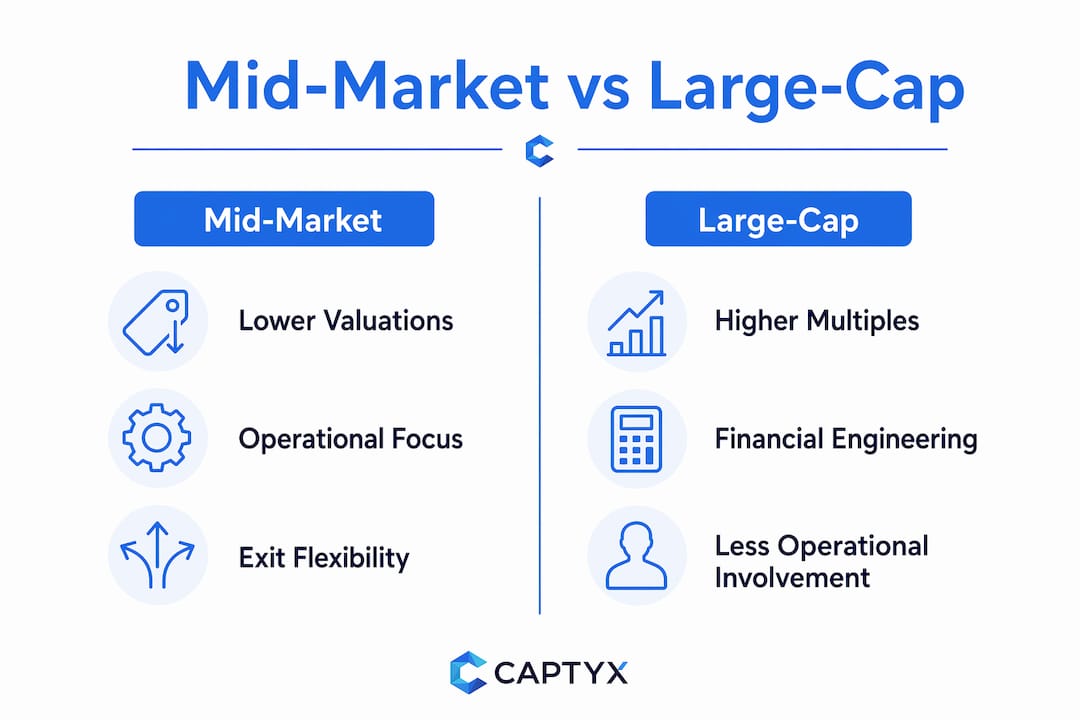
Compare that to large-cap targets, where bidding wars push purchase multiples to levels that make value creation nearly impossible without financial engineering. Mid-market deals offer lower entry valuations and reduced competition, which creates room for genuine operational upside rather than relying on leverage to generate returns.
| Factor | Mid-market firms | Large-cap firms |
|---|---|---|
| Entry valuation multiples | Lower, less competitive | Higher, auction-driven |
| Operational improvement room | Significant | Limited |
| Leverage dependency | Moderate | High |
| Exit pathway diversity | Trade sale, secondary buyout, IPO | Primarily IPO or large strategic |
| Management professionalization | High opportunity | Already institutionalized |
How private equity firms create value in mid-market companies
Private equity’s value creation playbook in the mid-market goes well beyond cutting costs. The modern approach centers on three levers: margin optimization, revenue growth, and add-on acquisitions. Each one compounds the others when executed in sequence.
-
Margin optimization starts with operational audits. PE firms bring in specialists to analyze procurement, pricing, and workforce productivity. Tools like ERP systems and CRM platforms, which many mid-market companies have never fully implemented, get deployed to professionalize operations and create the data infrastructure buyers expect at exit.
-
Revenue growth comes from geographic expansion, new product lines, and sales force professionalization. PE-backed companies often hire their first dedicated VP of Sales or Chief Revenue Officer during the holding period. This single hire frequently drives double-digit revenue growth within 18 months.
-
Add-on acquisitions are the most powerful lever. Buy-and-build strategies account for 72% of mid-market PE buyouts, meaning the majority of deals involve acquiring smaller competitors or complementary businesses to increase market share and enterprise value simultaneously. A company acquired at 6x EBITDA that grows through bolt-ons can exit at 9x or 10x, generating outsized returns without relying on market conditions.
The governance structure matters as much as the strategy. PE firms bypass quarterly public market pressures and focus relentlessly on cash metrics and execution speed. Active boards with industry operators, not just financial analysts, hold management accountable to milestones that directly drive exit value. This is a material difference from running a business without institutional oversight.
Pro Tip: Before engaging with any PE firm, ask specifically about their operational team. Firms with dedicated operating partners who have run businesses in your sector will create more value and cause less friction than those staffed entirely by finance professionals.
Why mid-market businesses offer attractive exit prospects
Exit flexibility is one of the most underappreciated reasons investor interest in mid-market companies remains strong. A PE firm acquiring a $50 million EBITDA business has multiple realistic exit paths. A large strategic buyer in the same industry may pay a premium for market share. A larger PE fund may execute a secondary buyout. In some cases, the company reaches a scale that supports an IPO.
Private equity firms typically hold investments for 3 to 7 years, a window that aligns with the operational transformation timeline in mid-market deals. This is shorter than the patient capital cycles of infrastructure or real estate, which means investors can recycle capital faster and generate carried interest for their limited partners on a predictable schedule.
The exit pricing advantage is equally significant:
- Trade sales to strategic buyers often command the highest multiples because the acquirer values synergies, not just standalone cash flow.
- Secondary buyouts provide liquidity even when public markets are closed, a critical advantage during periods of IPO market volatility.
- Partial exits allow founders to retain equity while taking chips off the table, a structure that mid-market deal flexibility makes possible.
- Less competitive auction processes at acquisition mean PE firms enter at lower multiples, widening the spread between entry and exit pricing.
Mid-market PE investments frequently outperform large-cap deals precisely because of this price efficiency combined with operational upside. The math is straightforward: buy at a lower multiple, improve EBITDA, and exit at a higher multiple. Large-cap deals rarely offer all three conditions simultaneously.
How the mid-market PE landscape differs from large-cap investments
The structural differences between mid-market and large-cap private equity are significant enough to change how business owners should prepare for and negotiate with investors.
In large-cap deals, financial engineering carries most of the return. High leverage amplifies equity returns when everything goes right, but it also amplifies losses when it doesn’t. Mid-market firms are less reliant on leverage, which reduces financial risk during rising interest rate environments like the one businesses navigated from 2022 through 2025. This makes mid-market PE structurally more resilient across economic cycles.
Operational involvement is also categorically different. Large-cap PE firms often function more like sophisticated financial managers, monitoring KPIs and managing capital structure. Mid-market PE firms get their hands dirty. They recruit management, redesign incentive structures, and sometimes install interim executives. Successful PE firms emphasize repeatable operational execution and board-level governance as the primary value driver, not cheap leverage.
| Dimension | Mid-market PE | Large-cap PE |
|---|---|---|
| Primary return driver | Operational improvement | Financial leverage |
| Investor involvement | High, hands-on | Moderate, oversight-focused |
| Deal competition | Lower, less auction-driven | High, investment bank-run |
| Capital structure flexibility | Greater | More rigid |
| Management alignment | Equity incentives, founder retention | Professional management teams |
For business owners, this means a mid-market PE partner will be present in your business in ways a large-cap firm never would be. That is both an opportunity and a challenge. The firms that create the most value treat this involvement as a genuine partnership, not a takeover.
Key takeaways
Mid-market businesses attract private equity because they offer the rare combination of operational improvement potential, flexible exit pathways, and price efficiency that large-cap deals cannot replicate.
| Point | Details |
|---|---|
| Size creates opportunity | Mid-market firms have room to professionalize operations, which directly drives EBITDA growth and exit multiples. |
| Add-on acquisitions dominate | Buy-and-build strategies account for 72% of mid-market buyouts, making consolidation a primary value creation tool. |
| Exit flexibility is a key draw | Trade sales, secondary buyouts, and partial exits give PE firms multiple paths to liquidity within a 3 to 7 year window. |
| Lower leverage reduces risk | Mid-market deals rely less on debt than large-cap transactions, improving resilience during economic uncertainty. |
| Operational governance matters | PE firms with dedicated operating partners and active boards consistently outperform those focused purely on financial engineering. |
What I’ve learned about choosing the right PE partner
After working through hundreds of mid-market transactions, the single most common mistake I see business owners make is evaluating PE firms purely on valuation. The firm that offers the highest number in a letter of intent is not always the firm that will deliver the best outcome for you, your team, or your business.
The cultural fit question is real, but it’s also frequently misunderstood. Sophisticated PE investors prioritize management continuity and value-preserving incentives. They are not coming in to gut your team. They are coming in to scale what you built. The firms that damage culture are typically those that lack operational expertise and compensate with financial pressure. You can screen for this by asking how many of their portfolio companies retained the founding CEO through exit.
What I tell every business owner I work with: the PE diligence process runs both ways. You are evaluating them as much as they are evaluating you. Ask for references from founders at their portfolio companies, specifically ones where the exit did not go as planned. How a PE firm behaves when things get hard tells you everything about whether they are a real partner or just a financial buyer with a management contract.
The advantages of private equity are real and well-documented. But they materialize only when the investor brings genuine operational capability, not just capital. The mid-market is full of both types. Knowing the difference before you sign is the most valuable work you can do.
— Tucker
How Captyx helps mid-market owners prepare for private equity

Captyx has advised on more than 225 business sales, including transactions where mid-market owners needed to position their companies specifically for private equity interest. The preparation work matters as much as the deal itself. PE firms conduct thorough financial and operational due diligence, and businesses that arrive unprepared leave significant value on the table.
Captyx’s M&A advisory services cover valuation analysis, operational readiness assessments, buyer targeting, and negotiation support. The firm’s process is built on real buyer feedback from completed transactions, which means the improvements Captyx recommends are the ones that actually move purchase price. If you are a mid-market business owner considering a PE transaction or a full exit, the time to start preparing is before the first investor conversation, not after. Learn more about how to sell your business with a process built for your outcome.
FAQ
What revenue range defines a mid-market business for private equity?
Most private equity firms define mid-market companies as those generating between $10 million and $1 billion in annual revenue, with the most active deal activity concentrated in the $25 million to $500 million range where deal economics and operational improvement potential align most favorably.
Why do PE firms prefer mid-market over small businesses?
Small businesses typically lack the management depth, financial reporting infrastructure, and scalable operations that PE firms need to execute their value creation strategies. Mid-market companies offer established cash flow and customer bases while still carrying enough operational inefficiency to justify a PE firm’s involvement.
How long does private equity typically hold a mid-market investment?
PE firms hold mid-market investments for 3 to 7 years on average, a timeline designed to complete operational improvements, execute add-on acquisitions, and exit at a higher valuation multiple than the entry price.
Will a PE firm replace my management team after acquisition?
Most mid-market PE firms prioritize retaining founders and key management because continuity protects business value during the transition. Equity incentives and performance-based compensation structures are standard tools used to align management goals with investor returns throughout the holding period.
What makes mid-market PE deals less risky than large-cap transactions?
Mid-market deals use less financial leverage than large-cap buyouts, which reduces exposure during interest rate increases or economic downturns. Combined with lower entry multiples and greater operational improvement potential, this creates a more favorable risk-return profile for investors across market cycles.


