


TL;DR:
- Business brokers are essential for accessing off-market deals since they build long-term relationships with motivated sellers.
- Most high-quality opportunities come through specialized brokers who pre-qualify and maintain referral pipelines, offering faster access.
Business brokers are the primary gatekeepers connecting serious buyers with business owners who sell quietly, away from public listings. The role of business brokers finding offmarket deals is to surface opportunities that never appear on public marketplaces, giving prepared buyers a decisive edge. Approximately 70% of small business sales occur off-market, and brokers account for 25–35% of lower-middle-market deal flow. That concentration of hidden activity means buyers who skip broker relationships are working with a fraction of the available market. The industry term for this practice is “proprietary deal sourcing,” and understanding how it works changes how serious buyers approach acquisitions entirely.
How business brokers find off-market business opportunities
Off-market deal flow is fundamentally relationship-driven. Brokers track owner lifecycle events such as estate planning milestones, debt maturity dates, and portfolio rebalancing decisions to identify sellers before they ever consider a public listing. A business owner turning 65 who mentions retirement to his accountant may not call a broker for another two years. The broker who already has that relationship gets the call first.

Experienced brokers build proprietary networks over years, not months. They attend industry conferences, cultivate referral pipelines from CPAs and attorneys, and maintain contact with owners they met during deals that never closed. Each of those touchpoints is a potential future listing. Niche specialization amplifies this effect. A broker who focuses exclusively on HVAC businesses, for example, knows every significant owner in a three-state region and can spot a motivated seller from a single offhand comment.
The qualification process is equally important. Before a deal reaches any buyer, a skilled broker assesses the seller’s readiness, motivation, and financial documentation. This pre-screening filters out owners who are curious but not committed, which means buyers who receive broker introductions are talking to sellers who are genuinely ready to transact.
- Relationship cultivation: Brokers maintain long-term contact with owners across industries, often years before a sale materializes.
- Lifecycle monitoring: Estate planning, debt maturity, and health events signal when an owner may be ready to sell.
- Niche networks: Specialized brokers know their industry’s ownership community deeply, creating early access to deals.
- Pre-qualification: Brokers screen sellers for readiness before introducing buyers, saving time on both sides.
- Referral pipelines: CPAs, attorneys, and lenders regularly refer owners to trusted brokers, expanding deal flow organically.
Pro Tip: Ask any broker you meet how they sourced their last three deals. The answer tells you immediately whether they rely on relationships or just wait for inbound listings.
Why working with 2–4 specialist brokers beats a wide net
Most buyers make the same mistake: they contact every broker they can find and expect deal flow to follow. The opposite is true. Limiting primary broker relationships to 2–4 specialists in your target industry produces better access and higher-quality introductions than spreading attention thin across dozens of generalists.
Brokers are not neutral conduits. They are professionals who protect their sellers and their own reputations. They prioritize buyers who make their job easier, and that means buyers who close. Brokers prefer buyers with proven track records, committed capital, or pre-approved financing because those buyers reduce the risk of a deal collapsing after significant time has been invested. Think of your first interaction with a broker as an audition, not a request.
Here is how to build the kind of broker relationship that generates consistent deal flow:
- Identify the right specialists. Research brokers who have closed deals in your specific industry and deal size range. A broker who sells manufacturing businesses in the $2M–$10M range is not the right contact for a $500K service business acquisition.
- Prepare a written acquisition criteria document. One page is enough. Include industry, geography, revenue range, EBITDA floor, and deal structure preferences. Brokers share this internally and remember buyers who make their criteria clear.
- Demonstrate financial readiness upfront. Provide proof of funds or a pre-approval letter at the first meeting. This single step separates serious buyers from tire-kickers in a broker’s mind.
- Communicate professionally and consistently. Follow up after every conversation. Send a brief email recapping your criteria and expressing continued interest. Brokers remember buyers who are organized and responsive.
- Deliver on every commitment. If you say you will review a CIM by Friday, review it by Friday. Reliability builds trust faster than any other behavior.
Pro Tip: Meet your top two or three brokers in person at least once. Face-to-face meetings create a level of trust that email and phone calls rarely replicate, and brokers are far more likely to call you first on a new deal.
How to collaborate with brokers to close off-market deals
Effective collaboration with a broker starts before you ever see a deal. Buyers who clarify their buy box and demonstrate financial readiness gain faster access to higher-quality opportunities. The acquisition criteria document mentioned above is your primary tool. Update it whenever your parameters change, and send the updated version to your broker contacts proactively.
Financing readiness is not optional. Sellers in off-market transactions often move quickly because they are motivated by personal circumstances, not market timing. A buyer who needs three months to arrange financing after finding a deal will lose it to a buyer who can move in three weeks. Pre-approved SBA financing or a committed equity partner signals to brokers that you can actually close.
- Share your criteria in writing. A one-page acquisition profile gives brokers something concrete to match against their pipeline.
- Ask about unlisted deals directly. Buyers who regularly ask brokers about pipeline opportunities stay top-of-mind and get early calls on new deals.
- Maintain a consistent outreach cadence. A brief check-in every four to six weeks keeps you visible without becoming a nuisance.
- Never re-trade a deal. Backing out of a deal or renegotiating terms late in diligence is a career-damaging event for brokers. Buyers who do it once rarely receive another introduction from that broker or their network.
- Use broker expertise in negotiation. Brokers know what sellers in their niche actually accept. Their guidance on deal structure, earnouts, and seller financing terms is worth more than most buyers realize.
Brokers also serve as informal deal coaches. They know which sellers are emotionally attached to their business and need extra time, which ones are purely financial, and which deals have hidden complications. Buyers who treat brokers as partners rather than intermediaries get access to that intelligence. It changes how you approach every conversation with a seller.
Pro Tip: When a broker sends you a deal that does not fit your criteria, respond quickly with a polite pass and a one-sentence reminder of what you are looking for. That response keeps you visible and reinforces your criteria in the broker’s memory.
Brokers vs. other methods for finding off-market businesses
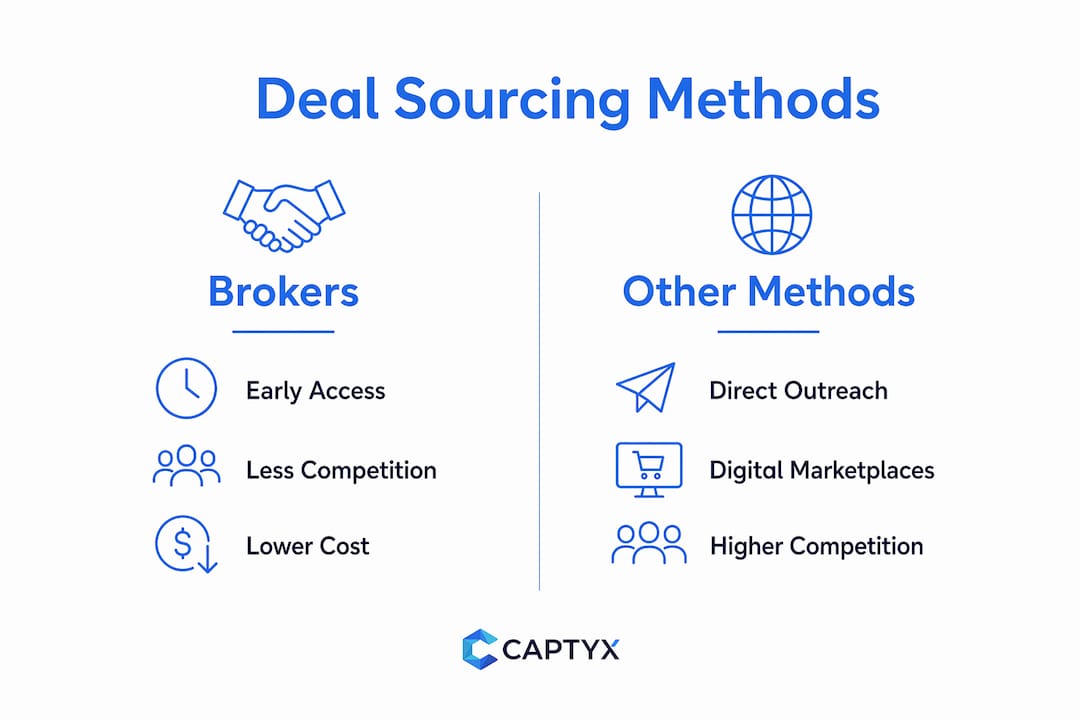
Direct outreach to business owners is the most common alternative to working with brokers. It works, but the hit rate is low and the process is slow. Cold letters and calls to owners produce a small fraction of the deal flow that a well-maintained broker relationship generates. Working with brokers provides access to over 80% of off-market deals, while buyers who avoid brokers effectively lock themselves out of most of the market.
Digital marketplaces have improved significantly. Platforms that combine on-market and verified off-market listings give buyers broader visibility, but the best deals still move through broker networks before they reach any platform. By the time a deal appears on a digital marketplace, it has often already been shown to the broker’s preferred buyers. Platforms complement broker relationships. They do not replace them.
| Sourcing method | Deal flow quality | Speed to access | Buyer cost | Competition level |
|---|---|---|---|---|
| Specialist broker network | High | Fast (pre-listing) | None (seller pays) | Low |
| Digital marketplace | Medium | Moderate | None | High |
| Direct owner outreach | Variable | Slow | Time-intensive | Low to medium |
| Public listings | Lower | Immediate | None | Very high |
The table above reflects a consistent pattern: broker-sourced deals arrive earlier, face less competition, and cost buyers nothing in direct fees because sellers pay brokerage commissions. That combination is why finding off-market businesses through specialist brokers remains the most efficient path for serious acquirers.
Key Takeaways
Business brokers are the most reliable source of off-market deal flow because they build relationships with sellers years before a sale, pre-qualify opportunities, and prioritize buyers who demonstrate financial readiness and professionalism.
| Point | Details |
|---|---|
| Off-market scale | 70% of small business sales never reach public listings, making broker access critical. |
| Specialist focus | Limit primary broker relationships to 2–4 niche experts for better deal quality and priority access. |
| Buyer credibility | Pre-approved financing and a clear acquisition criteria document are the fastest ways to earn broker trust. |
| Consistent outreach | Check in with brokers every four to six weeks and always ask about unlisted pipeline deals. |
| Avoid re-trading | Backing out late in diligence damages your reputation across an entire broker network, not just one relationship. |
What I’ve learned about buyers who actually get the best broker deals
Most buyers treat broker relationships transactionally. They reach out when they want a deal and go quiet when they do not. That approach produces mediocre results, and I have watched it happen repeatedly.
The buyers who consistently access the best off-market opportunities do one thing differently: they invest in the relationship before they need it. They show up to industry events where brokers are present. They send referrals to brokers even when they are not actively looking. They respond to every deal, even a pass, within 24 hours. That behavior signals to a broker that this buyer is serious, organized, and worth calling first.
The other mistake I see constantly is buyers who overstate their criteria or their financial position early on, then walk back those claims when a real deal appears. Brokers talk to each other. A reputation for wasting time travels fast in a niche market. The buyers who get the best deals are the ones who understate nothing and deliver on every commitment, every time.
Patience matters too. Building a broker relationship that produces consistent deal flow takes six to twelve months of consistent, professional contact. Buyers who expect results in the first 30 days almost always give up too early. The compounding effect of a trusted broker relationship, where a broker calls you before anyone else on every new deal in your niche, is worth the wait.
— Tucker
Captyx connects buyers to off-market business opportunities
Captyx has built the systems and frameworks that serious buyers use to access off-market deals through specialist broker networks. With experience across more than 225 completed transactions, Captyx understands exactly what brokers look for in a buyer and how to position you for priority access.

Whether you are refining your acquisition criteria, selecting the right broker type, or preparing your financing to move fast on a deal, Captyx provides the guidance that turns broker relationships into closed transactions. Explore how to find the right broker for your niche, or review the full breakdown of broker types for buyers to identify who should be in your network.
FAQ
What is the role of business brokers in off-market deals?
Business brokers act as gatekeepers who connect buyers with sellers who have not publicly listed their businesses. They source deals through long-term relationships, lifecycle monitoring, and niche networks, giving prepared buyers early access to opportunities.
How do brokers find businesses that are not listed publicly?
Brokers track owner lifecycle events such as estate planning, debt maturity, and retirement planning to identify motivated sellers before a listing occurs. They also maintain referral pipelines through CPAs, attorneys, and lenders who flag clients considering a sale.
How many brokers should a buyer work with?
Buyers should maintain active relationships with 2–4 specialist brokers in their target industry. A focused group of niche experts produces better deal quality and priority access than a wide network of generalists.
Do buyers pay broker commissions on off-market deals?
Sellers pay brokerage commissions in the vast majority of small business transactions. Buyers benefit from broker relationships and deal access without direct fees, which makes broker-sourced deals cost-effective compared to other sourcing methods.
What makes a buyer a broker’s top priority?
Brokers prioritize buyers who demonstrate certainty of close through pre-approved financing, a clear acquisition criteria, and a track record of following through on commitments. Consistent, professional communication and fast response times reinforce that priority status over time.


