


TL;DR:
- Offmarket business listings are private sales not advertised on public platforms, offering confidentiality and negotiation benefits. Buyers and sellers gain an advantage through controlled access, flexible pricing, and reduced competition, with success relying on systematic outreach and patience. Combining offmarket strategies with broker relationships yields the best results for acquisition and exit value.
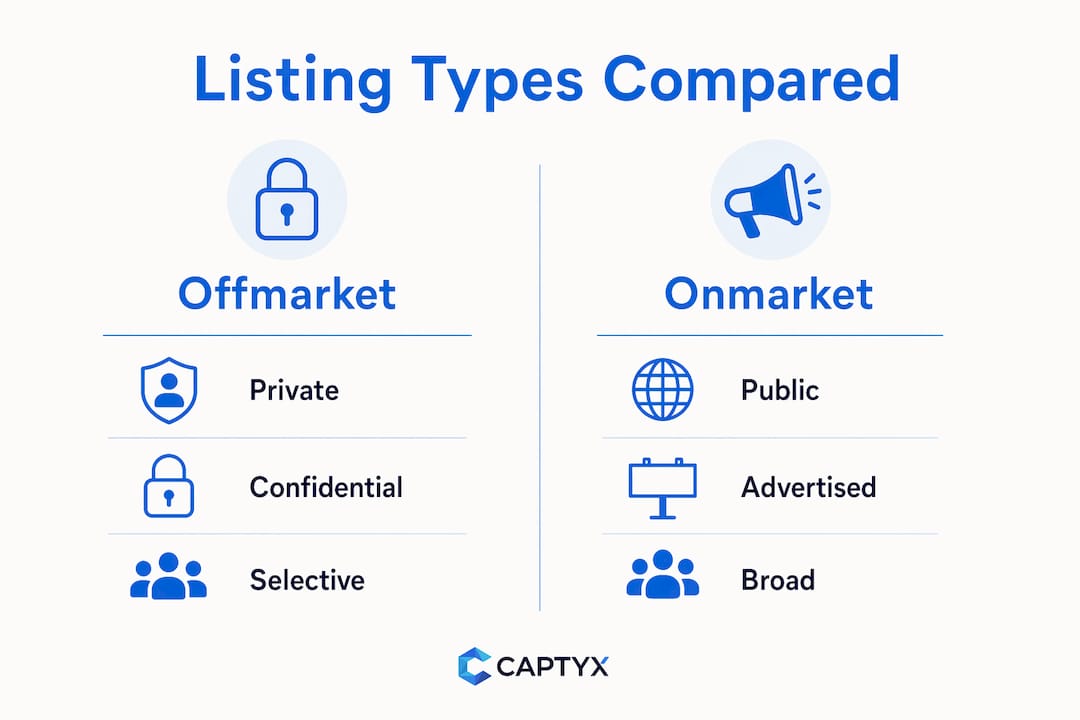
An offmarket business listing is a business available for sale that is not publicly advertised on common marketplaces or broker listing sites. The industry term for this practice is “proprietary deal sourcing,” and it covers any transaction where a seller engages buyers directly, through a trusted advisor, or via a private network rather than a public listing. These deals never appear on platforms like BizBuySell or similar business-for-sale directories. Buyers who access them gain a structural advantage: less visible competition, more flexible pricing conversations, and a seller who is often more motivated to negotiate. For sellers, the benefit is confidentiality. Employees, customers, and competitors stay unaware that the business is on the market.
What is an offmarket business listing and why does it matter?
An offmarket business listing is defined by what it lacks: a public price tag, a formal information memorandum distributed to strangers, and an open auction process driven by broker commissions. That absence creates a fundamentally different deal environment for both sides.

Sellers who choose this path protect their business from the disruption that public listings cause. Staff morale drops when employees learn a business is for sale. Key customers start exploring alternatives. Suppliers tighten credit terms. An offmarket sale avoids all of that. The business continues operating normally while a quiet process runs in the background.
Buyers benefit because offmarket deals allow negotiation without an anchored listing price or broker-driven auction dynamics. When a seller has not committed to a public asking price, the conversation starts from a different place. Both parties can structure terms around what actually works rather than defending a number posted online.
The parties typically involved are the business owner, a trusted M&A advisor or business broker, and a small group of pre-qualified buyers. Captyx, which has sold over 225 businesses using proprietary systems, operates primarily in this space. The firm’s approach centers on preparing businesses for sale before any buyer conversation begins, which is exactly the kind of preparation that offmarket deals reward.
Why offmarket business sales give buyers and sellers an edge
Offmarket business sales produce advantages that public listings structurally cannot replicate. The key benefits break down differently depending on which side of the table you sit on.
For sellers, the core advantages are:
- Confidentiality. The sale stays private until a deal is signed. Employees, customers, and competitors learn nothing until you choose to tell them.
- Control over the buyer pool. You decide who receives information about your business. You are not handing a prospectus to every tire-kicker who fills out an online form.
- Negotiation flexibility. Without a public asking price, you can test buyer interest and adjust terms based on real feedback rather than defending an arbitrary number.
- Preserved business value. A business that keeps operating without disruption during the sale process is worth more at closing than one where staff turnover and customer anxiety have already set in.
For buyers, the advantages are equally real:
- Less visible competition. Offmarket opportunities attract fewer buyers by definition. You are not competing against 40 other bidders in a formal process.
- Better pricing potential. Owners open to selling but not publicly listing often accept terms that a competitive auction would never produce.
- Direct seller access. You speak with the owner, not a broker managing a process designed to extract the highest price from you.
Pro Tip: If you are a buyer, always ask your M&A advisor whether they have offmarket opportunities before you start browsing public listings. The best businesses rarely appear online.
One critical misconception to address: offmarket does not mean no competition. Multiple buyers can pursue a strong offmarket business once a seller decides to engage. The competition is just less visible. That is why preparation and speed matter as much in offmarket deals as in public ones.
How to find offmarket listings: proven sourcing strategies
Finding offmarket business opportunities requires a system, not luck. Proactive and systematic outreach is the defining factor that separates buyers who close deals from those who spend years searching. The goal is to reach business owners before they decide to list publicly, which means building relationships before a transaction is even on their radar.
Here is a practical framework for sourcing offmarket deals:
- Build a target list. Identify the industries, revenue ranges, and geographies that match your acquisition criteria. Use business databases, LinkedIn, and industry association directories to compile a list of potential targets.
- Contact business brokers directly. Ask brokers specifically for “fixer” deals, pre-market opportunities, or businesses where the owner has expressed interest in selling but has not yet listed. Brokers often know about these situations months before a formal listing appears.
- Reach out to owners directly. A well-crafted letter or email to a business owner explaining your interest and qualifications is more effective than most buyers expect. Many owners have considered selling but never took the first step. You can be that first step. Captyx’s guide on approaching business owners covers exactly how to frame this conversation.
- Tap niche networks. Industry associations, trade shows, and professional groups are where owners talk candidly about their plans. A conversation at an industry event can surface an offmarket opportunity that no database would ever reveal.
- Monitor transition signals. Watch for signs that an owner may be ready to sell: retirement announcements, leadership changes, business pivots, or declining trade show presence. These signals often precede a sale by 12–24 months.
- Maintain consistent follow-up. Most offmarket deals do not close on the first contact. A structured outreach cadence, with follow-ups spaced over months, keeps you top of mind when an owner is finally ready to move.
Strong offmarket sourcing programs rely on list-building, qualification, outreach cadence, and conversion steps. Relationships matter, but they are not enough on their own. The system is what produces consistent deal flow.
Pro Tip: Set a calendar reminder to follow up with every owner contact every 90 days. Timing is everything in offmarket deals, and the buyer who stays in touch is the one who gets the call when the owner is ready.
The same principles apply in offmarket real estate. Real estate offmarket deals rely on network connections, direct outreach, and specialized platforms to uncover opportunities before public listing. The business acquisition world works the same way. For a detailed playbook, Captyx’s resource on finding offmarket businesses covers the full process.
Offmarket vs. on-market listings: what buyers and sellers need to know
An on-market business listing is one that has been formally prepared for sale, assigned a public asking price, and marketed through broker channels or business-for-sale platforms. On-market listings require formal preparation including broker commissions, information memoranda, and public marketing. That process filters the seller pool toward owners with specific price expectations and the willingness to run a competitive process.
The table below shows the key differences between the two approaches:
| Factor | Offmarket listing | On-market listing |
|---|---|---|
| Visibility | Private, invitation-only | Public, open to all buyers |
| Competition | Lower visibility, but still present | High, often auction-style |
| Pricing | Flexible, no anchored asking price | Fixed public asking price |
| Confidentiality | High | Low to moderate |
| Deal speed | Slower to initiate, faster to close | Faster to initiate, slower to close |
| Broker involvement | Optional or minimal | Standard, with formal commissions |
| Seller motivation | Often exploratory or motivated | Committed to a formal process |
Neither approach is universally better. Combining offmarket outreach with broker relationships and on-market sources produces the best results for both acquisition speed and deal quality. Offmarket deals tend to yield better terms over the long term. On-market broker listings fulfill faster acquisition needs when timing is critical.
The practical implication for buyers is to run both tracks simultaneously. Maintain active relationships with brokers who specialize in your target industry while also running a direct outreach program to business owners. The two approaches feed each other. A broker who knows your criteria will often share offmarket opportunities before they list them publicly.
How to maximize exit value with an offmarket selling strategy
Offmarket selling gives owners the most control over their exit. That control translates directly into a higher sale price when the process is managed well.
The first step is preparation. A business that enters an offmarket process without clean financials, documented systems, and a clear value narrative will underperform. Buyers who engage offmarket are sophisticated. They will find every weakness in your business during due diligence, and they will use those weaknesses to reduce the price. Captyx’s approach to increasing business sale price starts with fixing those weaknesses before any buyer conversation begins.
Best practices for maximizing exit value through an offmarket sale:
- Qualify buyers before sharing financials. Require a signed non-disclosure agreement and a brief buyer profile before you share any sensitive information.
- Control the narrative. Prepare a clear, honest summary of your business’s strengths, growth opportunities, and competitive position. Do not leave buyers to draw their own conclusions.
- Create competitive tension without a public auction. Engage two or three qualified buyers simultaneously. Even in an offmarket process, the knowledge that other buyers are interested motivates faster decisions and better offers.
- Time the sale strategically. Businesses sell for more when revenue is growing and the market is favorable. Timing directly affects sale outcomes, and an offmarket process gives you the flexibility to choose your moment rather than reacting to market conditions.
- Use an experienced advisor. An M&A advisor who has run offmarket processes knows how to manage buyer conversations, maintain confidentiality, and close deals at full value.
Offmarket sourcing is not synonymous with hidden or irregular deals. Normal due diligence, contract verification, and legal review remain required. The process is private, not informal.
Key Takeaways
Offmarket business listings give sellers confidentiality and negotiation control while giving buyers access to deals that never reach public marketplaces, and a systematic outreach program is the only reliable way to source them consistently.
| Point | Details |
|---|---|
| Definition is clear | An offmarket listing is a business for sale not advertised on public platforms or broker sites. |
| Competition still exists | Multiple buyers can pursue the same offmarket deal once a seller engages, so speed matters. |
| Sourcing requires a system | List-building, outreach cadence, and follow-up produce deal flow; relationships alone do not. |
| Sellers gain the most control | Offmarket selling protects confidentiality and allows sellers to time and structure the deal. |
| Both approaches work together | Combining offmarket outreach with broker relationships produces the best acquisition results. |
The patience problem most buyers ignore
The single biggest mistake I see buyers make in offmarket sourcing is treating it like a search rather than a sales process. They build a list, send a few emails, get no response, and conclude that offmarket deals are a myth. They are not. They just require a different mindset.
Multi-channel outreach and relationship cultivation often take 6–12 months before formal due diligence begins. That timeline shocks most buyers who are used to browsing a listing site and submitting an offer within a week. But the buyers who commit to that timeline are the ones who close the best deals. The patience is the competitive advantage.
What I have found works in practice is treating offmarket sourcing like a sales pipeline. You track every contact, every follow-up, and every conversation. You qualify relentlessly. Most owners you contact will not be ready to sell for months or years. That is fine. The goal is to be the first call they make when they are ready.
The other mistake is going offmarket without preparation. Sellers who enter a private process without clean books and a clear story waste everyone’s time, including their own. The offmarket environment rewards preparation more than the public market does, because sophisticated buyers have no competing bids to push them forward. They will walk away from a messy deal faster than a buyer in a competitive auction would.
My honest advice: if you are a seller, spend three to six months preparing your business before you approach a single buyer. If you are a buyer, build your outreach system now and commit to running it for at least a year. The deals are there. The process just demands more from you than a public listing does.
— Tucker
How Captyx helps you work the offmarket advantage
Captyx has built the systems that most business brokers and M&A advisors use to prepare businesses for sale. With over 225 completed transactions, including businesses Captyx has owned and sold itself, the firm brings a seller’s perspective to every engagement.

For sellers, Captyx runs a structured preparation process that addresses the exact weaknesses buyers use to reduce prices. For buyers, the firm’s done-for-you deal sourcing service handles the outreach, qualification, and pipeline management that most buyers lack the time to run themselves. Whether you are preparing for an exit or searching for your next acquisition, start with a free business valuation to understand where you stand before the first conversation begins.
FAQ
What is an offmarket business listing in simple terms?
An offmarket business listing is a business for sale that is not advertised publicly on listing platforms or broker sites. The sale happens through private networks, direct outreach, or trusted advisors.
Are offmarket business deals legal?
Offmarket deals are fully legal. Normal due diligence, contract review, and legal verification are still required, just as they are in any public transaction.
How long does it take to find an offmarket business opportunity?
Consistent offmarket deal flow typically requires 6–12 months of systematic outreach before due diligence begins. Buyers who treat it as a structured pipeline process close deals faster than those who rely on passive networking.
Do offmarket sellers get a lower price than on-market sellers?
Not necessarily. Sellers who prepare their business properly and create competitive tension among a small group of qualified buyers can achieve prices equal to or better than a public process, without the disruption a public listing causes.
What is the difference between offmarket and on-market business sales?
On-market sales use public listings, formal broker processes, and open competition. Offmarket sales are private, involve fewer buyers, and offer more flexible deal structures for both sides.
Recommended
- How to Find Offmarket Businesses for Sale in 2026
- COMMERCIAL PEST CONTROL SERVICE COMPANY – Top Way to Sell a Business | Captyx
- RESIDENTIAL & COMMERCIAL PLUMBING COMPANY – Top Way to Sell a Business | Captyx
- RESIDENTIAL HVAC COMPANY WITH 4,000+ MAINTENANCE CONTRACTS – Top Way to Sell a Business | Captyx


