


TL;DR:
- Selling a business quietly involves conducting an off-market, confidential transaction that safeguards value and operational stability. Owners choose this approach primarily to avoid market disruptions, protect their legacy, and reduce emotional pressure during the sale process. Effective preparation, legal safeguards, and trusted buyer networks are essential for a successful discreet sale.
Selling a business quietly is defined as conducting a private, off-market transaction designed to maximize value while limiting public exposure and operational disruption. The industry term for this is a confidential business sale, and it is far more common than most owners realize. Understanding how business owners decide to sell quietly means recognizing that the decision is rarely just financial. It is psychological, strategic, and deeply personal. This guide breaks down the real motivations, the practical steps, and the legal guardrails that make a discreet sale work.
What motivates business owners to choose a quiet sale?
The most common driver behind a private business sale is fear. Not fear of failure, but fear of what public exposure will cost before a deal even closes. When employees hear rumors of a sale, top performers start updating their resumes. When competitors catch wind, they use the uncertainty to poach clients. When vendors find out, payment terms tighten. A public sale announcement can trigger all three problems simultaneously, often before a single qualified buyer has signed an NDA.
Beyond operational risk, there is a deeper psychological layer. Research shows that decision fatigue and identity fusion complicate exit decisions for many owners. When your business is also your identity, the act of selling feels like a personal loss. That emotional weight causes owners to delay, hedge, or avoid the process entirely. A quiet sale reduces the psychological pressure by keeping the process contained and controlled.
Owners who choose discretion also tend to be protecting something beyond the balance sheet. They want to preserve company culture, protect long-term employees, and maintain the legacy they built. A loud, public auction process can strip all of that away in weeks.
“The owners who get the best outcomes are the ones who treat the sale like a confidential project, not a public announcement.” This mindset shift is what separates sellers who close strong from those who watch their value erode during the process.
Key motivations for choosing a quiet sale include:
- Employee stability: Keeping sale plans confidential prevents workforce disruption and maintains operational continuity.
- Competitive protection: Competitors cannot exploit uncertainty they do not know exists.
- Negotiation control: A limited buyer pool gives the seller more leverage over deal terms.
- Legacy preservation: Owners can vet buyers for cultural fit, not just price.
- Psychological comfort: A private process reduces the emotional exposure that causes decision paralysis.
How do business owners prepare and execute a private sale?
Preparation is where most quiet sales either succeed or collapse. The process follows a clear sequence, and skipping steps is the fastest way to lose both confidentiality and value.
-
Get a confidential valuation first. Before any buyer conversation, you need to know what your business is worth. Confidential valuations with professional guidance give you a defensible number and prevent you from anchoring too low or too high in early discussions. This step also forces you to see your business through a buyer’s eyes, which is often clarifying.
-
Select a discreet advisor or broker. Not every broker operates with the same confidentiality standards. Look for advisors who specialize in off-market deals and have a documented process for screening buyers before sharing any business information. Captyx, for example, has built systems specifically designed to protect seller identity throughout the process.
-
Use off-market channels. Quiet sales do not appear on business listing platforms. Instead, they move through trusted networks, direct outreach to pre-qualified buyers, and private equity relationships. Quiet marketing through owned channels like curated email lists and professional networks attracts serious buyers without broadcasting intent.
-
Control internal communications. Decide in advance who inside your organization needs to know, and when. Most owners tell no one until a letter of intent is signed. If you must involve a key employee, use a confidentiality agreement before the conversation.
-
Break the process into discrete steps. Stepwise exit planning reduces the overwhelm that causes owners to stall. Instead of thinking about “selling the business,” think about completing the next single task: getting a valuation, then identifying three potential buyers, then drafting an NDA template.
Pro Tip: If you are a quieter, more introverted owner, use that as an asset in negotiations. Strategic silence and deep listening reveal buyer positions without giving away your own. Introverted negotiators who are willing to pause and wait consistently extract better terms than those who fill every silence with concessions.
The preparation phase typically takes 60–120 days for a small to mid-sized business. Rushing it is one of the most common and costly mistakes sellers make.

Quiet vs. public sale: which produces better value outcomes?
The assumption that a public sale generates more competition and therefore a higher price is not always correct. The quality of buyers matters more than the quantity.
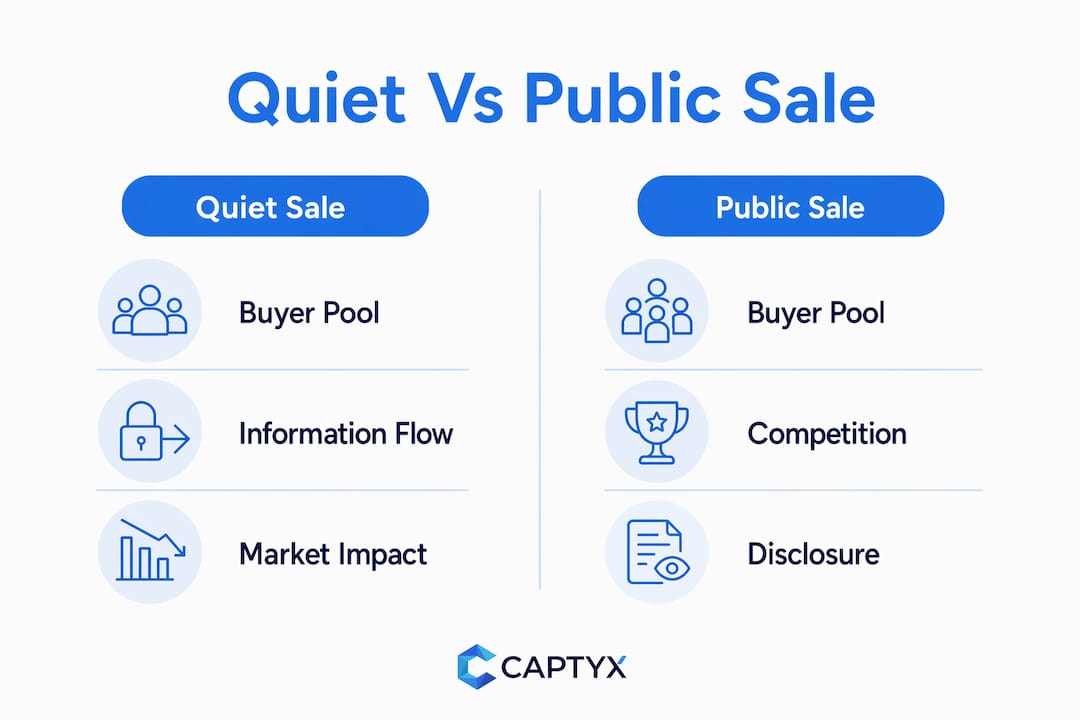
| Factor | Quiet sale | Public sale |
|---|---|---|
| Buyer pool | Small, pre-qualified | Large, mixed quality |
| Confidentiality | High | Low to none |
| Negotiation leverage | Seller-controlled | Buyer-competitive |
| Employee disruption risk | Low | High |
| Time to close | Moderate | Often longer |
| Price erosion risk | Low | Moderate to high |
A discreet sale attracts qualified buyers and avoids the market disturbances that lower perceived value. When a business sits on a public listing for months without closing, buyers start to wonder what is wrong with it. That stigma is nearly impossible to reverse.
Public sales do have a place. If your business is in a hot sector with multiple strategic acquirers competing for market share, a controlled auction process can drive price up significantly. But for most small to mid-sized owners, the risks of public exposure outweigh the theoretical upside of a broader buyer pool.
Pro Tip: Before deciding between a quiet and public process, ask your advisor to identify the top five most likely buyers for your business. If those five buyers can be approached directly and confidentially, a quiet sale almost always produces a better outcome.
The value of your business is not fixed. It is shaped by how the sale process is managed. A poorly run public process can reduce a business’s perceived value by 15–25% before a single offer is made.
What legal and confidentiality steps protect a quiet sale?
Legal protection is not optional in a private sale. It is the infrastructure that makes discretion possible.
The core legal tools for business sale confidentiality include:
- Non-disclosure agreements (NDAs): Every potential buyer signs an NDA before receiving any financial information. The NDA should cover not just financials but also the fact that the business is for sale at all. NDAs and communication protocols are the standard first line of defense in any confidential transaction.
- Teaser documents: Instead of sharing a full information memorandum upfront, use a one-page teaser that describes the business in general terms without identifying it. Only buyers who sign the NDA receive the full package.
- Buyer screening: Qualify buyers financially before any substantive conversation. A buyer who cannot demonstrate funding capacity should not receive confidential business information.
- Vendor and customer communication controls: Instruct your advisor to avoid any outreach that could reach your existing vendors or customers. Leaks through supply chain contacts are more common than most owners expect.
- Employee communication timing: Plan the exact moment and message for employee disclosure. This should happen after a letter of intent is signed and due diligence is underway, not before.
Tax planning is also part of the confidential sale process. Working with a qualified accountant early, particularly one experienced with professional service firm exits, can materially affect your net proceeds without requiring any public disclosure.
The legal framework for a quiet sale does not need to be complicated. The goal is controlled information flow at every stage, with written agreements governing who knows what and when.
Key Takeaways
Selling a business quietly requires confidential preparation, a pre-qualified buyer network, and legal controls that protect both value and operational stability throughout the process.
| Point | Details |
|---|---|
| Start with a confidential valuation | Know your number before any buyer conversation to anchor negotiations effectively. |
| Use off-market buyer channels | Pre-qualified buyers through private networks produce better outcomes than public listings. |
| NDAs protect more than financials | Require NDAs that cover the existence of the sale, not just the business data shared. |
| Stepwise planning reduces paralysis | Breaking the process into single tasks overcomes the decision fatigue that delays most exits. |
| Quiet sales often outperform public ones | Controlled buyer pools and limited exposure reduce price erosion and preserve negotiation leverage. |
What I have learned from watching owners sell quietly
I have worked through enough of these transactions to say this plainly: the owners who struggle most with a quiet sale are not the ones who lack strategy. They are the ones who have not separated their identity from their business.
When you have built something for 10 or 20 years, the idea of handing it to someone else feels like losing a part of yourself. That feeling is real, and it causes owners to stall, over-negotiate on minor points, or sabotage deals at the finish line without realizing it. I have seen it happen more than once.
The owners who close well are the ones who reframe the sale as a transition, not an ending. They treat the quiet process as a way to protect what they built, not hide it. They use the confidentiality not out of shame but out of strategy.
One thing I consistently tell owners: your introversion or your preference for privacy is not a weakness in this process. It is an advantage. The ability to sit with silence, to listen more than you speak, and to walk away from a bad offer without emotional reaction is exactly what good deal-making requires. Most buyers expect sellers to be anxious and eager. When you are neither, the dynamic shifts in your favor.
The practical advice is simple. Start earlier than you think you need to. Get a valuation before you are ready to sell. Build the process one step at a time. And find an advisor who treats your confidentiality as a non-negotiable, not an afterthought.
— Tucker
How Captyx supports your confidential sale
Captyx has built the systems and processes that most brokers and M&A advisors use to prepare businesses for sale. With over 225 completed transactions, including businesses Captyx has owned and sold itself, the firm brings a seller’s perspective to every engagement.

For owners considering a quiet sale, Captyx provides confidential valuations, off-market buyer introductions, and negotiation support designed to protect both your identity and your price. The process is built around real-time buyer feedback, which means your business is positioned based on what actual buyers respond to, not guesswork. If you are ready to explore your options without going public, explore Captyx’s M&A advisory services or review whether a broker is right for your situation before making any decisions.
FAQ
What does it mean to sell a business quietly?
Selling a business quietly means conducting a confidential, off-market sale where the business is not publicly listed and only pre-screened buyers are approached. The goal is to protect value, maintain operational stability, and control the narrative throughout the transaction.
Why do owners choose a private sale over a public listing?
Owners choose private sales to prevent employee uncertainty, protect competitive position, and maintain negotiation leverage. Public exposure before a deal closes can reduce perceived business value and trigger staff or client departures.
How do you find buyers for a quiet business sale?
Buyers for quiet sales come through trusted advisor networks, direct outreach to pre-qualified strategic buyers, and private equity relationships. A discreet broker with an established buyer network is the most reliable way to identify serious, qualified buyers without public advertising.
What legal protections are required in a confidential sale?
NDAs are the minimum legal requirement before sharing any business information with a potential buyer. The NDA should cover both financial details and the fact that the business is for sale, preventing buyers from disclosing the opportunity to competitors or the market.
How long does a quiet business sale typically take?
A confidential sale for a small to mid-sized business typically takes 6–12 months from initial valuation to closing. Preparation, including avoiding common sale mistakes, accounts for the first 60–120 days and has the greatest impact on final sale price.


