


TL;DR:
- Industry consolidation offers small business owners buy opportunities by enabling rapid revenue growth and market dominance. Strategic acquisitions, supported by creative deal structures and non-labor synergies, can double revenue and improve margins within months. Successful consolidators treat deals as redesign projects, prioritize synergy planning, and build relationships to secure off-market opportunities.
Industry consolidation creates buy opportunities by letting entrepreneurs acquire competitors, gain their customers, and grow revenue far faster than organic methods allow. A single acquisition can double revenue overnight while simultaneously eliminating a rival and inheriting their pre-trained workforce. The formal term for this strategy is acquisitive growth through market consolidation, and it sits at the core of how private equity firms have built dominant positions in fragmented industries for decades. Small business owners now have access to the same playbook, backed by SBA expansion loans, creative deal structures, and a growing supply of businesses for sale as baby boomer owners retire.
How industry consolidation creates buy opportunities for small business owners
The core financial case for acquisitive growth is straightforward. Organic revenue growth in most small businesses runs at 10–15% annually. Acquiring a direct competitor can double revenue in a single transaction, compressing years of growth into months. That math alone explains why consolidation strategies attract serious entrepreneurs.
The strategic benefits extend well beyond the revenue line:
- Workforce acquisition. You inherit trained employees, removing the cost and delay of recruiting and onboarding from scratch.
- Pricing power. Fewer competitors in your market means less pressure to discount. Margins expand without changing a single internal process.
- Supplier leverage. Combined purchasing volume gives you negotiating power that neither business had independently.
- Shared overhead. Two businesses running on one set of back-office systems, insurance policies, and technology licenses cost less per dollar of revenue than two separate operations.
- Market share. You absorb the acquired firm’s customer base immediately, rather than winning those clients one by one.
Fragmented industries are the best hunting grounds. Home services, landscaping, HVAC, accounting, physical therapy, and specialty trucking all feature hundreds of small operators with no dominant player. These markets reward the first consolidator who moves with discipline. SBA expansion loans, which offer 0% down payment options and long amortization terms, make entry accessible even for buyers without deep capital reserves.
What are the financial benefits of acquiring competitors during consolidation?

Strategic acquisitions restructure competitive advantage. They do not simply add revenue. They leverage complementary assets and operational scale in ways that change your market position permanently.
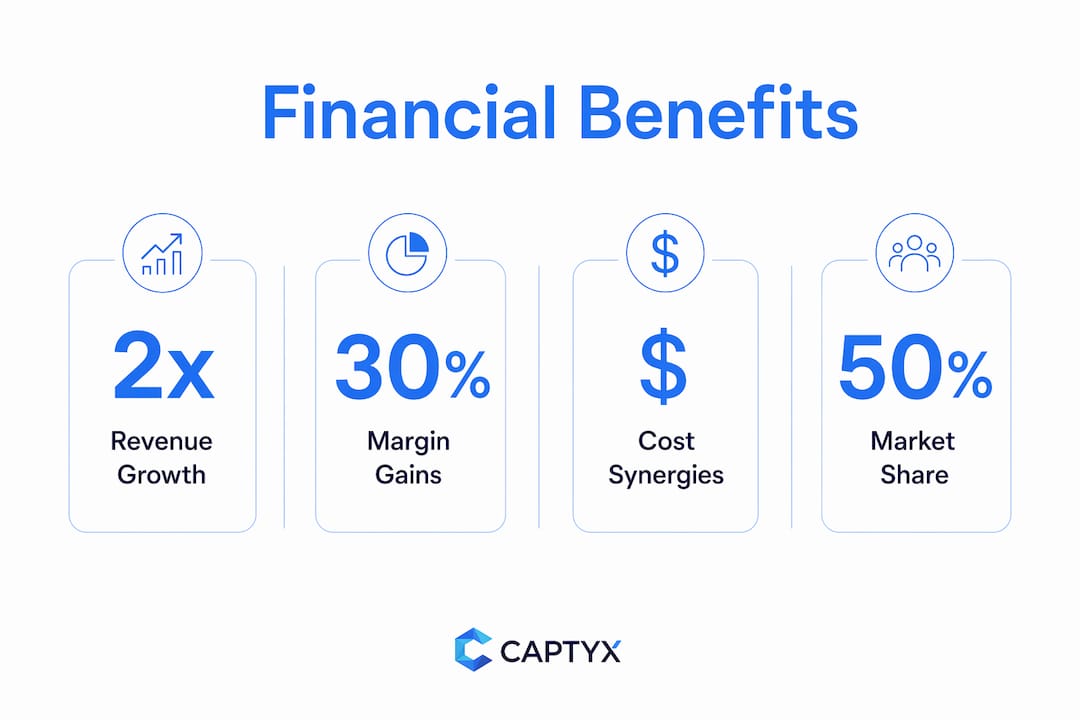
This is why buyers often pay a strategic premium above a business’s standalone valuation. A strategic premium reflects the value created after ownership transfers, including pricing power and operational efficiencies that only exist once the two businesses combine. Paying above market value is rational when the combined entity generates returns the seller could never achieve alone.
Synergies fall into three categories:
- Cost synergies. Eliminating duplicate expenses: software subscriptions, office leases, redundant staff roles, and overlapping vendor contracts.
- Revenue synergies. Cross-selling your existing services to the acquired firm’s customer base, or entering new geographies the seller already serves.
- Capital synergies. Combining balance sheets to access better financing terms, higher credit lines, or more favorable insurance rates.
Strategic buyers consistently outperform financial buyers because they build synergy muscle through repeated deal execution. That muscle means precisely identifying which synergies are real, articulating them in dollar terms before signing, and executing integration with a clear sequence. Buyers who skip this step pay strategic premiums and then fail to capture the value that justified the price.
Pro Tip: Before you sign a letter of intent, write down every synergy you expect, assign a dollar value to each, and set a realistic timeline for capture. If the numbers do not justify the premium on paper, they will not justify it after closing either.
Disciplined synergy delivery requires quantifying value capture estimates and sequencing implementation realistically. Buyers who skip this step often destroy value after paying a premium, because integration costs exceed the savings they assumed.
What are the fastest synergy wins beyond labor cuts in small business deals?
The instinct to cut headcount immediately after an acquisition is common and almost always wrong. Cutting people early harms operations, damages customer relationships, and destroys the workforce value you just paid to acquire. Non-labor synergies are faster to realize, less risky, and more durable.
The best non-labor synergy opportunities in small business consolidations include:
- Software consolidation. Two businesses rarely need two project management tools, two CRM systems, or two accounting platforms. Canceling duplicate subscriptions produces savings within 30 days of closing.
- Vendor renegotiation. Combined purchasing volume justifies renegotiating supplier contracts immediately. Vendors respond to volume. A single conversation can cut input costs by a meaningful percentage.
- Insurance consolidation. Combining two policies into one often reduces total premiums while improving coverage terms.
- Process standardization. Applying your best operational processes to the acquired business eliminates inefficiency without touching headcount.
- Facility rationalization. If both businesses operate from separate locations with overlapping service areas, consolidating into one reduces rent, utilities, and equipment costs.
Non-labor synergies deliver early wins within 30–90 days of closing, preserving key employees while improving margins. That timeline matters because early wins build internal confidence in the integration and demonstrate to the acquired team that the new ownership is competent and organized.
Pro Tip: Build a 90-day integration checklist before you close. Assign an owner to each non-labor synergy item and set a specific dollar target. Checklists convert good intentions into captured savings.
Maximizing M&A value requires transformational integration rather than incremental cost cutting. The buyers who win long-term treat integration as a redesign of the combined business, not a merger of two unchanged operations.
How does the current market affect small business acquisition opportunities?
The acquisition market in 2026 is active and competitive. 32% of buyers report more competition for deals than the prior year. That pressure comes from two directions: more buyers chasing quality businesses, and sellers with valuation expectations that do not always match market realities.
The supply side is improving. 46% of buyers expect more businesses to hit the market as baby boomer owners retire, a trend widely called the Silver Tsunami. More sellers means more opportunities, but only for buyers who are prepared to move quickly and structure deals creatively.
The friction points are real. Sellers cite valuation gaps as the primary obstacle in 68% of deals, while financing availability creates friction in 54% of transactions. Creative deal structures close that gap:
- Seller notes. The seller finances a portion of the purchase price, reducing the cash required at closing. Used in 34% of deals.
- SBA-backed loans. Government-backed financing with favorable terms, used in 27% of small business acquisitions.
- Earn-outs. A portion of the purchase price is paid based on future performance, bridging the gap between what the seller expects and what the buyer can justify. Used in 22% of deals. Understanding how earn-outs work before you negotiate one is non-negotiable.
Buyers competing in intense markets must differentiate with speed and relationships rather than price alone. Sellers frequently choose buyers they trust over buyers who offer marginally more money. Building relationships with business owners before they formally list for sale gives you access to off-market deals where competition is lower and pricing is more rational. Avoid common mistakes in small business deals by understanding seller psychology as well as you understand the financials.
Key Takeaways
Industry consolidation creates buy opportunities that compound: each acquisition expands pricing power, workforce capacity, and market share simultaneously, making the next deal easier to justify and execute.
| Point | Details |
|---|---|
| Revenue acceleration | Acquiring a competitor can double revenue in one transaction versus 10–15% annual organic growth. |
| Strategic premium discipline | Pay above standalone value only when synergies are quantified and sequenced before signing. |
| Non-labor synergies first | Target software, vendors, and processes within 30–90 days to capture savings without harming operations. |
| Creative deal structures | Seller notes, earn-outs, and SBA loans close valuation gaps in the majority of competitive deals. |
| Relationship-driven sourcing | Off-market deals offer lower competition and better pricing for buyers who build seller relationships early. |
The consolidation trap most buyers walk right into
Most entrepreneurs I work with arrive at their first acquisition with the same assumption: buy the business, merge the teams, cut the overlap, and watch the profits grow. That logic sounds clean. In practice, it produces mediocre results about two-thirds of the time.
The trap is confusing consolidation with transformation. Consolidating two businesses into one is the beginning of the work, not the end. The buyers who build real competitive advantages treat the acquisition as a redesign opportunity. They ask which processes from each business are actually best-in-class, then build a new operating model from those pieces. That takes more effort than simply merging org charts, but it produces a business worth far more than the sum of its parts.
The second mistake I see constantly is paying a strategic premium without a written synergy plan. A premium is only rational when you can name the specific value you will create and when you will capture it. Vague assumptions about “operational efficiencies” are not a plan. They are a way of convincing yourself to overpay.
My advice to any entrepreneur entering a consolidation strategy: build your synergy model before you build your offer. Know your 30-day wins, your 90-day wins, and your 12-month targets. Then structure the deal so the seller shares some of the risk through an earn-out or seller note if the synergies do not materialize on schedule. That discipline protects your capital and keeps you honest about what you are actually buying.
— Tucker
Captyx helps buyers find and win consolidation deals
Finding the right acquisition target is harder than most buyers expect. The best businesses rarely appear on public listing sites. They sell through relationships, referrals, and advisors who know which owners are ready to exit before they formally announce it.

Captyx has advised on over 225 business transactions, including acquisitions in fragmented industries where consolidation creates the clearest advantages. The team knows how brokers find off-market deals and how to structure offers that win in competitive situations. Whether you need help identifying targets, modeling synergies, or negotiating deal terms, Captyx brings the same systems and buyer-side experience that have closed deals across dozens of industries. If you are ready to build an acquisition pipeline, Captyx M&A advisory services are the right starting point.
FAQ
How does industry consolidation create buy opportunities?
Industry consolidation creates buy opportunities by producing motivated sellers, fragmented markets with no dominant player, and conditions where a single acquisition can double revenue while eliminating a competitor. Buyers who move with discipline and creative deal structures gain outsized advantages.
What is a strategic premium in an acquisition?
A strategic premium is the amount a buyer pays above a business’s standalone value, justified by synergies that only exist after the two businesses combine, such as pricing power, shared overhead, and expanded market share.
What are non-labor synergies in small business M&A?
Non-labor synergies are cost savings from consolidating software subscriptions, renegotiating vendor contracts, combining insurance policies, and standardizing processes. These savings typically appear within 30–90 days of closing without requiring layoffs.
What deal structures help buyers close in a competitive market?
Seller notes, SBA-backed loans, and earn-outs are the three most common tools. Seller notes appeared in 34% of deals, SBA financing in 27%, and earn-outs in 22%, according to recent buyer trend data.
How do I find businesses to acquire before they are publicly listed?
Off-market deals come through broker relationships, industry networks, and direct outreach to business owners in fragmented sectors. Working with an experienced M&A advisor gives buyers access to sellers who have not yet formally listed their businesses.
Recommended
- Construction & Manufacturing Businesses for Sale | Top Way to Sell a Business | Captyx
- Industries Poised for High Business Sale Value in 2026 | Captyx
- Buy a Business with Captyx – Top Way to Sell a Business | Captyx
- Active Buyer Mandates | Businesses Sought by Industry & State – Top Way to Sell a Business | Captyx


