


TL;DR:
- Leveraged buyouts use mostly borrowed money secured against the company’s assets, affecting seller payouts and risks. Sellers face risks from high leverage, uncertain earnouts, and deferred payments, which depend on buyer decisions during ownership. Proper analysis of deal terms, valuation, and financing layers is essential for sellers to maximize value and avoid unfavorable outcomes.
A leveraged buyout (LBO) is an acquisition where a buyer uses mostly borrowed money to purchase a company, securing that debt against the target’s own assets and cash flows. For sellers, understanding how leveraged buyouts work is the difference between walking away with maximum proceeds and leaving significant money on the table. Private equity firms typically contribute only 20%–40% equity in an LBO, with 60%–80% funded by debt. That debt ratio shapes every dollar you receive at closing. Bain & Company reports global PE buyouts average 5.6x debt/EBITDA leverage, with middle market deals ranging 4.0x–6.5x depending on industry. Knowing where your business sits in that range tells you how much a buyer can realistically offer.
How does the capital structure in an LBO affect sellers?
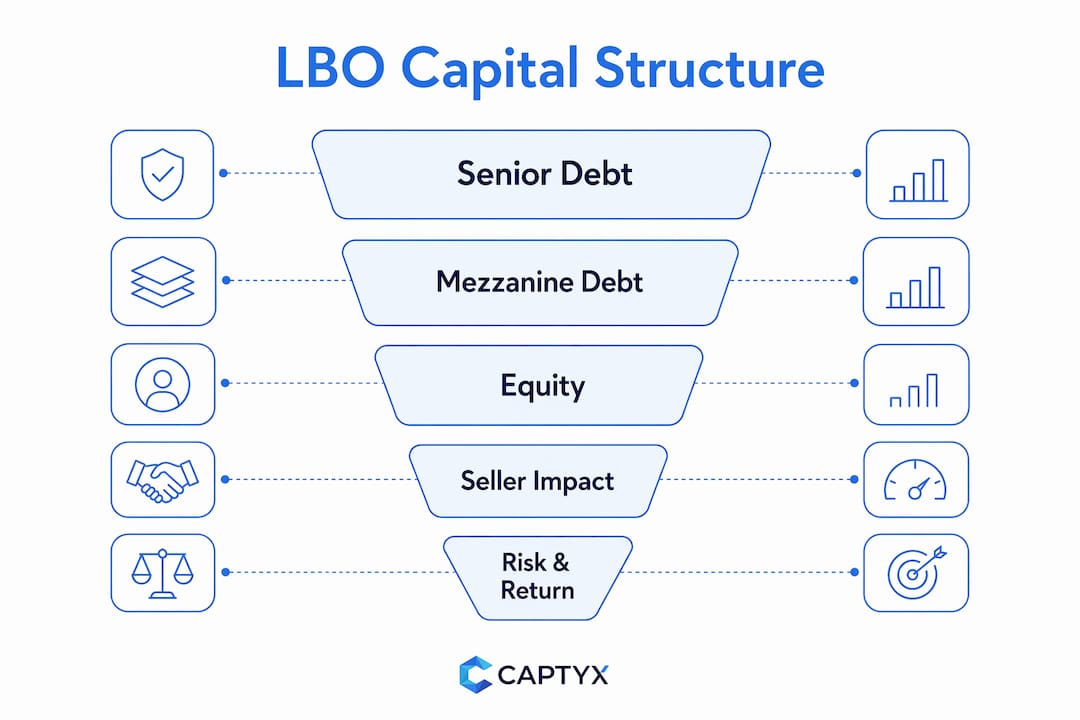
The capital structure of an LBO directly determines how much cash you receive at closing and how much gets deferred. Three layers of financing stack on top of each other, and each one affects your payout differently.

Senior debt sits at the top of the stack. It carries the lowest interest rate but holds the first claim on assets if the business fails. Senior lenders scrutinize your cash flow closely because their repayment depends on it.
Subordinated or mezzanine debt fills the gap between senior loans and equity. It carries higher interest rates to compensate for its lower repayment priority. Sellers sometimes provide a portion of this layer themselves through a seller note.
Equity is what the private equity firm contributes directly. This is the residual claim after all debt is repaid. If you roll over equity into the new structure, your future payout comes from this layer.
| Capital layer | Typical share of deal | Seller impact |
|---|---|---|
| Senior debt | 40%–60% of deal value | Limits buyer’s offer ceiling; first repaid |
| Mezzanine/subordinated debt | 10%–20% of deal value | May include seller note at below-market rates |
| Buyer equity | 20%–40% of deal value | Seller rollover equity lives here; illiquid until exit |
| Seller note (if applicable) | 5%–15% of deal value | Deferred cash; subordinated repayment risk |
The practical takeaway: the more debt a buyer stacks into the deal, the less equity cushion exists to protect your deferred payments. A seller note in a highly leveraged deal is a subordinated, unsecured position. That is a meaningful credit risk, not a guaranteed payment.
Pro Tip: Ask your advisor to model the deal’s debt service coverage ratio. If the business barely covers its debt payments in a base-case scenario, your seller note and earnout are at serious risk.
What risks do sellers face in leveraged buyout transactions?
Sellers often focus on the headline purchase price and underestimate the structural risks buried in the deal terms. The control paradox is the most dangerous: you bear outcome risk while the buyer controls the decisions that drive those outcomes.
The most common risks sellers face in LBO transactions include:
- Earnout risk. Buyers can make operational decisions that reduce the business’s performance without technically breaching the earnout contract. You have little recourse.
- Vendor financing risk. Vendor notes are subordinated to senior lenders and trade creditors, typically at 5%–6% interest rates that do not compensate for the unsecured credit risk.
- Covenant restrictions. Loan covenants restrict spending, investments, and strategic shifts during the PE holding period. This limits the buyer’s ability to grow the business and protect your deferred payments.
- Market risk. Economic downturns during the holding period can impair the business’s value before your rollover equity is liquidated.
“Vendor financing often misleads sellers into subordination with minimal control, risking lost capital post-sale.” — Industry expert Sean Cavanagh, as cited in analysis of earnout and vendor note structures.
Understanding how earnouts work before you sign is not optional. Sellers who treat earnouts as guaranteed deferred payments routinely discover they are contingent, controllable by the buyer, and difficult to enforce.
Pro Tip: Before accepting any earnout or vendor note, ask your attorney to identify every buyer action that could legally reduce your payout. If the list is long, negotiate a higher cash component at closing instead.
How do management rollovers and earnouts impact seller proceeds?
A management rollover means you reinvest a portion of your sale proceeds back into the new ownership structure alongside the private equity firm. Rollovers typically represent 20%–30% of the executive’s total payout, aligning your incentives with the buyer but deferring that portion of your liquidity.
Rollovers and earnouts each carry distinct tradeoffs for sellers:
- Rollover pros: Potential for a second, larger payout at the PE firm’s exit; tax deferral on the rolled portion in some structures.
- Rollover cons: Illiquid for the full holding period; value depends entirely on the buyer’s operational execution and exit market conditions.
- Earnout pros: Allows sellers to capture upside if the business outperforms post-close; can bridge valuation gaps between buyer and seller.
- Earnout cons: Performance targets are set and measured by the buyer; sellers have limited ability to influence outcomes after closing.
| Feature | Rollover equity | Earnout |
|---|---|---|
| When you get paid | At PE exit event (4–7 years) | At performance milestone dates |
| Who controls the outcome | Buyer’s operational decisions | Buyer’s operational decisions |
| Tax treatment | Often tax-deferred at rollover | Taxed as ordinary income or capital gains depending on structure |
| Liquidity | None until exit | Partial, milestone-based |
| Upside potential | High if exit multiple expands | Moderate, capped by contract |
The tax and liquidity implications deserve serious attention. A rollover that defers taxes sounds attractive, but if the PE firm exits at a lower multiple than expected, you may receive less than the cash you would have taken at closing.
What steps can sellers take to maximize value in an LBO?
Maximizing your exit value in an LBO requires preparation well before a buyer approaches you. The sellers who get the best outcomes treat the process as a negotiation on multiple dimensions, not just a price discussion.
-
Get an independent business valuation. Buyers conduct quality of earnings analysis and independent asset valuations to set their offer. You need your own analysis to counter their assumptions. Captyx provides independent business valuations that give sellers a credible baseline before any offer arrives.
-
Analyze deal terms beyond the headline price. The total consideration includes cash at closing, seller notes, earnouts, and rollover equity. Calculate the net present value of each component using realistic assumptions, not the buyer’s optimistic projections.
-
Evaluate the buyer’s financing sources. A buyer relying heavily on mezzanine debt or seller notes is a riskier counterparty than one with committed senior financing. Ask for proof of financing before you proceed.
-
Negotiate earnout definitions carefully. Define every performance metric in precise, measurable terms. Specify which buyer actions are prohibited during the earnout period. Limit the buyer’s ability to change accounting methods that affect your targets.
-
Assess rollover terms with a tax advisor. The tax treatment of a rollover depends on deal structure and jurisdiction. A qualified tax advisor can model the after-tax difference between taking cash now versus rolling equity.
-
Engage legal, financial, and tax advisors early. Due diligence in an LBO covers financial, legal, tax, and operational dimensions. Sellers who engage advisors after the letter of intent is signed are already negotiating from a weaker position.
Pro Tip: Run a “cash equivalent” comparison for every offer. Convert all deferred components to their present value using a discount rate that reflects their actual risk. A $10 million offer with $3 million in subordinated seller notes is not the same as $10 million in cash.
Understanding why business valuation matters before you enter any LBO negotiation gives you the data to push back on aggressive buyer assumptions and protect your net proceeds.
What does the LBO exit process mean for sellers who retain equity?
Sellers who roll over equity into an LBO become minority investors in a PE-owned company. Your liquidity depends entirely on when and how the PE firm exits. Holding periods average 4–7 years before an exit event occurs.
The three primary exit paths each carry different implications for rollover equity holders:
- Secondary buyout. Another PE firm acquires the business. Secondary buyouts typically yield a lower price than strategic sales but close faster due to buyer familiarity with leveraged models. Your rollover equity gets liquidated, but the multiple may disappoint.
- Strategic sale. A corporate buyer acquires the business. Strategic buyers often pay the highest multiples because they value synergies. This is the best exit scenario for rollover equity holders.
- IPO. The company goes public. This path is rare for middle market businesses and introduces a lockup period before you can sell your shares.
During the holding period, most free cash flow services the debt, not growth initiatives. That constraint limits the buyer’s ability to build value aggressively. Sellers with rollover equity should model their personal financial needs against a realistic exit timeline. If you need liquidity within three years, a 20% rollover in a highly leveraged deal is a poor fit for your financial goals.
Key Takeaways
Sellers who understand the full LBO capital structure, including debt layers, earnout mechanics, and rollover equity timelines, consistently negotiate better net proceeds than those who focus only on headline price.
| Point | Details |
|---|---|
| Debt drives the deal | PE firms fund 60%–80% of an LBO with debt, which caps the buyer’s offer and subordinates seller notes. |
| Earnouts transfer risk | Buyers control the decisions that determine earnout payouts, leaving sellers with limited recourse if targets are missed. |
| Rollovers defer liquidity | Management rollovers lock up 20%–30% of proceeds for 4–7 years, with value tied to the buyer’s exit outcome. |
| Independent valuation is non-negotiable | Sellers need their own quality of earnings analysis to counter buyer assumptions and protect deal price. |
| Cash equivalent math matters | Convert every deferred component to present value before comparing offers. A higher headline price with subordinated notes may be worth less than a lower all-cash offer. |
The number that changes everything
I have watched business owners accept LBO offers that looked great on paper and felt terrible two years later. The pattern is almost always the same: the seller focused on the total consideration number, not the risk-adjusted cash equivalent.
The most common mistake I see is treating a seller note like a bank deposit. It is not. When a buyer asks you to carry 15% of the deal as a subordinated vendor note at 5.5% interest, they are asking you to become their unsecured lender. You get paid after the bank, after trade creditors, and after anyone else with a senior claim. If the business hits a rough patch, your note is the first thing that stops paying.
Earnouts are the second trap. I have seen earnout provisions written so broadly that the buyer could legally restructure the sales team, change the pricing model, and shift product focus without technically breaching the contract. The seller’s earnout evaporated, and there was no legal remedy. The lesson: if you cannot define the earnout metric in one clear sentence and identify every buyer action that could reduce it, do not accept it.
My honest advice is to treat every dollar of deferred consideration as worth roughly half its face value until you have verified the buyer’s financing, reviewed the covenants, and had a tax attorney model the after-tax outcome. If the deal still looks good after that analysis, proceed. If it does not, walk away. There will be other buyers. There will not be another chance to undo a bad deal structure after you have signed.
— Tucker
How Captyx helps sellers navigate LBO offers
Selling a business through an LBO is one of the most complex financial transactions a business owner will face. The deal structure, the financing layers, and the deferred payment terms all require experienced analysis before you sign anything.

Captyx has advised on over 225 business sales, including LBO transactions across multiple industries. The team helps sellers get an accurate business valuation estimate before any buyer conversation begins, so you negotiate from a position of knowledge rather than assumption. Captyx also helps sellers evaluate earnout and rollover terms, identify red flags in buyer financing, and connect with qualified buyers. If you are weighing an LBO offer or want to understand your options before one arrives, working with a broker who understands deal structure is the clearest path to protecting your exit value.
FAQ
What is a leveraged buyout from a seller’s perspective?
A leveraged buyout is a sale where the buyer funds most of the purchase price with debt secured against your business’s assets and cash flows. As the seller, you receive proceeds at closing, but deal terms like earnouts and seller notes can defer a significant portion of your total payout.
How do sellers profit from an LBO?
Sellers typically receive a cash payment at closing plus potential deferred proceeds through earnouts or rollover equity. LBOs often deliver a price premium over strategic sales, but net proceeds depend heavily on how much of the deal is structured as deferred or contingent payments.
What is a seller note in an LBO?
A seller note is a loan the seller extends to the buyer as part of the deal financing. It is typically subordinated to senior lenders, carries below-market interest rates around 5%–6%, and carries meaningful repayment risk if the business underperforms post-close.
How long does a seller wait for rollover equity to pay out?
Sellers who roll over equity into an LBO typically wait 4–7 years for a liquidity event such as a secondary buyout, strategic sale, or IPO. The actual timeline depends on the PE firm’s fund cycle and market conditions at exit.
What is the biggest risk sellers face in an LBO?
The control paradox is the most significant risk: sellers bear financial exposure through earnouts and vendor notes while buyers retain full operational control over the decisions that determine those payouts. Engaging experienced legal and financial advisors before signing is the primary protection against this risk.


