


TL;DR:
- A partial business sale involves selling a percentage of ownership while the owner retains some control and involvement. It offers liquidity, continued growth upside, and strategic partnerships, but introduces governance and reporting obligations. Proper structuring, valuation, and tax planning are essential for success and alignment with long-term goals.
A partial business sale is defined as an owner selling a percentage of their business while retaining some ownership stake and, in most cases, operational involvement. The industry term for this transaction type is a “partial exit,” and it covers everything from selling 10% to a private equity firm to transferring 49% to a key employee. Understanding how partial business sales work gives you a real alternative to the all-or-nothing decision most owners assume they face. Unlike full exits, partial exits are shaped by owner preferences, balancing capital release against continued ownership and operational roles.
How partial business sales work: the core mechanics
A partial sale transfers a defined percentage of ownership to a buyer while the original owner keeps the rest. The buyer receives equity, which means they share in future profits, losses, and any eventual full sale. Common buyers include private equity firms, strategic partners, employee groups, and family members. Each buyer type brings different expectations about governance, growth, and exit timing.

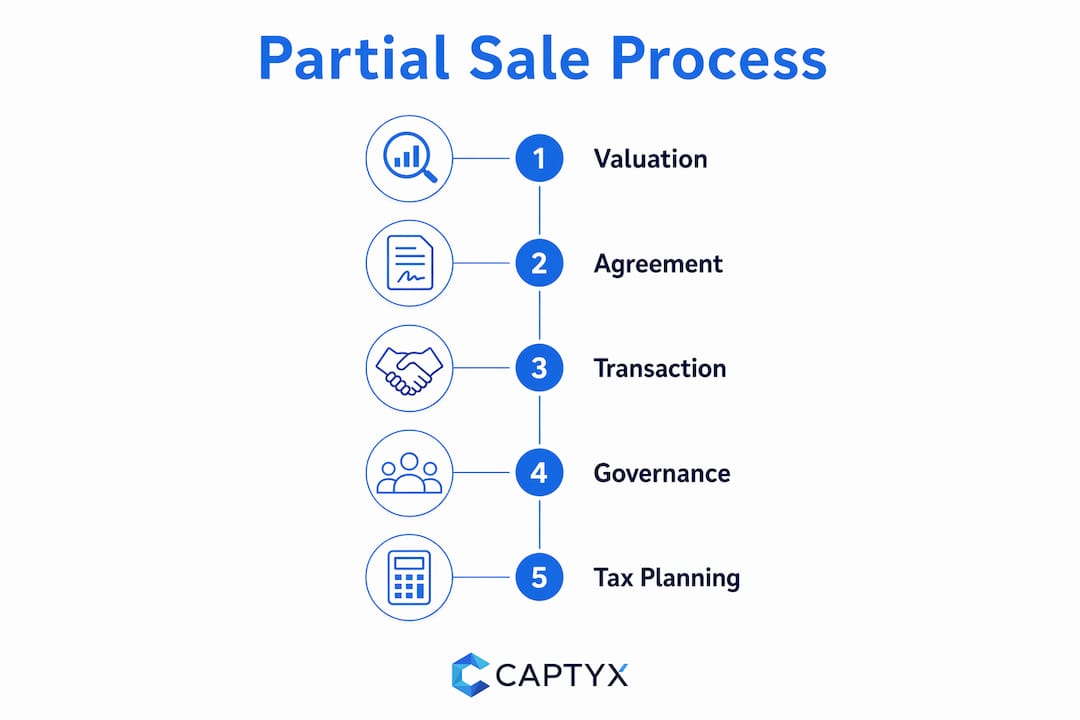
The partial sale process begins with agreeing on a valuation for the percentage being sold. That valuation drives the purchase price and shapes every negotiation that follows. A minority interest recapitalization is the most common structure for selling 10% to 49% of a business. It provides the owner with immediate liquidity while preserving majority control and day-to-day authority.
Sellers can also structure a partial sale as an asset transaction rather than a stock transaction. In an asset sale, specific business units, product lines, or physical assets are sold rather than shares of the company itself. This approach is common when an owner wants to shed a division while keeping the core business intact.
What are the key benefits and trade-offs of partial sales?
Selling a portion of a business delivers liquidity without requiring a full exit. That distinction matters because many owners are not ready to walk away but do need to convert some equity into cash. A partial sale lets you take money off the table while staying involved in the business you built.
The benefits of partial business sales extend beyond personal liquidity:
- Retained upside. You still own a share of future growth. If the business doubles in value before a full exit, you benefit from that increase.
- Reduced personal risk. Selling part of your equity reduces your financial exposure to a single asset. Owners with significant net worth tied to one business often use partial sales to diversify.
- Growth capital. Many partial sale buyers, especially private equity firms, inject new capital alongside their equity purchase. That capital funds expansion, technology upgrades, or acquisitions.
- Strategic partnership. A well-chosen investor brings industry contacts, operational expertise, and credibility with lenders.
The trade-offs are real and worth naming directly. Partial sale owners retain exposure to future business performance and responsibilities, sharing upside potential as well as risk with investors. You also take on reporting obligations, board meetings, and investor communications that did not exist before. Loss of full autonomy is the most common complaint from owners who complete partial sales without fully understanding the governance changes involved.
Pro Tip: Before signing any term sheet, write down the three business decisions you make most often. Then confirm in writing whether those decisions require investor consent after the deal closes.
How is ownership divided and governance structured in partial sales?
Ownership percentage determines voting power, but it does not tell the whole story. Minority investors routinely negotiate protective rights that give them veto or consent authority over specific decisions, regardless of their ownership stake. Minority investors secure protective rights including veto or consent on major decisions, which can limit founder autonomy despite majority ownership.
The table below shows how governance rights typically differ between majority and minority ownership positions in a partial sale:
| Governance area | Majority owner (51%+) | Minority investor (10–49%) |
|---|---|---|
| Day-to-day operations | Full authority | No direct authority |
| Capital expenditures above threshold | Unilateral decision | Consent often required |
| Hiring or firing key executives | Usually unilateral | Consent often required |
| Company sale or merger | Controls outcome | Veto right common |
| Dividend distributions | Sets policy | Protective rights apply |
| New debt or equity issuance | Controls decision | Consent often required |
The practical impact of these governance changes shows up in daily operations. Approving a major equipment purchase, signing a new lease, or bringing on a co-founder may now require investor sign-off. That slows decisions and adds administrative work. Owners who underestimate this shift often feel constrained within months of closing.
Pro Tip: Negotiate a clear dollar threshold for capital expenditure consent requirements. A threshold of $50,000 or $100,000 protects investors without paralyzing routine business decisions.
What are the typical structures and processes in a partial sale transaction?
The partial sale process follows a defined sequence, though the timeline varies by deal complexity. Here are the core steps:
- Establish a valuation. Agree on a business valuation before any negotiation begins. Buyers and sellers often use EBITDA multiples, discounted cash flow models, or comparable transaction data. Captyx offers a free business valuation estimate that gives owners a credible starting point.
- Define the deal structure. Decide whether the transaction is a stock sale, asset sale, or minority recapitalization. Each structure has different legal, tax, and governance implications.
- Negotiate key terms. Price is only one variable. Governance rights, capital commitments from the buyer, earnout provisions, and exit timelines are all negotiated at this stage.
- Complete due diligence. The buyer reviews financial statements, contracts, customer concentration, legal liabilities, and operational risks. Partial business carve-outs still involve complex contract assignments, liability allocations, and detailed deal documentation to protect the seller from indemnities and representations.
- Draft and sign deal documents. The purchase agreement, shareholder agreement, and any ancillary documents are finalized. The shareholder agreement governs the ongoing relationship between owner and investor.
- Close and transition. Funds transfer, ownership records update, and any operational transition arrangements take effect. Board seats, reporting schedules, and consent thresholds go live at closing.
The negotiation phase is where most deals stall. Owners who enter without a clear position on governance rights and exit timelines often make concessions they later regret. Knowing your business exit value before negotiations start gives you the confidence to hold firm on price.
What are the tax implications and financial considerations of partial sales?
Tax treatment in a partial sale depends heavily on deal structure, entity type, and how payments are timed. The table below summarizes the key differences:
| Tax factor | Stock sale | Asset sale |
|---|---|---|
| Seller tax rate | Capital gains (typically lower) | Ordinary income on some assets |
| Buyer tax basis | Carries over from seller | Stepped up to purchase price |
| Depreciation recapture | Generally avoided | Triggered on depreciated assets |
| Installment sale eligibility | Available | Available on qualifying assets |
| Entity type impact | S-corps, C-corps differ | Same rules apply |
Asset sales favor buyers from a tax standpoint. Buyers in asset sales receive a stepped-up tax basis in acquired assets, which reduces their taxable income going forward. Sellers can sometimes negotiate a price premium to offset their higher tax burden in an asset sale structure.
Installment sales offer a useful tool for partial sale sellers. Installment sales under Section 453 allow sellers to spread tax recognition over multiple years for qualifying assets. This is especially relevant when a partial sale includes earnout payments tied to future performance.
Rollover transactions are another tax planning tool. An owner who sells equity and reinvests proceeds into a new holding entity may defer taxes under IRS Section 351 (for corporations) or Section 721 (for LLCs and partnerships). Tax deferral via rollover transactions depends on maintaining “control” and proper structuring under IRS rules. Misstructuring a rollover triggers immediate tax liability even when the economic outcome looks identical to a qualifying transaction. Always work with a tax advisor who specializes in M&A transactions before finalizing any partial sale structure.
Key Takeaways
Partial business sales succeed when owners align deal structure with their liquidity goals, governance tolerance, and long-term exit plan before entering negotiations.
| Point | Details |
|---|---|
| Partial sale defined | An owner sells a percentage of equity while retaining ownership and usually operational control. |
| Governance changes are real | Minority investors often hold veto rights on major decisions regardless of their ownership percentage. |
| Structure drives tax outcome | Stock sales typically favor sellers on tax rates; asset sales give buyers a stepped-up basis. |
| Rollover transactions defer tax | Section 351 and Section 721 rollovers defer tax liability but require strict IRS compliance on control rules. |
| Valuation comes first | Agreeing on a credible business valuation before negotiations prevents price concessions under pressure. |
What I’ve learned from watching partial sales go wrong
Most partial sale problems trace back to one mistake: owners negotiate price hard and governance soft. I have watched founders walk away from closing with a check in hand, only to spend the next two years fighting investors over decisions they assumed were still theirs to make. The shareholder agreement is not a formality. It is the document that defines your working life for the next three to seven years.
The second pattern I see consistently is owners who skip specialized tax advice because they assume their regular CPA can handle an M&A transaction. General accounting and M&A tax structuring are different disciplines. A rollover transaction that looks clean on paper can trigger a six-figure tax bill if the entity type or control threshold is not structured correctly. That is not a recoverable mistake.
Successful partial sales require aligning transaction structure with owner ambitions, business goals, and readiness for a future exit. The owners who get this right spend as much time defining what they want post-close as they do negotiating the purchase price. They know which decisions they need to make unilaterally, which reporting burdens they can tolerate, and what their full exit looks like in five years. That clarity is what separates a partial sale that works from one that creates regret.
If you are weighing a partial exit, read about why mid-market businesses attract private equity before you take your first meeting with a PE firm. Knowing what they want from the deal makes you a far better negotiator.
— Tucker
How Captyx helps owners structure partial and full exits
Captyx has advised on and closed over 225 business sales, including partial exits across a range of industries and deal sizes. That experience means the team has seen which governance structures create problems, which tax approaches hold up under scrutiny, and which valuation methods buyers actually accept.

Owners considering selling a portion of their business benefit from working with advisors who have structured these deals before, not brokers learning on the job. Captyx builds the preparation and positioning work that gets partial sales closed at the right price and on terms the owner can live with. If you want to understand your options before committing to any structure, the Captyx M&A advisory team is the right starting point. You can also use Captyx’s free valuation tool to get a credible number before your first investor conversation.
FAQ
What is a partial business sale?
A partial business sale is when an owner sells a defined percentage of their business equity to a buyer while retaining the remaining ownership stake. The seller typically keeps some operational role and shares future upside and risk with the new investor.
How does a minority interest recapitalization work?
A minority interest recapitalization involves selling 10% to 49% of a business to an investor, providing the owner with liquidity while preserving majority control and day-to-day authority. The investor typically receives protective governance rights in exchange for their minority position.
What are the tax differences between a stock sale and an asset sale in a partial transaction?
Stock sales generally result in capital gains tax rates for the seller, while asset sales can trigger ordinary income tax on certain assets and depreciation recapture. Buyers prefer asset sales because they receive a stepped-up tax basis, which reduces their future taxable income.
Can I defer taxes on a partial business sale?
Yes, rollover transactions structured under IRS Section 351 (corporations) or Section 721 (LLCs and partnerships) can defer tax liability, but only if the transaction meets strict IRS control and structuring requirements. Misstructuring a rollover triggers immediate tax despite the similar economic outcome.
How do I know what percentage of my business to sell?
The right percentage depends on your liquidity needs, your tolerance for governance constraints, and your long-term exit plan. Selling below 50% preserves majority control but still subjects you to investor protective rights on key decisions.


