



Offmarket businesses for sale are privately available acquisitions not listed on public marketplaces like BizBuySell or BizQuest, handled directly between owners and qualified buyers. Approximately 70% of small business sales happen offmarket, meaning the most attractive deals never appear in a public search. Buyers who know how to find offmarket businesses for sale gain access to less competition, more flexible deal terms, and pricing that reflects reality rather than auction pressure. This guide covers the exact tools, strategies, and financial preparation you need to source and close these private business sales.
How to find offmarket businesses for sale: buyer prerequisites
Before you contact a single business owner, your buyer profile must be airtight. Brokers screen buyers aggressively and limit deal information to qualified parties only. Arriving unprepared wastes everyone’s time and closes doors that are hard to reopen.
Define your acquisition criteria first
Your criteria act as a filter that keeps you focused and signals seriousness to sellers and intermediaries. Vague buyers get ignored. Specific buyers get callbacks.
Define the following before you reach out to anyone:
- Industry and niche: Manufacturing, home services, SaaS, healthcare, or another vertical you understand
- Revenue and cash flow range: Target businesses with $500K to $5M in annual revenue, or whatever range your capital supports
- Geography: Local, regional, or remote-operable businesses
- Deal size and structure: All-cash, SBA-financed, or seller-financed transactions
- Operational involvement: Absentee ownership versus owner-operator models
Financial readiness: what you need before outreach
| Document | Purpose |
|---|---|
| Proof of funds or bank statements | Confirms liquidity for equity injection or down payment |
| SBA pre-approval letter | Signals financing readiness to sellers and brokers |
| Personal financial statement | Required by most SBA lenders and brokers |
| Investor bio or buyer profile | Establishes credibility and acquisition intent |
SBA acquisition loans require at least 10% equity injection, so know your capital position before you begin. A buyer who shows up with pre-approval moves faster and negotiates from a position of strength.
Pro Tip: Build a one-page buyer profile that includes your background, acquisition criteria, and financing status. Brokers and owners respond to buyers who look prepared. Attach it to every initial outreach email.
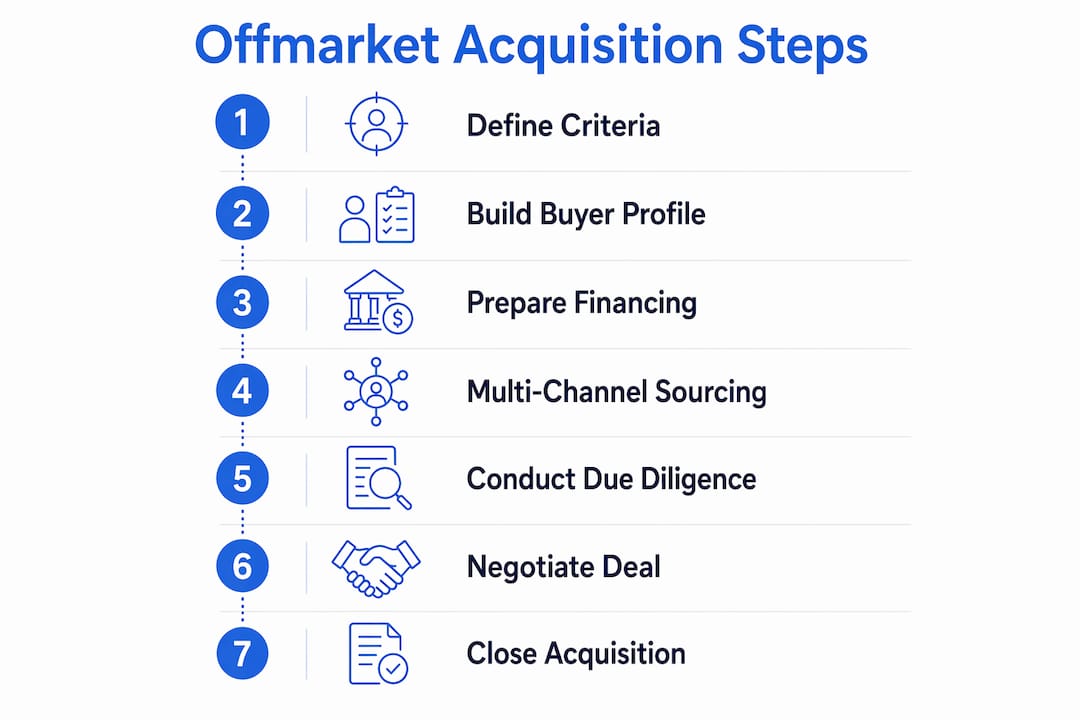
Which strategies effectively uncover hidden business opportunities?
Sourcing private business sales requires a multi-channel approach. No single method produces enough deal flow on its own. The buyers who consistently find offmarket company listings combine research, networking, and direct outreach into a repeatable system.
Here are the most effective sourcing strategies, ranked by reliability:
- Build relationships with professional intermediaries. Networks of brokers, accountants, and attorneys are the first to know when an owner considers selling. A CPA who handles a business owner’s taxes for 10 years will hear about a sale intention months before anyone else. Cultivate these relationships consistently, not just when you are actively searching.
- Join industry-specific trade groups and chambers of commerce. Local business associations surface owners who are aging out or ready to transition. Attend meetings, sponsor events, and become a recognizable face. Owners sell to people they trust, and trust is built in person.
- Use platforms built for offmarket access. SMB.co, for example, uses private outreach campaigns to gauge owner interest before public listing. These platforms match buyers to owner conversations early, giving you first-to-know advantage on deals that may never reach a public marketplace.
- Run a direct owner outreach campaign. Identify target businesses through local industry directories, LinkedIn, Google Maps, and state business registries. Send personalized letters or emails that acknowledge the owner’s work, explain your background, and express genuine interest without pressure. Respectful, specific outreach converts far better than generic templates.
- Build a proprietary deal flow pipeline. Proprietary deal flow means engaging owners before a business is listed or brokered. Dedicated outreach infrastructure produces 2.5x higher reply rates, with an average of 60 to 120 days from first contact to a signed letter of intent. This is not a sprint. It is a long-term relationship strategy.
Pro Tip: When sending cold outreach to business owners, reference something specific about their business: a recent award, a product they sell, or a market they serve. Generic letters get deleted. Specific letters get read.
How to prepare for financial due diligence and SBA financing

Offmarket acquisitions move faster than brokered deals, which means your financial preparation must be complete before you make an offer. Buyers who scramble for documents after signing a letter of intent lose deals to better-prepared competitors.
SBA lenders require a minimum 1.25x debt service coverage ratio along with three years of tax returns and bank statements. This ratio measures whether the business generates enough cash flow to cover loan payments. If the business does not clear this threshold, the deal either needs restructuring or a price reduction.
Assemble your due diligence package early. The core documents include:
- Three years of business tax returns and personal tax returns
- Year-to-date profit and loss statements and balance sheets
- Three to six months of business bank statements
- Add-back documentation for owner compensation and discretionary expenses
- Any existing lien or payoff documentation on business assets
Synchronizing your financial diligence with SBA lender expectations before you submit a letter of intent prevents the most common cause of deal collapse: financing delays. Treat your due diligence package like a loan application from day one.
Watch for these red flags during review:
- Revenue reported on tax returns that does not match bank deposits
- Heavy customer concentration where one client represents more than 30% of revenue
- Seasonal cash flow swings that compress annual debt service coverage
- Unexplained spikes or drops in revenue in the most recent 12 months
Independent business valuations cost $2,500 to $5,000 and are required for most SBA-financed acquisitions. If the appraised value comes in below the purchase price, you either cover the gap with additional equity or renegotiate. Knowing this before you make an offer shapes how you structure your initial bid.
Pro Tip: Prepare a “data room starter pack” with your financial documents organized and ready to share under NDA. Sellers and lenders read buyer seriousness through how quickly and cleanly documents are delivered.
What are the negotiation dynamics unique to offmarket deals?
Offmarket business sales operate on a different logic than brokered auctions. The seller is not fielding five competing offers. They are evaluating whether you are the right person to take over something they built. That shift in dynamic changes everything about how you negotiate.
Offmarket deals close at 15 to 30% lower multiples than brokered listings because there is no auction pressure driving up the price. Owners set valuations based on their own sense of worth rather than a broker’s comparable sales analysis. This creates real pricing opportunity for prepared buyers.
Here is how to structure negotiations that actually close:
- Lead with certainty, not just price. Owners who are retiring or transitioning care deeply about whether the deal will actually close. A buyer with SBA pre-approval and clean financials signals certainty. That matters more than a slightly higher offer from an unproven buyer.
- Tailor your offer to seller motivations. A retiring owner may want a gradual exit with a consulting period. A burned-out operator may want a clean break. Ask directly what a successful transition looks like to them, then structure your offer around that answer.
- Use a letter of intent early. A non-binding LOI locks in key terms and signals commitment without requiring full legal documentation. It also starts the exclusivity clock, preventing the owner from shopping the deal while you complete diligence.
- Sign a mutual confidentiality agreement on day one. Offmarket sellers are sharing sensitive financial information before any public announcement. Protecting that information builds trust and keeps the deal quiet.
| Brokered deal | Offmarket deal |
|---|---|
| Multiple competing buyers | Direct buyer-seller conversation |
| Auction-driven pricing | Negotiated pricing, often 15 to 30% lower |
| Broker controls information flow | Buyer builds direct relationship with owner |
| Faster initial process | Longer relationship build, faster close once aligned |
Avoid the most common mistakes buyers make in offmarket negotiations: overvaluing the business based on seller claims without verification, skipping professional legal review of purchase agreements, and failing to communicate consistently during the diligence period. Silence kills offmarket deals faster than any pricing disagreement.
Key takeaways
Finding offmarket businesses for sale requires combining buyer credibility, multi-channel sourcing, SBA financing readiness, and relationship-driven negotiation to access deals that never reach public marketplaces.
| Point | Details |
|---|---|
| Offmarket deal prevalence | 70% of small business sales happen offmarket, making private sourcing the primary acquisition channel. |
| Buyer preparation | A complete investor profile, SBA pre-approval, and organized financials unlock broker and owner access. |
| Sourcing channels | Brokers, accountants, trade groups, direct outreach, and platforms like SMB.co each surface different deal types. |
| Due diligence timing | Prepare your financial data room before signing an LOI to prevent financing delays from collapsing deals. |
| Negotiation advantage | Offmarket deals close at 15 to 30% lower multiples when buyers lead with certainty and align with seller motivations. |
Why most buyers are thinking about this backward
The conventional advice on acquiring a business tells you to search listings, find something you like, and then make an offer. That process works fine for buying a used car. For acquiring a business worth $1M or more, it leaves you competing for the same publicly available deals as every other buyer who read the same article.
What I have seen work consistently is the opposite approach. Build your buyer credibility and financing readiness first, then go looking. When you show up to a conversation with an owner already holding SBA pre-approval, a clean investor profile, and a specific acquisition thesis, you are not just another person who wants to buy a business. You are a serious counterparty who can actually close.
The 60 to 120 day timeline from first contact to LOI in a proprietary deal flow pipeline is not a bug. It is the feature. That time is when trust gets built. Owners who have spent 20 years building something do not hand it to a stranger after one phone call. They hand it to someone who stayed in touch, asked good questions, and demonstrated they understood what the business actually was.
The buyers I respect most treat offmarket sourcing like a job function, not a one-time search. They have a list of 50 target businesses, they send updates quarterly, and they are the first call when an owner is ready to talk. That is how you discover offmarket businesses before anyone else even knows they exist.
SBA readiness is the other underrated factor. Sellers and brokers both know that financing is where deals die. A buyer who can demonstrate clean loan packaging from the first meeting removes the biggest uncertainty in the transaction. That alone can get you a deal that a higher bidder loses.
— Tucker
How Captyx helps you source and close offmarket acquisitions

Captyx provides done-for-you offmarket deal sourcing and M&A advisory for entrepreneurs and investors who want to acquire profitable businesses without spending months chasing dead ends. With over 225 businesses sold, Captyx brings direct access to verified confidential listings, owner contacts, and the advisory infrastructure to move from first conversation to closed deal efficiently. The team supports buyers through SBA loan preparation, business valuation, and negotiation structuring so that financing and diligence move in parallel rather than sequentially. If you are ready to buy a business and want professional support at every stage, explore Captyx’s M&A advisory services or review active buyer mandates to see what acquisition opportunities are currently available.
FAQ
What does offmarket business for sale mean?
An offmarket business for sale is a business available for acquisition that is not publicly listed on marketplaces like BizBuySell or BizQuest. These deals are handled privately between owners and qualified buyers, often through brokers, advisors, or direct outreach.
Why do most business sales happen offmarket?
Approximately 70% of small business sales happen offmarket because owners prioritize confidentiality, want to avoid disrupting employees and customers, and prefer to deal with vetted buyers rather than fielding public inquiries.
How do I get access to offmarket business listings?
Access comes through building relationships with business brokers, accountants, and attorneys, joining platforms that specialize in private deal sourcing, and running direct outreach campaigns to target business owners. Preparing a complete investor profile and SBA pre-approval letter significantly increases your access.
What financing do I need to buy an offmarket business?
Most buyers use SBA 7(a) loans, which require at least 10% equity injection and a minimum 1.25x debt service coverage ratio from the target business. Having pre-approval in place before you begin outreach strengthens your negotiating position considerably.
How long does it take to close an offmarket business acquisition?
From first owner contact to a signed letter of intent typically takes 60 to 120 days in a structured outreach pipeline. Full closing, including due diligence and financing, generally adds another 60 to 90 days depending on deal complexity and lender timelines.