


Business exit value is the actual amount an owner or investor receives when selling their stake in a company through a liquidity event such as an acquisition, merger, IPO, or buyout. This figure is not what your accountant lists on a balance sheet. It is what a real buyer pays in a real transaction. For small business owners, understanding this distinction changes everything about how you plan, prepare, and ultimately profit from a sale. The gap between what you think your business is worth and what a buyer will actually pay can cost you hundreds of thousands of dollars if you go in unprepared.
What is business exit value and how does it work?
Business exit value is defined as the proceeds received at a liquidity event, the moment when ownership transfers and cash (or equivalent consideration) changes hands. In venture capital and private equity, it is a critical metric for measuring return on investment. For small business owners, it carries the same weight: it is the number that determines whether decades of work translate into financial freedom or a disappointing check.

The term “exit value” is closely related to, but distinct from, the industry term fair value used in formal accounting. Fair value refers to the price in an orderly, arm’s length transaction between market participants. Exit value, in practice, is the realized version of that concept. It is what actually lands in your account after deal structure, taxes, earnouts, and closing adjustments are applied.
Common liquidity events that trigger an exit include strategic acquisitions by larger companies, private equity buyouts, management buyouts, mergers, and initial public offerings. Each event type produces a different exit value outcome because buyer motivations, deal terms, and market conditions vary significantly. A strategic acquirer who wants your customer base may pay a premium. A financial buyer focused purely on cash flow returns may not.
Understanding exit value vs. book value is the first mental shift every owner needs to make before entering a sale process.
How to calculate exit value: the main business valuation methods
Calculating exit value is not a single formula. Professional valuations produce a range, not one definitive number, by reconciling multiple approaches. That range reflects the assumptions baked into each method and the realities of your specific market.
The most common method in investment banking and M&A is the exit multiple method, where terminal value equals final year EBITDA multiplied by an industry-specific multiple. This figure is then discounted as part of a DCF (discounted cash flow) analysis to arrive at a present value. If your business generates $500,000 in EBITDA and comparable businesses sell at a 4x multiple, your indicated exit value is $2 million before adjustments.
The table below compares the six primary valuation methods used to estimate exit value:
| Method | How it works | Best used when |
|---|---|---|
| Exit multiple (EBITDA) | Multiplies normalized EBITDA by an industry multiple | Profitable businesses with stable earnings |
| Discounted cash flow (DCF) | Projects future cash flows and discounts to present value | Businesses with predictable, growing revenue |
| Market comparables | Benchmarks against recent sales of similar businesses | Active M&A markets with comparable transactions |
| Asset-based valuation | Sums fair market value of all business assets | Asset-heavy businesses or holding companies |
| Liquidation value | Estimates proceeds from a forced, rapid asset sale | Distressed situations or last-resort scenarios |
| Book value | Uses balance sheet equity as the valuation basis | Rarely used alone; serves as a floor estimate |
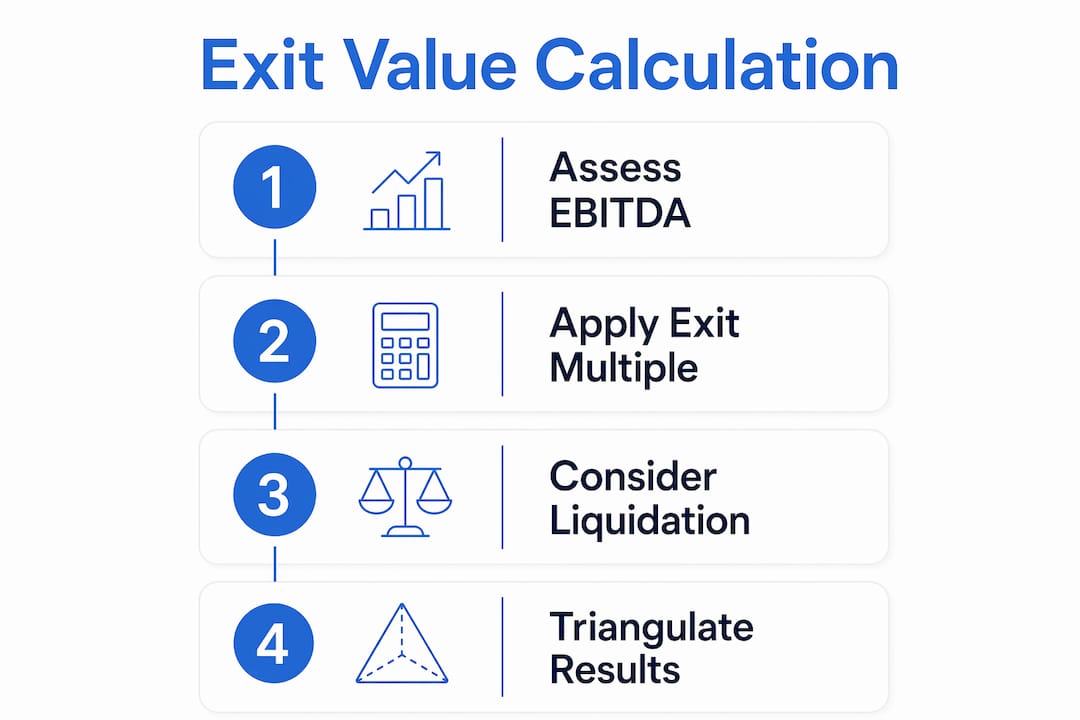
Liquidation value consistently produces the lowest exit value because it assumes a forced sale under time pressure. This is the worst-case scenario, not a target. Owners who confuse liquidation value with realistic exit value systematically underestimate what their business could fetch in an orderly process.
Pro Tip: Never rely on a single valuation method when estimating your exit value. Practitioners who triangulate across income, market, and asset approaches produce more defensible conclusions and are better positioned to justify their asking price to skeptical buyers.
What factors most influence your business exit value?
Buyers pay for sustainable cash generation and the confidence that the business will keep generating it after the owner leaves. That single insight explains most of what drives exit value up or down.
Financial performance is the starting point. Buyers scrutinize EBITDA, net cash flow, revenue trends, and profit margins. A business growing at 15% annually commands a higher multiple than one that has been flat for three years, even if absolute profits are similar. Consistency matters as much as size.
Risk is the second major driver. Owner dependency is one of the most common value killers in small business sales. If your business cannot operate without you making daily decisions, a buyer is not acquiring a business. They are acquiring a job, and they will price it accordingly. Reducing owner dependency by building a capable management team and documented processes directly increases what a buyer will pay.
Recurring revenue, customer concentration, and operational scalability round out the picture. A business where 60% of revenue comes from one client carries significant risk that buyers discount heavily. Diversified revenue streams with long-term contracts or subscription models attract premium valuations.
Factors you can control to strengthen your exit value include:
-
EBITDA growth: Increase profitability through margin improvement and cost discipline in the 24 to 36 months before a sale
-
Management depth: Hire or promote leaders who can run operations independently of the owner
-
Customer diversification: Reduce reliance on any single client to below 15% of total revenue
-
Documented processes: Create standard operating procedures that make the business transferable
-
Clean financials: Maintain audited or reviewed financial statements for at least three years
-
Recurring revenue: Shift toward contracts, retainers, or subscription models where possible
Pro Tip: One of the most common valuation pitfalls is running personal expenses through the business. Buyers and their accountants will find them, and every dollar of unexplained expense reduces your EBITDA and, by extension, your exit multiple.
How exit value differs from book, fair, and liquidation value
These terms are frequently confused, and the confusion costs owners money. The table below clarifies each concept:
| Term | Definition | Context |
|---|---|---|
| Exit value | Actual proceeds received at a liquidity event | M&A transactions, buyouts, IPOs |
| Fair value | Price in an orderly, arm’s length transaction between market participants | IFRS and U.S. GAAP accounting standards |
| Book value | Net assets per the balance sheet (assets minus liabilities) | Internal accounting; rarely reflects market reality |
| Liquidation value | Proceeds from a forced, rapid asset sale | Distress situations; typically the lowest outcome |
Under both IFRS and U.S. GAAP, exit value and fair value are treated as equivalent for orderly transactions. The accounting definition assumes a hypothetical willing buyer and seller with full information. Real-world M&A transactions introduce deal structure complexity, earnouts, seller financing, and post-closing adjustments that can make realized proceeds diverge significantly from the theoretical fair value.
Book value is the figure most owners see regularly, and it is almost always misleading as an exit benchmark. A manufacturing business with $1 million in net assets on its balance sheet might sell for $3.5 million based on earnings power, or for $600,000 in a forced liquidation. The balance sheet tells you almost nothing about what a motivated buyer will pay.
The practical takeaway: when you are planning a sale, focus on earnings-based and market-based methods. Book value is a starting point for accountants, not a negotiating position for sellers.
Practical steps to maximize your business exit value before selling
Preparation is the single largest variable in determining your final exit value. Businesses that enter a sale process unprepared consistently leave money on the table, while those that spend 12 to 36 months preparing command materially higher multiples. Here is a structured approach:
-
Get a professional valuation early. Commission a formal valuation 18 to 24 months before your target sale date. This gives you a realistic baseline and time to address gaps. Valuation engagements distinguish between full valuations and calculations, so work with a credentialed advisor who can explain the difference.
-
Normalize your financials. Work with your accountant to recast financial statements, removing one-time expenses and personal items to show true EBITDA. Buyers and their advisors will do this anyway. Do it first so you control the narrative.
-
Reduce owner dependency. Document your role, then systematically delegate. Buyers discount heavily for businesses where the owner is the product. A strong management team is one of the highest-return investments you can make before a sale.
-
Strengthen recurring revenue. Convert project-based clients to retainer or subscription arrangements. Even partial success here can shift your multiple meaningfully.
-
Clean up your legal and operational house. Resolve pending disputes, renew key contracts, and formalize vendor agreements. Buyers conduct thorough due diligence, and surprises during that process kill deals or reduce price.
-
Choose the right exit strategy. A strategic sale to a competitor, a private equity recapitalization, or a management buyout each produce different exit value outcomes. Align your strategy with your financial goals and timeline.
-
Engage an experienced M&A advisor. Advisors who specialize in your industry and deal size know what buyers actually want and can position your business to attract competitive offers.
Pro Tip: The businesses that achieve the highest exit values are not necessarily the most profitable. They are the most prepared. Strategic planning 24 months before a sale consistently produces better outcomes than rushing to market.
Key takeaways
Business exit value is a realized figure, not an estimate, and the gap between your perceived value and a buyer’s offer closes only through deliberate preparation.
| Point | Details |
|---|---|
| Exit value is realized proceeds | It reflects actual deal outcomes, not balance sheet figures or theoretical fair value. |
| Multiple valuation methods matter | Triangulating income, market, and asset approaches produces a more defensible asking price. |
| Buyer risk perception drives multiples | Reducing owner dependency and diversifying revenue directly increases what buyers will pay. |
| Preparation timeline is 12 to 36 months | Businesses that prepare early consistently achieve higher exit multiples than those rushed to market. |
| Deal structure affects final proceeds | Earnouts, seller financing, and post-closing adjustments can reduce realized exit value below headline price. |
What I’ve learned about exit value after 225 business sales
Most owners I work with arrive at the conversation believing their business is worth what they feel it is worth. That number is usually tied to how hard they worked, how long they have owned it, or what they need for retirement. Buyers do not care about any of those things. They care about what the business will generate after the owner walks out the door.
The most expensive misconception I see is treating the headline sale price as the exit value. Deal structure matters enormously. An offer of $3 million with a two-year earnout tied to performance targets is not the same as $3 million in cash at closing. I have watched owners accept structurally complex deals that looked attractive on paper and then realize far less than they expected because the earnout conditions were never met.
The owners who walk away with the best outcomes are the ones who spent years building a business that does not need them. They have clean books, a real management team, and revenue that does not depend on any single relationship. Those businesses attract multiple buyers, create competitive tension, and command the multiples that make exits genuinely life-changing.
My honest advice: start preparing earlier than you think you need to. The changes that move your exit value most take time to show up in your financials, and buyers want to see a track record, not a promise.
— Tucker
How Captyx helps you achieve your best exit value

Captyx has sold over 225 businesses and brings a performance-guarantee approach that most M&A advisors simply do not offer. Rather than listing your business and hoping for the best, Captyx uses real-time buyer feedback to identify and fix the specific issues that suppress your sale price before they become deal-killers. If you are serious about maximizing your exit value, the place to start is understanding exactly where your business stands today. Explore Captyx’s M&A advisory services to see how a structured, feedback-driven process produces better outcomes, or review whether a broker is right for you before you make any decisions.
FAQ
What is business exit value in simple terms?
Business exit value is the actual cash or consideration an owner receives when selling their business through a transaction such as an acquisition, merger, or buyout. It reflects real deal proceeds, not accounting estimates or balance sheet figures.
How is exit value different from fair value?
Under U.S. GAAP and IFRS, exit value and fair value are treated as equivalent for orderly transactions between willing parties. In practice, deal structure, earnouts, and closing adjustments mean realized proceeds often differ from the theoretical fair value figure.
What is the most common method used to calculate exit value?
The exit multiple method, which multiplies normalized EBITDA by an industry-specific multiple, is the standard approach in M&A and investment banking. Most professional valuations reconcile this with discounted cash flow and market comparable analyses to produce a defensible range.
What factors reduce business exit value the most?
Owner dependency, customer concentration, inconsistent financial records, and declining revenue trends are the four factors that most consistently suppress exit value. Buyers price these risks into their offers through lower multiples or deal structure contingencies.
How long before selling should I start preparing my business?
Most M&A advisors recommend beginning preparation 18 to 36 months before your target sale date. This window gives you time to improve financials, reduce owner dependency, and build the track record buyers need to justify a premium price.


