


TL;DR:
- Preparing early to improve recurring revenue, margins, and owner independence raises a business’s sale price. Documenting all improvements and building a management team help ensure a higher valuation and smoother due diligence process. Starting preparation 18 months in advance and obtaining two valuations boost the chances of achieving a premium sale price.
Increasing your business sale price is defined by one principle: buyers pay premiums for businesses that are predictable, profitable, and owner-independent. The industry term for this process is “pre-sale value enhancement,” and it covers every deliberate improvement you make to financial performance, operations, and market positioning before going to market. Most owners underestimate how much preparation time matters. A structured approach to boosting business valuation can mean the difference between a fair offer and an exceptional one. Captyx has sold over 225 businesses and the patterns are consistent: prepared sellers get better prices.
What are the essential value drivers that boost business sale price?
Business valuation is built on a handful of measurable factors buyers use to calculate risk and return. Understanding these drivers is the fastest way to identify where your business leaves money on the table.
Recurring revenue is the single most powerful valuation lever. Recurring revenue raises multiples from 3x to 6x EBITDA depending on the industry, because it reduces the buyer’s perceived risk of future cash flow. A business with 60% of revenue locked into annual contracts is fundamentally less risky than one that restarts sales from zero each month.
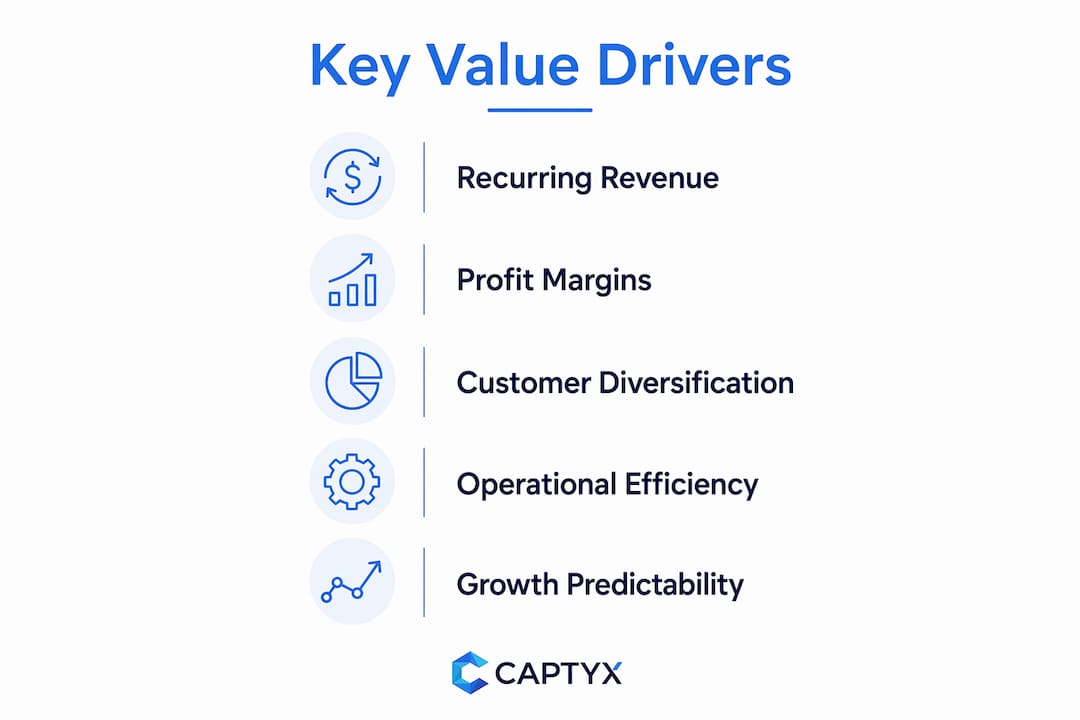
Profit margins compound the effect of every other improvement. A business generating $5 million in revenue at a 20% margin is worth significantly more than one with the same revenue at an 8% margin, because margin improvements compound through both higher EBITDA and higher multiples applied to that EBITDA. Buyers are not just buying revenue. They are buying earnings.
Customer concentration is a risk flag most owners overlook. When a single customer accounts for more than 15–20% of revenue, buyers apply discounts to the asking price to account for the risk of losing that account post-sale. Diversifying your customer base before going to market directly removes that discount.
Owner dependency is the other major discount trigger. Buyers pay premiums for businesses that run without the owner through a proven management team. If the business cannot operate for 30 days without you, buyers will price that risk into their offer.
- Recurring or contracted revenue raises valuation multiples meaningfully
- High profit margins amplify EBITDA and the multiple applied to it
- Customer concentration above 15–20% triggers buyer discounts
- Owner-independent operations command premium multiples
- Clear competitive differentiation signals pricing power to buyers
Pro Tip: Map your top five customers by revenue percentage before you start any sale preparation. If any one customer exceeds 15% of total revenue, build a diversification plan into your 18-month roadmap.
How to prepare your business financially and operationally for a higher sale price
Financial and operational preparation is where most owners either win or lose the negotiation. Buyers conduct thorough due diligence, and anything that cannot be verified does not add value to your asking price.
-
Get your financial records clean and auditable. Three years of accurate, well-organized financial statements are the foundation of any strong sale. Buyers and their advisors will reconstruct your earnings, so every revenue line, expense, and owner benefit needs to be clearly documented and explainable.
-
Commission a quality of earnings analysis. A quality of earnings report goes deeper than standard financials. It separates recurring earnings from one-time events, adjusts for owner compensation, and gives buyers confidence that the reported EBITDA is real and repeatable. This single document reduces buyer skepticism more than almost anything else.
-
Document your operational processes. Write down how the business actually runs. Standard operating procedures, employee handbooks, customer onboarding workflows, and vendor contracts all demonstrate that the business is a system, not a person. Buyers pay more for systems.
-
Build a leadership team that can operate without you. Identify the two or three people who could run the business day-to-day after you leave. Invest in their development, give them documented authority, and let buyers meet them during the sale process. This directly addresses the owner-dependency discount.
-
Start at least 18 months before you plan to sell. Pre-sale improvement programs running 12 to 18 months with phased milestones lead to 20–40% higher closing prices versus unprepared sales. That timeline gives you enough runway to show two years of improving financials, which is exactly what buyers want to see.
-
Document every improvement as you make it. Undocumented improvements do not transfer value in buyer due diligence. If you reduced costs, hired a manager, or won a new contract, record it with dates, numbers, and context. Proof is what moves offers upward.
Pro Tip: Create a “value enhancement log” from day one of your preparation. Date every improvement, attach supporting data, and organize it by value driver category. This becomes your most persuasive document during due diligence.
What specific strategies can increase revenue and margin sustainably before sale?
Growing revenue and margin in the 18 months before a sale is not about chasing short-term wins. Buyers see through one-time spikes. The goal is to show a credible, repeatable growth trend that justifies a premium multiple.

Shift toward recurring revenue models. If your business currently runs on project-based or transactional revenue, introduce retainer agreements, subscription tiers, or service contracts. Even converting 20% of your revenue to recurring contracts changes the risk profile buyers assign to your business. The valuation math rewards this shift immediately.
Compete on value, not price. Businesses that compete on value rather than price hold more pricing power and defend higher sale prices through sustainable differentiation. Buyers read pricing power as a signal of brand strength and competitive moat. Raise prices where your market position supports it, and document the customer retention data that proves clients stay.
Diversify your customer base deliberately. Add new customers in different industries or geographies. Reduce the revenue share of your largest accounts by growing others. This is not just about removing the concentration discount. It also demonstrates that your sales process works and that growth is repeatable.
Cut costs that do not drive revenue. Review every expense line for the past two years. Eliminate redundant subscriptions, renegotiate supplier contracts, and remove costs tied to the owner’s personal preferences rather than business operations. Every dollar of margin improvement flows directly into EBITDA, and EBITDA is what buyers multiply.
- Convert project revenue to retainer or subscription contracts
- Raise prices where brand and quality justify it
- Add customers in new segments to reduce concentration risk
- Eliminate non-revenue-driving costs to improve EBITDA
- Document growth trends with monthly data to show trajectory
Buyers want to see evidence of predictable growth before they commit to a premium multiple. Monthly revenue reports, customer retention rates, and gross margin trends over 24 months are the data points that justify your asking price. Prepare these reports before you go to market, not after a buyer asks for them.
How to use valuation benchmarks and buyer perspectives to set the right asking price
Setting the right asking price requires more than guessing at a multiple. Buyers use EBITDA multiples benchmarked against comparable transactions in your industry. Your job is to understand those benchmarks and then position your business to earn the top of the range.
Understanding EBITDA multiples
EBITDA (earnings before interest, taxes, depreciation, and amortization) is the most common valuation base for small and mid-sized businesses. Industry multiples vary widely. A manufacturing business might trade at 3x to 5x EBITDA, while a software business with recurring revenue might trade at 6x to 10x. Knowing your industry’s range tells you exactly which value drivers to prioritize.
Getting two valuations, not one
A second valuation before going to market serves as the final asking price anchor and demonstrates margin improvement trajectory, increasing buyer confidence and price multiples. The first valuation establishes your baseline. The second, taken after 12 to 18 months of documented improvements, shows buyers a business on an upward trajectory. Visible margin progression over two years yields significantly higher buyer offers.
Avoiding the overpricing trap
Overpricing is as damaging as underpricing. A business priced above market comps attracts fewer qualified buyers, sits on the market longer, and often sells for less than a correctly priced business would have. Work with an advisor who understands what buyers actually value to set a price that is ambitious but defensible.
| Valuation factor | Low multiple signal | High multiple signal |
|---|---|---|
| Revenue type | Project-based, transactional | Recurring, contracted |
| Customer concentration | One customer above 20% | No customer above 10% |
| Owner dependency | Owner runs daily operations | Standalone management team |
| Margin trend | Flat or declining | Growing over 24 months |
| Documentation | Informal, incomplete | Auditable, fully documented |
Key takeaways
Increasing your business sale price requires documented improvements across revenue quality, profit margins, customer diversification, and owner independence, all completed well before going to market.
| Point | Details |
|---|---|
| Recurring revenue raises multiples | Shifting to contracted revenue can raise valuation multiples from 3x to 6x EBITDA. |
| Start 18 months early | Structured pre-sale programs lead to 20–40% higher closing prices versus unprepared sales. |
| Document every improvement | Undocumented changes do not count in due diligence and will not raise your final offer. |
| Reduce owner dependency | Buyers pay premiums for businesses with standalone management teams in place. |
| Get two valuations | A second valuation after improvements demonstrates trajectory and anchors your asking price. |
What I’ve learned from selling over 225 businesses
Most owners I work with believe their business is worth more than the market will pay. That gap is almost never about the business itself. It is about preparation, documentation, and timing.
The owners who get the best prices are not always running the most profitable businesses. They are the ones who started preparing early, documented every improvement with hard data, and walked into due diligence with a clean, organized story. Buyers are not buying your past. They are buying their future. Your job is to make that future look as predictable and low-risk as possible.
The single most common mistake I see is owners making real, meaningful improvements to their business in the final six months before a sale, then failing to document any of it. A new manager hired, a cost structure rebuilt, a customer contract renewed. None of it shows up in the offer because there is no paper trail. Undocumented improvements fail to transfer value in due diligence, full stop.
The other mistake is emotional pricing. Owners attach personal value to what they built, and that is understandable. But buyers use math. When you understand the math, you can work the math in your favor. Check whether your business shows the signs of sale readiness before you set a price, and you will go into negotiations with confidence instead of hope.
— Tucker
How Captyx helps you sell for the price your business deserves
Captyx has built the systems and frameworks that many business brokers and M&A advisors use to prepare businesses for sale. With over 225 completed transactions, including businesses Captyx has owned and sold itself, the firm brings direct seller experience to every engagement.

Start with a free business valuation estimate to establish your baseline and identify the gaps between where your business is today and where it needs to be to command a premium price. From there, Captyx’s M&A advisory services guide you through every phase of preparation, buyer outreach, and negotiation. If you are weighing your options on representation, the broker vs. advisor comparison is a practical starting point for making that decision.
FAQ
What is the fastest way to increase business sale price?
The fastest way to increase your sale price is to shift revenue toward recurring contracts and reduce owner dependency, since both directly raise the valuation multiple buyers apply to your EBITDA.
How long before selling should I start preparing?
Start at least 18 months before your target sale date. Structured pre-sale programs running 12 to 18 months with documented milestones produce 20–40% higher closing prices than unprepared sales.
What is EBITDA and why does it matter for sale price?
EBITDA stands for earnings before interest, taxes, depreciation, and amortization. Buyers multiply it by an industry-specific number to calculate your business’s value, so every dollar of EBITDA improvement directly raises your sale price.
Does customer concentration really lower my sale price?
Yes. When a single customer accounts for more than 15–20% of revenue, buyers discount the asking price to account for the risk of losing that account after the sale closes.
Do I need two business valuations before selling?
Getting a second valuation after your improvement period is complete gives buyers a documented trajectory of margin growth, which increases their confidence and supports a higher final offer.


