


TL;DR:
- Buyers most often reject small businesses due to poor financial documentation and operational risks.
- Clear, consistent records and documented processes are crucial for closing deals and building buyer confidence.
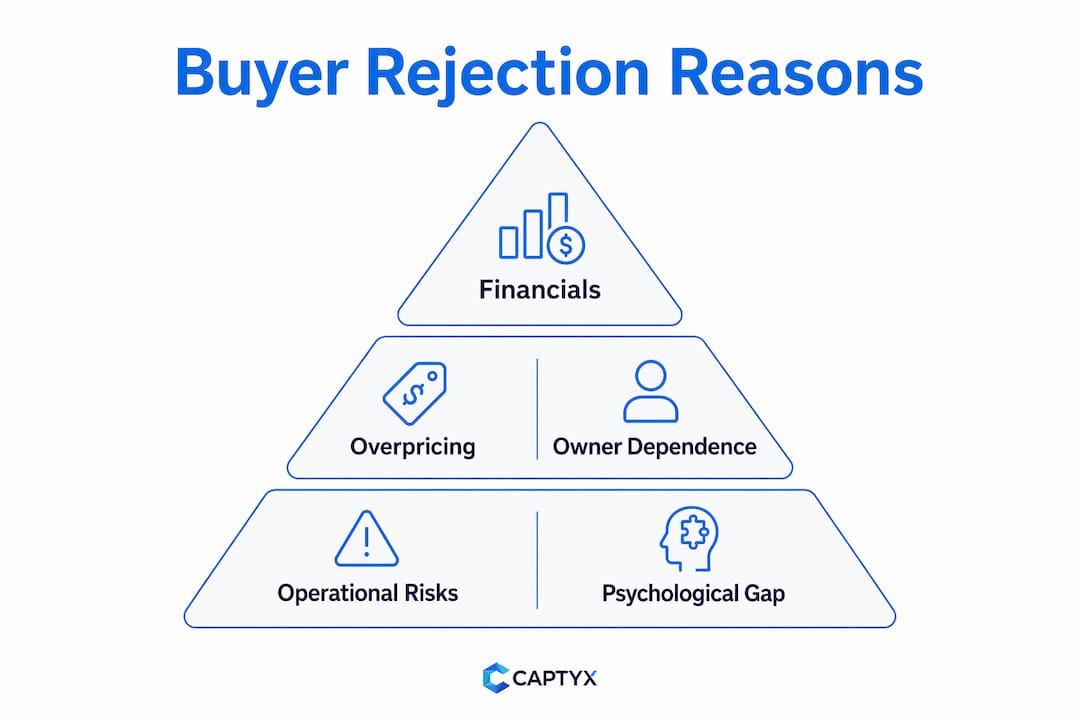
Buyers reject small businesses most often because of poor financial documentation, unrealistic pricing, owner dependence, and operational risks that signal unmanageable uncertainty. These are not random deal killers. They follow a pattern that serious buyers recognize within days of opening a data room. Understanding why buyers reject small businesses is the first step toward fixing the problems before they cost you a deal. 70–80% of small business sales fail to close, and the reasons are almost always preventable. Buyers are not looking for perfection. They are looking for clarity, consistency, and confidence that the business will survive without you.
Why buyers reject small businesses: the financial documentation problem
Messy financials are the single fastest way to lose a serious buyer. Businesses with transparent financials move through due diligence faster and hold buyer confidence throughout the process. The opposite is also true. When bank statements do not reconcile with tax returns and profit and loss statements, buyers assume the worst.
Buyers are trained to look for specific red flags in financial records:
- Inconsistent deposits that do not match reported revenue
- Excessive personal expenses run through the business account
- Add-back exaggerations that inflate Seller’s Discretionary Earnings beyond what is verifiable
- Cash basis accounting that hides timing differences in revenue and expenses
- Inconsistent expense categorization across multiple years
Sophisticated buyers discount reported earnings by 15–50% until every add-back is verified. That is not a negotiating tactic. It is a standard practice to uncover true cash flow before committing capital.
Standard due diligence for businesses under $2 million takes 30–45 days. Documentation problems extend that timeline and drain buyer patience. Approximately 30% of signed Letters of Intent in the smaller market fail to close. Most of those failures trace back to financial records that could not survive scrutiny.

Pro Tip: Get your last three years of bank statements, tax returns, and P&Ls reconciled by a CPA before you list. Buyers will find every discrepancy. You should find them first.
Does overpricing really cause buyers to walk away?
Overpricing is the second most common reason buyers reject small companies. Sellers often anchor their price to what they need in retirement or what they believe the business is worth emotionally. Buyers anchor to cash flow, risk, and what they can realistically earn after debt service.
The gap between those two anchors kills deals before they start. Here is how sellers typically inflate perceived value and why each move backfires:
- Adding back owner salary without documentation. Buyers will verify whether the role can be filled at market rate. If it cannot, the add-back disappears.
- Projecting future revenue as current value. Buyers pay for what the business has done, not what the seller hopes it will do.
- Ignoring capital expenditure needs. A business with aging equipment or outdated systems carries a hidden cost that buyers subtract from the purchase price.
- Rushing to list before financials are clean. Sellers who need to close fast often price high to leave room for negotiation. Buyers read that urgency as a warning sign.
Clear, realistic seller motivation signals improve buyer confidence and negotiating leverage. A seller who can explain why they are selling, at a price supported by verifiable numbers, creates a deal environment where buyers feel safe moving forward. Learn how buyers actually value your business before setting your asking price.
How does owner dependence drive buyer hesitation?
Owner dependence is the problem buyers call “buying a job.” If the business cannot function for two weeks without the owner, buyers face a transition risk they cannot price or manage. That uncertainty is enough to kill a deal.
Buyers seek clarity on how the business will function without the current owner. When that clarity is missing, even a well-priced business with clean financials stalls. The buyer’s internal question becomes: “Am I buying a business or am I buying this specific person’s relationships and reputation?”
The warning signs buyers look for in owner-dependent businesses include:
- No documented processes for daily operations, customer service, or vendor management
- Owner holds all key customer relationships with no secondary contacts in place
- No management team capable of running operations independently
- Absence of a transition plan covering the first 12–24 months post-sale
- Owner cannot articulate how the business will continue without them
Owner inability to articulate business continuity and a structured transition consulting role critically damages buyer trust. A seller who offers a 12-month consulting agreement, with documented handoff procedures, removes the single largest source of post-sale risk in the buyer’s mind.
Pro Tip: Start documenting your processes now, even if you are not selling for two years. A business that runs on documented systems is worth more and sells faster than one that runs on the owner’s memory.
What operational risks make buyers walk away from deals?
Financial and pricing problems are visible. Operational risks are often buried, and buyers who find them late in due diligence feel deceived. That feeling ends deals.
| Operational risk | Why buyers care | Threshold that triggers rejection |
|---|---|---|
| Customer concentration | Revenue loss if one client leaves | Above 20–30% from one client |
| Owner-held relationships | Client loyalty may not transfer | No secondary contacts documented |
| Outdated systems | Hidden upgrade costs post-sale | No IT documentation or vendor contracts |
| Employee turnover | Operational instability signal | High turnover in key roles |
| Vendor dependence | Supply chain fragility | Single-source vendors with no alternatives |
Customer concentration above 20–30% of revenue is flagged as a structural deal risk by buyers. A business where one client represents 40% of revenue is one phone call away from a crisis. Buyers price that risk heavily or walk away entirely.
Recurring revenue changes this calculation. Businesses with subscription models, long-term contracts, or retainer-based client relationships command higher multiples and face fewer buyer objections. If your revenue is transactional and relationship-dependent, buyers will discount the value and increase their scrutiny of every other risk factor. Check whether your business meets the criteria of being truly sale ready before approaching buyers.
How does buyer psychology create a “clarity gap” that kills deals?
Buyer psychology is the factor most sellers underestimate. Sophisticated buyers reject up to 90% of deals after thorough bank statement analysis reveals cash flow weaknesses that never appeared in the P&L. That discipline is not pessimism. It is loss aversion operating at a professional level.
Loss aversion is the proven tendency for people to weigh potential losses more heavily than equivalent gains. In business acquisitions, this means buyers will walk away from a good deal the moment they encounter friction, confusion, or inconsistency. The deal does not have to be bad. It just has to feel uncertain.
The “clarity gap” is the space between what the seller’s documents say and what the buyer experiences when they look under the hood. This gap causes buyers to lose conviction before closing, even without a single catastrophic issue. Small inconsistencies compound. A missing contract here, an unexplained revenue dip there, and a seller who gets defensive under questioning all add up to a buyer who quietly stops returning calls.
The friction points sellers most commonly create include:
- Providing documents in batches instead of a complete data room upfront
- Answering due diligence questions with vague or inconsistent responses
- Showing impatience or frustration when buyers ask follow-up questions
- Hiding known problems and hoping buyers will not find them
“Buyers do not need a reason to say yes. They need the absence of reasons to say no.”
First-time buyers are especially sensitive to risk and prefer walking away over making uncertain decisions. Understanding this is not just reassuring. It is the foundation of every preparation decision you make before going to market.
Key Takeaways
Buyers reject small businesses when sellers fail to provide the clarity, documentation, and operational independence that serious acquirers require before committing capital.
| Point | Details |
|---|---|
| Financial documentation is the top rejection trigger | Reconcile bank statements, tax returns, and P&Ls before listing to survive due diligence. |
| Overpricing signals seller inexperience | Price based on verifiable cash flow, not emotional value or future projections. |
| Owner dependence kills deals | Document processes and offer a structured 12–24 month transition plan to reduce buyer risk. |
| Operational risks compound buyer hesitation | Customer concentration above 20–30% and undocumented systems are structural deal killers. |
| The clarity gap is a psychology problem | Buyers walk away from friction and inconsistency, not just bad numbers. |
What I have learned about why deals really fall apart
The most common seller mistake I see is not financial. It is the belief that a good business sells itself. It does not. A good business that is poorly presented, inconsistently documented, and priced above what the numbers support will sit on the market for months and eventually sell for less than it deserved.
Sellers who prepare like buyers think close faster and at better prices. That means building a data room before you need one, getting a third-party valuation before you set a price, and practicing your answers to the questions buyers will ask. The sellers I have watched lose deals almost always had the same tell: they got defensive when buyers pushed back. Buyers interpret defensiveness as a sign that something is being hidden.
The other pattern I keep seeing is sellers who underestimate how much the transition plan matters. A buyer is not just buying your revenue. They are buying their future. When you can show them exactly how the business runs without you, what the first 90 days look like, and who handles what, you remove the biggest source of fear in the deal. That fear is what kills conviction. Conviction is what closes deals.
Understanding common sale mistakes before you go to market is one of the highest-return investments you can make as a seller.
— Tucker
How Captyx helps sellers close deals buyers actually want
Captyx has built the systems and formulas that most business brokers and M&A advisors use to prepare businesses for sale. Having sold over 225 businesses, including their own, Captyx brings real-world buyer feedback into every engagement.

Captyx works with sellers to set realistic valuations, organize financial documentation, and build transition plans that remove the objections buyers use to walk away. If you are unsure whether to go to market alone or with professional support, the broker decision guide is a direct starting point. For sellers who want full advisory support from valuation through close, Captyx M&A advisory services cover every stage of the process.
FAQ
Why do most small business sales fail to close?
70–80% of small business sales fail primarily due to poor financial documentation and unmitigated operational risks that surface during due diligence.
What financial records do buyers check first?
Buyers cross-reference bank statements against tax returns and profit and loss statements. Inconsistencies in those three documents are the fastest path to deal rejection.
How does customer concentration affect a sale?
Customer concentration above 20–30% of revenue from a single client is flagged as a structural risk. Buyers either discount the price significantly or walk away from the deal.
What is the clarity gap in a business sale?
The clarity gap is the disconnect between what seller documents show and what buyers observe when they examine operations. This gap erodes buyer conviction and causes deals to stall even without a single major problem.
How long does due diligence take for a small business?
Standard due diligence for businesses under $2 million takes 30–45 days. Poor documentation extends that timeline and increases the chance the buyer loses interest or finds additional problems.


