


TL;DR:
- Making a credible offer on a small business involves using verified cash flow and market multiples, not the asking price.
- A well-structured Letter of Intent and pre-approved financing signal deal certainty and improve chances of closing.
Making an offer on a small business is a formal, strategic proposal to purchase a company at a defined price and under specific terms. The industry term for this process is a business acquisition offer, and it begins long before you submit any paperwork. Buyers who succeed treat the offer as the foundation of the entire deal, not just a starting number. This guide covers how to value a business correctly, how to write a Letter of Intent that gets accepted, and how to negotiate without losing the deal.
How to make an offer on a small business: start with valuation
The price you offer must be grounded in verified cash flow, not the seller’s asking price. Most buyers mistakenly treat the asking price as a final number. Experienced buyers build their offer from the bottom up using financial analysis.
Understanding Seller’s Discretionary Earnings (SDE)
Seller’s Discretionary Earnings, or SDE, is the total financial benefit a single working owner receives from the business each year. It includes net profit, the owner’s salary, and any personal expenses run through the company. SDE is the standard valuation metric for small businesses with revenues under $5 million.
The median small business sells at a 2.7x SDE multiple, with a typical range of 2x–4x. Financeable deals, meaning those eligible for SBA lending, tend to cluster at 3x–5x EBITDA. That spread matters because it tells you where your offer needs to land to get bank approval.
What drives the multiple up or down
Several factors push a business’s multiple higher or lower:
- Revenue trend: Growing revenue commands a higher multiple than flat or declining revenue.
- Owner dependency: A business that runs without the owner daily is worth more than one that collapses when the owner leaves.
- Customer concentration: If one client represents more than 20% of revenue, buyers and lenders discount the multiple.
- Industry: Service businesses with recurring contracts trade at higher multiples than project-based businesses.
- Documented systems: Clean books, written processes, and trained staff all add value.
Watch out for inflated add-backs
Sellers often add back personal expenses to inflate SDE. Seller add-backs can inflate SDE by 15–50%. You should discount every add-back until you verify it line by line against bank statements and tax returns.
Pro Tip: Request three years of tax returns and compare them to the seller’s stated financials. Discrepancies between the two are a red flag that warrants a lower offer or a quality of earnings report.
| Valuation factor | Impact on offer price |
|---|---|
| Verified SDE with clean books | Supports full multiple offer |
| Unverified add-backs | Reduce offer by 15–50% of add-back amount |
| High owner dependency | Discount multiple by 0.5x–1x |
| Declining revenue trend | Offer at low end of range (2x SDE) |
| Recurring revenue model | Supports upper end of range (4x SDE) |
What do you need before submitting an offer?
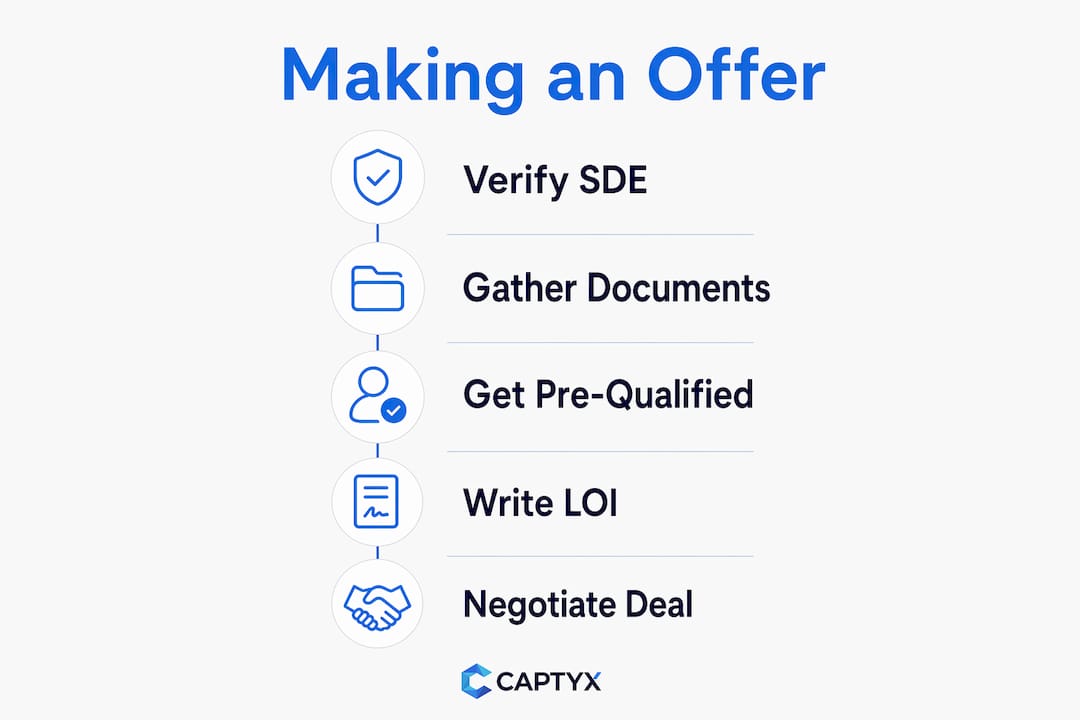
Preparation signals seriousness to sellers. A buyer who shows up with pre-approval letters, organized financials, and a clear financing plan wins deals over higher bidders who look unprepared.

Financing: get pre-qualified first
The SBA 7(a) loan program is the most common financing tool for small business acquisitions. It requires a 10–20% down payment and carries a 60–90 day closing timeline. The SBA guaranteed over 70,000 loans in fiscal year 2024, which shows the program is active and accessible.
Pre-qualification is not optional. Without it, sellers and their brokers will not take your offer seriously. A pre-approval letter from an SBA lender tells the seller you can close.
Documents to gather before you offer
- Three years of the seller’s tax returns and profit and loss statements
- A pre-approval or pre-qualification letter from your lender
- Proof of funds for the down payment
- A quality of earnings report if the deal is above $500,000
- A deal-flow tracker to manage timelines and document requests
Pro Tip: Build a simple deal-flow tracker in a spreadsheet. Log every business you evaluate, the SDE, the asking multiple, and the status of your due diligence. This keeps you organized and helps you compare deals objectively.
Sellers read buyer readiness as a proxy for deal certainty. A buyer who arrives with all documents organized closes more deals than one who scrambles for paperwork after the LOI is signed.
How do you write a Letter of Intent that gets accepted?
A Letter of Intent, or LOI, is the formal document that initiates the purchase agreement process. It is typically 3–4 pages and includes both binding and non-binding clauses. 78% of initial LOIs are rejected primarily because of inadequate terms and a failure to demonstrate the ability to close.
Key elements every LOI must include
- Opening rationale. State clearly why you want to buy this specific business. Sellers respond to buyers who understand and respect what they built.
- Offer price and structure. Specify the total price, how much is cash at closing, and whether any portion is seller financing or an earnout.
- Contingencies. List the conditions that must be met before closing, such as satisfactory due diligence and financing approval.
- Timeline. Define the due diligence period (typically 30–60 days) and the target closing date.
- Exclusivity clause. Request a 30–45 day exclusivity window so the seller stops marketing the business while you complete due diligence.
- Proof of funds. Attach your pre-approval letter or bank statement showing available capital.
Binding vs. non-binding clauses
Most LOI terms are non-binding, meaning either party can walk away during due diligence. The exceptions are the exclusivity clause and the confidentiality agreement, which are typically binding. LOI rejection often stems from buyers misunderstanding this distinction and including terms that are either too aggressive or too vague.
Deal certainty influences sellers more than price in many cases. A buyer offering $1.8 million with SBA pre-approval and proof of funds will often beat a buyer offering $2 million with no financing documentation.
Pro Tip: Keep your LOI clean and professional. Avoid attaching excessive conditions or lowball contingencies that signal you are not serious. A concise, well-structured LOI communicates competence.
What negotiation strategies work after you submit your offer?
Negotiation begins the moment the seller reads your LOI. Your goal is to reach a deal that works financially for you while keeping the seller engaged and confident.
Make the first offer when you are prepared
Making the first offer anchors the negotiation favorably when you have objective market data behind it. Research from Harvard’s Program on Negotiation confirms that the first offer shapes the bargaining range and maximizes economic outcomes for the party that sets it. The key word is “prepared.” An uninformed first offer backfires.
“The buyer who makes the first offer with verified data and a clear rationale controls the negotiation frame. The buyer who waits for the seller to anchor loses that advantage before the conversation starts.”
Leave room to move. If your target price is $1.5 million, open at $1.35 million. That gives you space to negotiate up while staying within your financial model.
How to handle counteroffers
- Respond to every counteroffer in writing, even if it is just to acknowledge receipt.
- Never accept the first counteroffer immediately, even if it is acceptable. A pause signals that you are evaluating carefully.
- Use objective data to justify your position. Reference the SDE multiple, comparable sales, or the add-backs you could not verify.
- Separate price from terms. If the seller will not move on price, negotiate on seller financing, earnout structure, or transition support.
Pro Tip: Sellers are often more attached to their business emotionally than financially. Acknowledging the business’s strengths in your counteroffer language builds goodwill and keeps the conversation productive.
Understanding how buyers actually value businesses gives you a significant edge when you explain your offer rationale to a seller.
Common mistakes to avoid when making an offer
Buyers lose deals not because they offered too little, but because they made avoidable errors that destroyed seller confidence.
- Basing the offer on the asking price. The asking price is a starting point, not a valuation. Build your number from verified SDE and market multiples.
- Ignoring seller motivations. Some sellers prioritize a fast close over maximum price. Others care deeply about employee retention. Understanding their priorities helps you structure a more attractive offer.
- Submitting an LOI without proof of funds. An LOI with no financing documentation signals that you are not ready to close. Sellers and brokers will move to the next buyer.
- Accepting add-backs without verification. Inflated add-backs are the most common way buyers overpay. Verify every line item before you finalize your offer price.
- Overlooking financing structure limits. SBA lenders have specific requirements around business type, revenue, and debt service coverage. Confirm your deal fits the lender’s criteria before you submit an offer.
Reviewing common mistakes in small business sales from the seller’s perspective also sharpens your instincts as a buyer.
Key Takeaways
Making a credible offer on a small business requires verified SDE, a well-structured LOI with proof of funds, and a negotiation approach grounded in objective market data.
| Point | Details |
|---|---|
| Value from SDE, not asking price | Build your offer from verified cash flow using the 2x–4x SDE multiple range. |
| Discount unverified add-backs | Sellers inflate SDE by 15–50%; verify every add-back before finalizing your price. |
| Get SBA pre-approval first | A pre-approval letter signals deal certainty and often beats higher offers without financing proof. |
| Write a clean, specific LOI | Include price, structure, contingencies, timeline, exclusivity, and proof of funds in 3–4 pages. |
| Anchor the negotiation early | Making the first offer with objective data sets the bargaining range in your favor. |
What I have learned from watching buyers win and lose deals
The buyers who consistently close deals are not the ones with the most money. They are the ones who show up prepared. I have watched buyers with strong financials lose deals to less-capitalized buyers simply because the prepared buyer’s LOI was cleaner, their financing was documented, and they understood the seller’s real motivation.
The biggest misconception I see is that negotiation is about grinding the price down. It is not. Negotiation is about building enough trust that the seller believes you will actually close. A seller who doubts your ability to close will accept a lower offer from a buyer they trust. That is not irrational. It is practical.
Valuation is where most buyers also get into trouble. They hear “2.7x SDE” and apply it mechanically without adjusting for the specific business. A business with declining revenue, one major customer, and an owner who handles every client relationship is not a 2.7x business. It might be a 1.8x business, and you need to be able to explain that clearly and respectfully in your offer.
The LOI is your first real test of professionalism. Sellers and their advisors read LOIs carefully. A vague, poorly structured LOI tells them you are a first-time buyer who may not close. A tight, well-organized LOI tells them you are serious. That perception alone changes how they respond to your offer.
— Tucker
Captyx can help you structure a stronger offer
Buying a business is one of the largest financial decisions you will make. Getting the valuation wrong or submitting a weak LOI can cost you the deal or, worse, cause you to overpay significantly.

Captyx has advised on over 225 business transactions and built the systems that most M&A advisors use to prepare businesses for sale. That same expertise works in your favor as a buyer. Use Captyx’s free business valuation tool to build a defensible offer price before you approach any seller. For buyers who want full advisory support through the offer and negotiation process, Captyx M&A advisory services provide hands-on guidance from term sheet to closing.
FAQ
What is a Letter of Intent when buying a small business?
A Letter of Intent (LOI) is a 3–4 page document that outlines your offer price, deal structure, contingencies, and timeline. Most LOI terms are non-binding, but exclusivity and confidentiality clauses are typically binding.
What multiple of SDE should I offer for a small business?
The median small business sells at 2.7x SDE, with a typical range of 2x–4x. The right multiple depends on revenue trends, owner dependency, customer concentration, and the quality of the business’s financials.
How do I get financing to buy a small business?
The SBA 7(a) loan is the most common financing option. It requires a 10–20% down payment and a 60–90 day closing process. Get pre-qualified before submitting any offer.
Why do most Letters of Intent get rejected?
78% of LOIs are rejected due to inadequate terms and a failure to demonstrate the ability to close. Including proof of funds and a clear financing plan significantly improves acceptance rates.
Should I make the first offer or wait for the seller?
Make the first offer when you have verified financial data and a clear rationale. Research from Harvard’s Program on Negotiation shows that the first offer anchors the negotiation and maximizes outcomes for the party that sets it.


