


TL;DR:
- Qualifying an offmarket business involves assessing financial health, seller motivation, operational maturity, and strategic fit to identify viable deals early. Using financial metrics like revenue growth, EBITDA margin, and debt ratios, along with seller signals and operational indicators, helps filter high-potential opportunities before engaging. A focused, relationship-driven approach rooted in precise qualification processes leads to better acquisition outcomes.
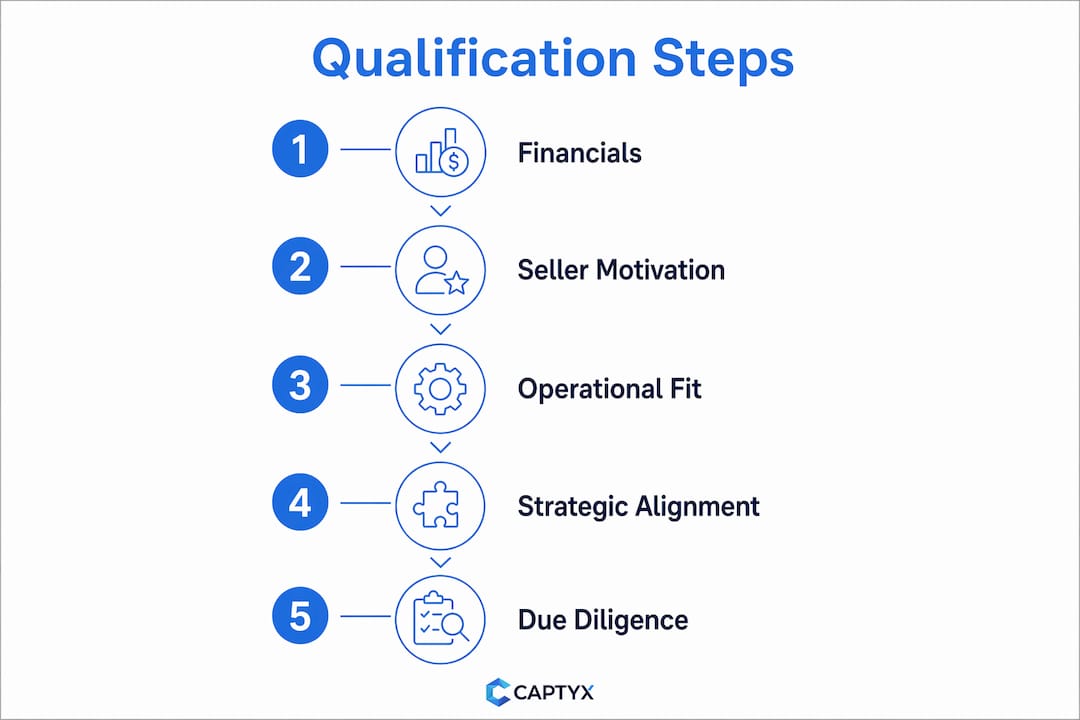
Qualifying an offmarket business opportunity means determining whether a business is a viable acquisition by quickly assessing key financials, seller intent, and operational fit before competing buyers enter the picture. These hidden business opportunities rarely appear on public listing sites, which means buyers who move fast and screen well gain a real edge. The qualification process covers five core areas: financial health, seller motivation, operational maturity, strategic fit, and deal structure. Get these right, and you avoid wasting months on deals that were never going to close.
What financial metrics best qualify an offmarket business opportunity?
Financial qualification is the first filter every serious buyer applies. A business that looks attractive on the surface can hide weak cash flow, concentrated revenue, or debt that makes financing impossible.
The most reliable financial indicators to screen for are:
- Revenue growth trend: Look for consistent growth over three or more years. A single strong year followed by flat performance is a warning sign, not a green light.
- EBITDA margin: This shows how much profit the business generates before financing and accounting decisions. Healthy margins vary by industry, but declining margins signal operational problems.
- Free cash flow yield: Targets with FCF yield above the industry median and manageable debt indicate genuine financial health, not just accounting-friendly EBITDA.
- Debt to EBITDA ratio: Acquisition targets should carry a debt to EBITDA ratio below 3x to remain attractive to lenders and buyers alike. Higher ratios shrink your financing options fast.
- Customer concentration: SBA lenders prefer businesses with customer concentration below 30%. A single client representing 40% of revenue is a deal-killer for most loan approvals.
- Add-backs and adjustments: Sellers often add back owner compensation, personal expenses, and one-time costs to inflate EBITDA. Verify every add-back with documentation before accepting the adjusted figure.
Pro Tip: Request three years of tax returns alongside the profit and loss statements. Tax returns are harder to manipulate than internal financials and reveal the true earnings picture.
| Financial Metric | Qualification Threshold |
|---|---|
| Debt to EBITDA ratio | Below 3x |
| Customer concentration | Below 30% of revenue |
| Revenue trend | Growth over 3+ years |
| FCF yield | Above industry median |
| EBITDA add-backs | Verified with documentation |
Cross-checking revenue and EBITDA with actual documentation is the only reliable way to confirm cash flow sustainability. Never accept a seller’s adjusted numbers without a paper trail.
How does seller motivation affect offmarket deal qualification?
Seller motivation is the second filter, and buyers consistently underestimate it. A business with great financials attached to an unmotivated seller is not a deal. It is a waste of your time.
Understanding a seller’s timeline and role expectations directly shapes whether a deal can close and on what terms. A seller who wants to exit in 90 days has different needs than one who wants a two-year earnout and a continued advisory role. Misaligned expectations kill more offmarket deals than bad financials do.
Key signals to assess early in every conversation:
- Timeline urgency: Is the seller reacting to a health event, a partnership dispute, or a retirement plan? Urgency creates negotiation flexibility for buyers.
- Post-close role preference: Some sellers want a clean break. Others want to stay on for 12 months. Know this before you structure an offer.
- Minimum deal economics: What price and structure does the seller consider acceptable? A seller anchored to a number 40% above market value will not close regardless of your qualification work.
- Non-negotiable deal breakers: Identify these early. Common ones include employee retention guarantees, real estate lease assignments, and earn-out structures the seller refuses to accept.
- Communication confidentiality: Many offmarket sellers have not told employees, customers, or competitors they are considering a sale. Respect that. Breach of confidentiality ends the relationship immediately.
Direct access to sellers offmarket reduces bidding wars and gives buyers real leverage over deal structure, including the ability to negotiate seller financing. That leverage disappears the moment a deal goes to market.
Pro Tip: Ask the seller what a successful outcome looks like for them personally, not just financially. The answer tells you more about deal feasibility than any financial document.
How do you evaluate operational maturity and strategic fit?
Operational maturity separates businesses that can run without the owner from those that collapse the moment the owner leaves. Strategic fit and operational maturity influence integration success more than purchase price valuation does. That is a finding worth taking seriously.

Strong operational indicators include a documented management team, written processes, and systems that do not depend on one person’s knowledge. A business where the owner handles every key customer relationship, approves every invoice, and holds every vendor contract is an owner-dependent business. It carries a hidden risk that no financial model captures.
Assess these operational factors in every deal:
- Management team depth: Can the business run for 30 days without the owner present? If not, you are buying a job, not a business.
- Revenue recurrence: Subscription models, long-term contracts, and repeat customer rates above 70% signal stable, predictable cash flow.
- Customer retention rate: Analyzing retention and recurring revenues helps gauge long-term business viability. High churn is a structural problem, not a temporary one.
- Systems maturity: Are there documented SOPs, CRM systems, and financial reporting tools in place? Businesses without these require significant post-close investment.
- Cultural fit: Operating style, decision-making speed, and team culture all affect how smoothly integration goes. A mismatch here creates friction that costs money and talent.
| Operational Factor | Strong Signal | Weak Signal |
|---|---|---|
| Management depth | Team runs without owner | Owner is single point of failure |
| Revenue recurrence | 70%+ repeat or contract revenue | Mostly one-time transactional sales |
| Systems maturity | Documented SOPs and CRM in use | Processes exist only in owner’s head |
| Cultural fit | Similar decision-making style | Conflicting values and operating pace |
Long-term acquisition success depends more on cultural and operational synergy than on attractive valuations. Buyers who skip this assessment often close deals they later regret.
What is the step-by-step process for sourcing and qualifying offmarket deals?
A repeatable process beats a reactive one every time. Buyers who close offmarket deals consistently build a system, not a one-off search.
- Define precise acquisition criteria. Set specific parameters: industry, revenue range, geography, EBITDA floor, and owner profile. Vague criteria produce vague results.
- Identify succession signals. Most buyers fail by generating overly broad target lists instead of precise ones. Succession signals include owner age 55 or older, no identified successor, first-ever general manager job postings, and stale websites that have not been updated in years. These signals indicate a seller who may be ready but has not yet listed.
- Use AI tools for list building and enrichment. AI platforms like Leadbay, Clay, and Claude amplify search precision and research depth in offmarket sourcing. They filter on niche, revenue range, owner age, and succession signals to build targeted prospect lists with better close rates.
- Build and score your prospect list. Rank prospects by fit score based on your criteria. Prioritize outreach to the top 20% of your list rather than blasting every contact.
- Reach out through warm channels first. Accountants, attorneys, and commercial lenders all work with business owners who are quietly considering a sale. A referral from a trusted professional opens doors that cold outreach cannot.
- Qualify through a structured first conversation. Cover financial range, timeline, and deal structure in the first call. Do not spend three meetings getting to questions you should have asked in the first 20 minutes.
- Track and score responses. Log every interaction. Sellers who respond but are not ready today are often ready in 6 to 18 months. A CRM keeps those relationships alive.
Pro Tip: Build a targeted offmarket pipeline using succession signals as your primary filter. You will spend less time on cold outreach and more time on conversations with owners who are actually ready to sell.
| Sourcing Method | Best Use Case |
|---|---|
| AI-enriched prospect lists | High-volume, precise targeting by niche and owner profile |
| Professional referral networks | Warm introductions to confidential sellers |
| Succession signal screening | Identifying high-probability sellers before they list |
| Direct outreach campaigns | Building relationships with owners 6–18 months before readiness |
Key Takeaways
Qualifying an offmarket business opportunity requires financial screening, seller motivation assessment, and operational due diligence before any deal reaches the negotiation stage.
| Point | Details |
|---|---|
| Financial thresholds matter | Screen for debt to EBITDA below 3x and customer concentration below 30% before going further. |
| Seller motivation drives deal feasibility | Misaligned timelines and price expectations kill more deals than bad financials do. |
| Operational maturity reduces post-close risk | Businesses dependent on the owner carry hidden costs that no financial model captures. |
| Succession signals improve targeting | Owner age 55+, no successor, and stale websites identify high-probability sellers early. |
| AI tools sharpen sourcing precision | Platforms like Leadbay and Clay filter prospects by niche, revenue, and succession signals for better close rates. |
What most buyers get wrong about qualifying offmarket deals
The biggest mistake I see buyers make is treating qualification as a checklist rather than a conversation. They run the numbers, check the boxes, and miss the one thing that actually determines whether a deal closes: the seller’s real motivation.
I have watched buyers spend months on deals where the financials were clean, the operations were solid, and the price was fair. The deal still fell apart because the seller was not emotionally ready to exit. No spreadsheet catches that. You catch it by asking the right questions early and listening to what the seller says about their life, not just their business.
The second mistake is chasing too many opportunities at once. A broad list feels productive. It is not. The buyers who close deals consistently work a short, precise list of high-fit targets and build real relationships with those owners over time. That takes patience, but it produces results that reactive buyers never see.
Captyx has sold over 225 businesses, including its own, and the pattern is consistent: the deals that close well start with a tight qualification process and a genuine understanding of what both sides actually need. The offmarket deal sourcing process rewards discipline over volume every single time.
— Tucker
How Captyx helps you find and qualify offmarket deals
Captyx built the qualification systems and sourcing frameworks that serious buyers use to find offmarket business opportunities before they reach the open market.

With over 225 businesses sold, Captyx brings a tested process to every engagement. The team combines deep M&A advisory experience with modern sourcing methods to help buyers identify high-fit targets, screen them against real financial and operational criteria, and move into conversations with sellers who are genuinely ready. Whether you are building your first acquisition pipeline or refining an existing one, Captyx’s broker-assisted deal sourcing gives you a faster path to qualified opportunities. You can also explore Captyx’s full advisory services to see how the team supports buyers from first contact through close.
FAQ
What does it mean to qualify an offmarket business opportunity?
Qualifying an offmarket business opportunity means screening a business against defined financial, operational, and seller criteria to determine if it is worth pursuing before due diligence begins. The goal is to eliminate poor fits early and focus time on deals that can actually close.
What financial ratio disqualifies most offmarket acquisition targets?
A debt to EBITDA ratio above 3x disqualifies most targets because it limits financing options and signals overleveraged operations. SBA lenders also flag customer concentration above 30% as a deal-breaker.
How do succession signals help identify offmarket sellers?
Succession signals such as owner age 55 or older, no identified business successor, and first-time general manager job postings indicate an owner who may be ready to sell but has not yet listed. Targeting these signals produces a higher-probability prospect list than broad industry searches.
How do AI tools improve offmarket deal sourcing?
AI platforms like Leadbay, Clay, and Claude filter prospects by niche, revenue range, owner age, and succession signals to build targeted lists with stronger close rates. They reduce the time spent on manual research and improve outreach precision significantly.
Why does cultural fit matter in offmarket acquisitions?
Cultural and operational fit determines how smoothly integration goes after a deal closes. Mismatched operating styles and decision-making cultures create friction that costs money and drives out key employees, regardless of how attractive the purchase price was.


