


TL;DR:
- A business acquisition thesis is a concise document that defines target criteria, industry focus, and value creation plans. It guides disciplined deal evaluation and aligns stakeholders before engaging with sellers. Developing and updating this thesis proactively ensures strategic fit and reduces acquisition risks.
A business acquisition thesis is a structured framework that defines why a company intends to acquire other businesses and how those acquisitions will create measurable value. In M&A practice, this document is also called an investment thesis for acquisitions or a “buy box.” It answers three questions before any deal begins: What type of business should we buy? Why does it fit our strategy? How will we generate returns after closing? Without this framework, buyers react to whatever comes to market rather than pursuing targets that actually move their business forward.
What is a business acquisition thesis, and what does it include?
An acquisition thesis is a written document that combines industry focus, target criteria, and a value creation plan into one coherent argument. Think of it as a filter. Every deal you evaluate either passes through the filter or gets cut, regardless of how attractive the seller’s pitch sounds.

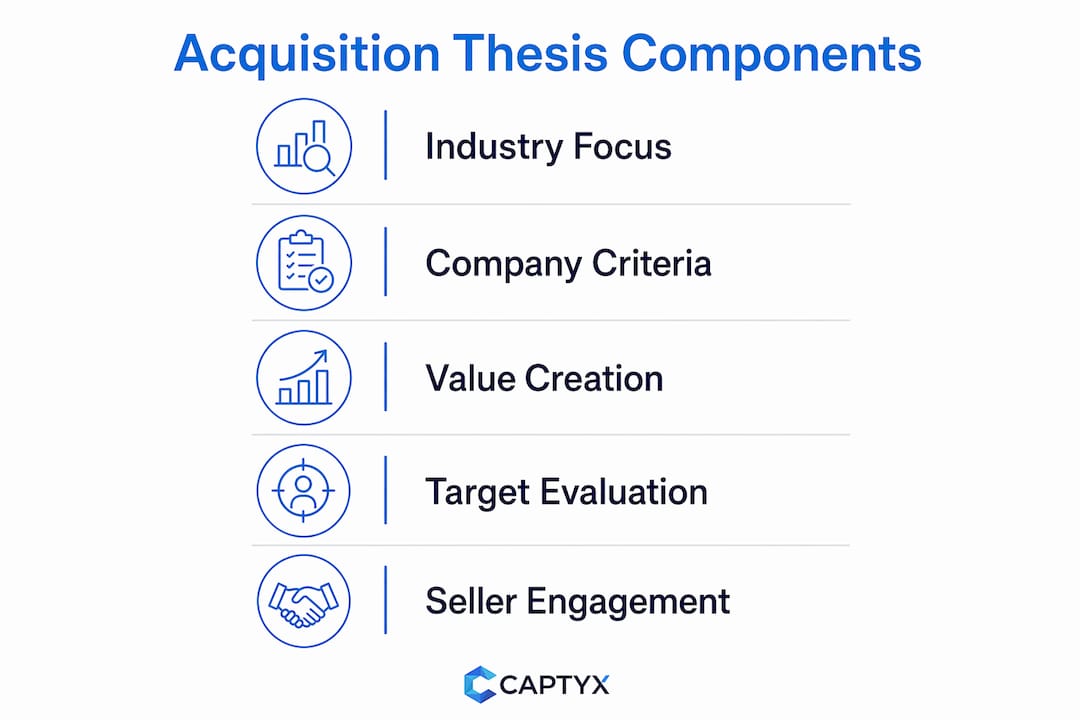
The core components of an acquisition thesis include three layers: industry focus, company criteria, and a value creation plan covering operational improvements, growth strategies, and technology enablement. A practical example: a buyer targeting HVAC or plumbing businesses might define criteria as $1M–$3M EBITDA, owner-operated, and located within a defined geographic region. That specificity keeps the search disciplined.
Industry focus and market context
Your thesis starts with a clear sector bet. You are not just buying a business. You are betting that a specific market will reward ownership over the next five to ten years. Define the sector, the demand drivers, and the competitive dynamics that make it attractive right now.
Company criteria
Criteria cover size, financial profile, business model, and geography. EBITDA range, revenue concentration, customer retention rates, and owner dependency are all fair criteria. The more specific your criteria, the faster you can disqualify poor fits and spend time on real opportunities.
Value creation plan
This is where most buyers underinvest. A value creation plan spells out exactly how you will improve the business after closing. Common levers include CRM implementation, geographic expansion, pricing discipline, and management team upgrades. Without this plan, you are buying hope rather than a thesis.
Pro Tip: Use the Six Ms framework — Market, Margins, Monetization, Moat, and Mitigants — to grade each target against your strategic priorities before spending time on diligence.
How do you evaluate acquisition targets rigorously?
Rigorous evaluation means testing every target across three separate dimensions: strategic fit, financial fit, and operational fit. Professional acquisition strategies require fit-testing across all three dimensions and excluding targets that fail any single benchmark, regardless of how attractive they look overall. A strong score in two dimensions cannot rescue a weak score in the third.
Here is how to apply each dimension in practice:
-
Strategic fit. Ask whether this acquisition gives you capabilities you could not build internally within 12 months. If the answer is no, the deal is probably not worth the complexity. Assess competitive advantage, market position, and whether the target’s customer base complements yours.
-
Financial fit. Model synergies conservatively. Revenue synergies are overestimated by 40–50% during thesis and valuation, which leads directly to overpaying. Build three scenarios: base, upside, and downside. The downside scenario should still produce an acceptable return.
-
Operational fit. Assess whether your team can actually absorb this business. Merging CRM, ERP, and financial systems is one of the most common failure points in acquisitions. Get concrete estimates from your operations and IT teams before you sign a letter of intent.
-
Cultural fit. Cultural misalignment causes 43% of failed integrations, surpassing price disputes, diligence gaps, or synergy misses as the leading cause of post-close failure. Assess management style, decision-making rhythms, and company values before closing.
-
Threshold scoring. Score each dimension independently. A target that scores well on strategy and finance but poorly on operations should be cut or restructured before deal momentum builds. Deal momentum is the enemy of clear thinking.
One more number worth internalizing: acquirers underestimate integration costs by 50–100%, overlooking management opportunity cost, system consolidation, and cultural alignment timelines that can stretch 12–24 months. Budget accordingly.
Why does your thesis need to exist before you talk to sellers?
The biggest mistake in M&A is treating acquisitions as reactive events rather than proactive strategies. Buyers who develop their thesis after seeing a deal are always playing catch-up. They evaluate the business on the seller’s terms rather than their own.
A finalized thesis before outreach produces three concrete advantages:
- Focused deal flow. You can brief brokers, advisors, and your network on exactly what you want. This generates better leads and wastes less time on mismatched opportunities. Captyx, for example, works with buyers who have a defined buy box to source off-market deals that never reach public listings.
- Negotiation clarity. When you know your walk-away criteria in advance, you negotiate from a position of discipline rather than desire. Sellers and their advisors can tell the difference.
- Stakeholder alignment. A written thesis aligns your board, partners, and lenders before the first conversation with a seller. It prevents the internal debates that slow deals and erode confidence.
Pro Tip: The best M&A processes start with a clear vision of where you want your business in five to ten years, not a target list. Write that vision first, then derive your acquisition criteria from it.
Businesses that skip this step often end up with acquisitions that looked good on paper but pulled the organization in two directions at once. A thesis prevents that by tying every deal back to a long-term strategic goal.
How to write an acquisition thesis that holds up under pressure
Building a thesis that survives contact with real deals requires more than a one-page summary. Follow these steps to create a document that guides decisions under pressure:
-
Start with your five-year strategic vision. Where does your business need to be? What capabilities, markets, or revenue streams are missing? The answers define what you should be buying.
-
Define your target criteria precisely. Set specific ranges for EBITDA, revenue, geography, and business model. Vague criteria produce vague deal flow. Use your business evaluation framework to set thresholds that reflect your actual integration capacity.
-
Apply the 3-Dimensional Fit Test. The “Should We Acquire” framework scores strategic, financial, and operational fit independently. Use it as a gate before committing to full diligence.
-
Engage cross-functional teams early. Engaging operations and IT teams early to get concrete integration estimates is the single most underused step in acquisition planning. Do it before the letter of intent, not after.
-
Plan integration before signing. Early integration planning across workstreams reduces execution risk and accelerates value capture from day one post-close. Waiting until after signing is one of the most expensive habits in M&A.
-
Iterate with market feedback. Your first thesis will not be perfect. Run it past advisors, brokers, and operators in your target sector. Refine the criteria based on what is actually available in the market at realistic valuations.
The table below maps each thesis component to its primary function in the acquisition process:
| Thesis component | Primary function |
|---|---|
| Industry focus | Defines the market bet and demand drivers |
| Target criteria | Filters deal flow and speeds disqualification |
| Value creation plan | Justifies the price and guides post-close actions |
| Fit-test scoring | Prevents deal momentum from overriding judgment |
| Integration plan | Protects value from day one post-close |
Key Takeaways
A business acquisition thesis is the single document that separates disciplined buyers from reactive ones, and it must exist before any seller conversation begins.
| Point | Details |
|---|---|
| Define the thesis first | Write your acquisition framework before contacting sellers or brokers. |
| Use three-dimensional fit testing | Score strategic, financial, and operational fit independently; a weak score in any one dimension disqualifies the deal. |
| Model synergies conservatively | Revenue synergies are overestimated by 40–50%; build a downside scenario that still works. |
| Plan integration before signing | Engaging operations and IT before the letter of intent prevents the most expensive post-close surprises. |
| Tie every deal to a long-term vision | Your five-year strategic goal should generate your acquisition criteria, not the other way around. |
The uncomfortable truth about acquisition theses I’ve seen ignored
Most buyers I work with arrive with a target in mind, not a thesis. They have already fallen in love with a business before they have asked whether it fits their strategy. That emotional attachment is the most expensive thing in M&A.
The pattern is consistent. A buyer sees a business with strong revenue and a motivated seller. They start diligence. Three months later, they discover the customer base is dangerously concentrated, the ERP system is incompatible with theirs, and the owner is the entire sales team. None of that would have survived a proper thesis filter applied on day one.
The other mistake I see constantly is treating the thesis as a one-time document. Markets shift. Your own business changes. A thesis written in january may need revision by september if your capacity or strategic priorities have moved. The best acquirers treat their thesis as a living document, not a box to check.
Flexibility matters too. A rigid thesis that disqualifies every deal because a target is 10% outside the EBITDA range will leave you sitting on the sidelines. The thesis is a guide, not a prison. Use it to make faster, better decisions, not to avoid making decisions at all. The buyers who avoid common acquisition mistakes are the ones who built their thesis early and updated it honestly.
— Tucker
How Captyx helps buyers build and execute their acquisition thesis
Captyx has advised on over 225 business transactions, including deals where the buyer came in with a clear thesis and deals where they did not. The difference in outcomes is not subtle.

Captyx works with buyers at the thesis stage, before a single seller conversation happens. The team helps define target criteria, stress-test value creation plans, and source off-market acquisition targets that match a defined buy box. Because Captyx built the systems most brokers use to prepare businesses for sale, the firm understands exactly what buyers should be looking for and what sellers are likely to conceal. If you are ready to move from reactive deal-chasing to a thesis-driven acquisition process, Captyx’s M&A advisory services are built for exactly that transition.
FAQ
What is a business acquisition thesis in simple terms?
A business acquisition thesis is a written framework that defines what type of business to buy, why it fits your strategy, and how you will create value after closing. It acts as a filter for every deal you evaluate.
How long should an acquisition thesis be?
An acquisition thesis does not need to be long. A clear, usable thesis fits on one to three pages and covers industry focus, target criteria, and a value creation plan with specific metrics.
What is the difference between an acquisition thesis and an acquisition strategy?
An acquisition strategy is the broader plan for using M&A to grow your business. An acquisition thesis is the specific argument for a particular type of deal or target, derived from that strategy.
Why do acquisitions fail without a clear thesis?
Without a thesis, buyers evaluate deals on the seller’s terms rather than their own. This leads to overpaying, poor strategic fit, and integration failures. Cultural misalignment alone causes 43% of failed integrations.
When should you develop your acquisition thesis?
Develop your thesis before you contact any seller, broker, or advisor. Experienced acquirers finalize their thesis first and let it guide outreach, not the other way around.


