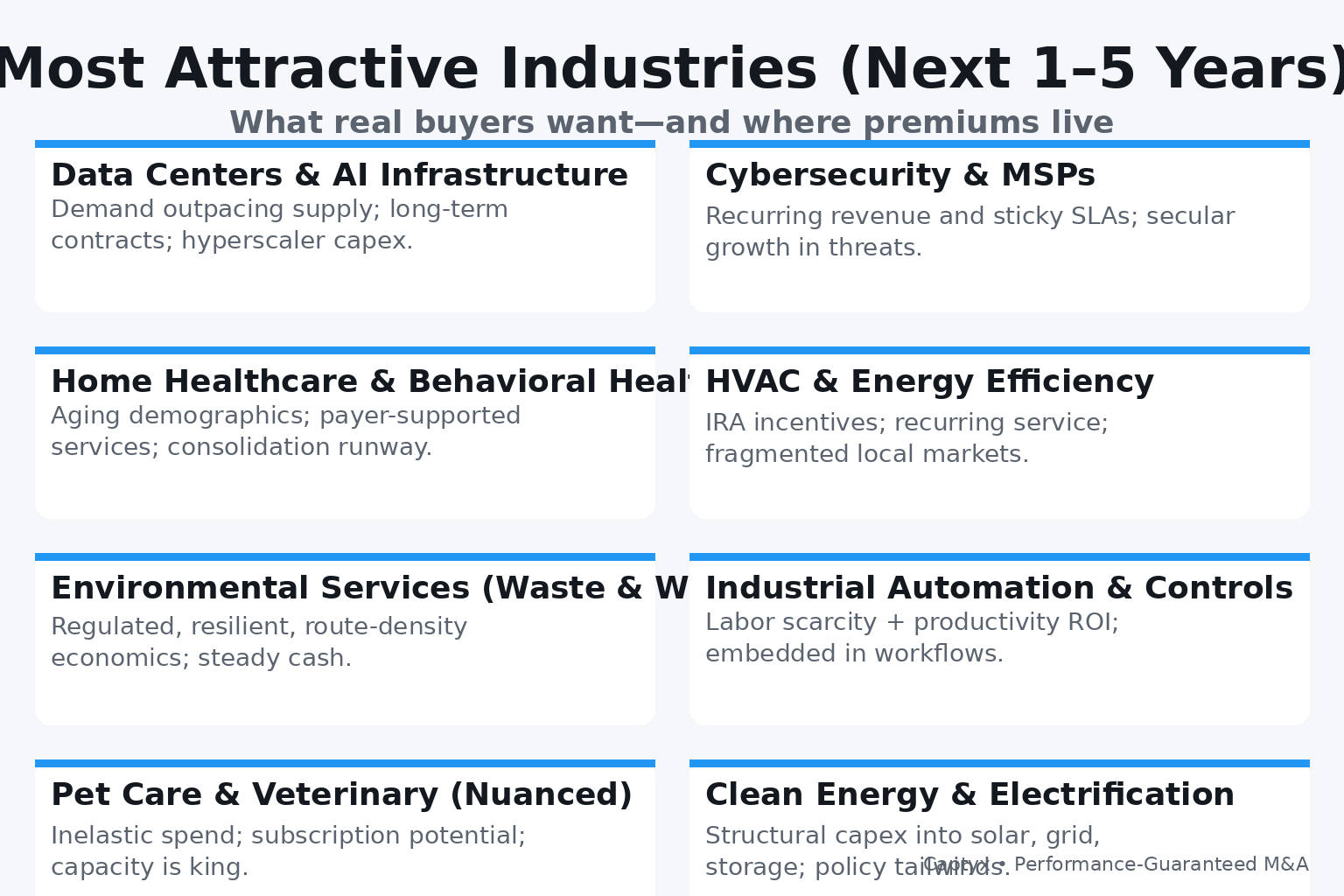
There are many industries that will be enhanced by AI, not replaced – and those are incredibly attractive to buyers.
Tucker Pool, CEO
I met with a business owner who operated an HVAC company for twenty years. Good business, solid margins, loyal customers. But he was shocked when I told him his timing couldn’t be better for an exit.
“Really?” he said. “I mean, we fix air conditioners. It’s not exactly cutting-edge.”
Here’s what he didn’t realize: his “boring” HVAC business sits at the center of the biggest infrastructure spend in a generation. Between the energy transition, new construction, and aging systems that need replacement, buyers are throwing money at anything that touches heating and cooling.
He’s not alone in missing this. Most business owners think their industry is just their industry. They don’t see the massive economic forces creating once-in-a-decade buying opportunities.
If you’re planning an exit in the next few years, understanding these forces isn’t just helpful—it’s the difference between a decent sale and a life-changing payday.
The Data Center Gold Rush
Let me start with the most obvious one: anything that touches data centers or AI infrastructure.
The numbers are almost silly at this point. We’re looking at nearly $7 trillion in global data center buildout by 2030. Not billion—trillion. Every tech company, every bank, every manufacturer needs more computing power, and they need it yesterday.
I’ve got clients in electrical contracting, cooling systems, even security services who are getting acquisition offers they never dreamed of. Why? Because their boring, steady businesses are suddenly mission-critical to the AI revolution.
If you’re in this space—construction, power systems, networking, facility management—buyers will pay premiums for anything that shortens their path to more capacity. Just make sure your contracts are long-term and your expansion rights are locked down before you go to market.
The Cybersecurity Arms Race
Speaking of technology, cybersecurity is having its moment too. Every week brings another ransomware attack, another data breach, another reason for companies to panic about their digital security.
The managed IT services guys I work with can’t hire fast enough. They’re turning down work because they don’t have the people. Meanwhile, private equity firms are paying twenty-plus times earnings for anything with recurring cybersecurity revenue.
The key here isn’t just being in cybersecurity—it’s proving you can keep customers safe and happy. Document your service levels, track your incident response times, and for the love of all that’s holy, get your SOC2 compliance sorted out. Buyers will pay for certainty, but they need to see the proof.
Healthcare’s Hidden Goldmine
Now here’s one that might surprise you: home healthcare and behavioral health services.
Everyone talks about healthcare being broken, but they’re missing the real story. Baby boomers are aging in place, insurance companies are pushing care out of hospitals, and suddenly every service that can be delivered at home is worth its weight in gold.
I sold a home nursing business last year for thirty-two times earnings. Thirty-two! The buyer’s reasoning was simple: non-discretionary demand, aging population, insurance reimbursement, and room to expand into adjacent services.
Same story with mental health. Between pandemic aftershocks and reduced stigma, demand for behavioral health services has exploded. The challenge isn’t finding customers—it’s finding qualified providers and proving you can retain them.
If you’re in healthcare services, clean up your credentialing files, document your payer relationships, and track your clinical outcomes. Buyers want to see that you’re not just busy, but that you’re actually helping people get better.
The Trades Are Having Their Day
Back to my HVAC friend. His industry is getting hit by three massive trends at once.
First, the Infrastructure Reduction Act is throwing billions at energy efficiency and electrification. Heat pumps, smart thermostats, building automation—there’s federal money for all of it.
Second, the skilled labor shortage means established companies with trained technicians are worth their weight in gold. You can’t just hire HVAC techs off the street anymore.
Third, the subscription economy has finally reached the trades. Smart operators are moving from one-time service calls to ongoing maintenance contracts. That recurring revenue is exactly what buyers want to see.
The same dynamic is playing out in electrical, plumbing, and other mission-critical trades. If you’ve got the technicians, the trucks, and the customer relationships, consolidators are writing big checks.
Environmental Services: Boring But Profitable
Want to know what never goes out of style? Waste management and water treatment.
People always need their trash picked up and their water cleaned, regardless of what the economy is doing. Plus, the regulatory environment keeps getting stricter, which creates barriers to entry that protect existing operators.
I’ve watched Waste Management pay premium multiples for regional players who can help them fill in their route maps. Same thing is happening in water treatment, where point-of-use systems are becoming standard in commercial buildings.
The key is proving your operational efficiency. Map your routes, document your disposal contracts, and keep your compliance records spotless. Buyers want to see that you understand the logistics game.
Industrial Automation’s Moment
Here’s another trend most people are missing: industrial automation is exploding because companies literally can’t find workers.
When you can’t hire people, you buy robots. When you buy robots, you need someone to install them, maintain them, and integrate them with your existing systems. Suddenly, every systems integrator and automation specialist is fielding acquisition calls.
The Industrial automation market is expected to nearly double by 2030, and that’s probably conservative. Labor shortages aren’t going away, and the ROI on automation keeps improving.
If you’re in this space, focus on your software capabilities and recurring service revenue. One-time installations are nice, but buyers pay premiums for businesses that stick around to support and upgrade systems over time.
Pet Care (But Be Careful)
I have to include veterinary and pet services, but with a big caveat.
The pet industry hit $152 billion last year, and pet owners still treat their animals like family members. Private equity loves the recurring revenue from wellness plans and the emotional stickiness of the customer relationships.
But—and this is important—we’re seeing some pricing pushback for the first time in years. Pet owners are trading down on some services and delaying non-essential care. The industry is still growing, but it’s not the slam dunk it was three years ago.
If you’re in pet care, focus on capacity utilization and client retention. Prove that your customers stick around even when times get tight.
Clean Energy’s Infrastructure Wave
Finally, anything touching clean energy infrastructure is getting crazy valuations right now.
Solar installations, grid improvements, energy storage, EV charging—there’s $2.2 trillion in clean energy investment happening globally, and most of it needs local contractors and service providers to make it work.
I’ve got clients in electrical contracting who’ve pivoted to solar and tripled their business valuations in two years. Not because they changed what they do, but because what they do is suddenly critical to the energy transition.
Document your incentive qualifications, track your project backlogs, and understand interconnection timelines in your markets. Buyers want to see that you can navigate the regulatory maze.
Why Timing Matters
Here’s the thing about industry trends: they don’t last forever. The businesses selling into these markets right now are catching buyers at peak enthusiasm. Wait five years, and the premiums might be gone.
But riding a hot industry trend isn’t enough. You still need clean operations, documented processes, and a business that runs without you. The premium is for being in the right place at the right time with the right preparation.
Start documenting your processes now. Clean up your financials. Build the systems that prove your business will thrive under new ownership.
Because when the right buyer comes along, you want to be ready to say yes.
The Bottom Line
We prepared and helped sell my HVAC friend’s business and our preparation got him an 8x multiple because of it.
His boring business just became a growth story that buyers can get excited about.
Whatever industry you’re in, look for the larger forces at work. Understand why buyers are paying attention to your sector. Then make sure your business is ready to capitalize on that attention.
The best exits happen when preparation meets opportunity. Right now, in these eight industries, opportunity is knocking pretty loudly.
Ready to understand how industry trends affect your business value? We specialize in positioning businesses to capture premium valuations by highlighting their strategic value to buyers. Because timing is everything, but preparation is what makes timing profitable.