Build your business to operate without you and the odds of selling your business skyrocket.
Tucker Pool, CEO
After years of watching deals fall apart at the eleventh hour, I’ve noticed something: sellers consistently misunderstand what buyers are really after.
Most business owners think buyers want their story. The passionate origin tale. The vision for tomorrow. The secret sauce that makes everything special.
Here’s the truth that might sting a little: buyers don’t care about your story.
They want one thing—future cash flows they can count on. Everything else is just noise.
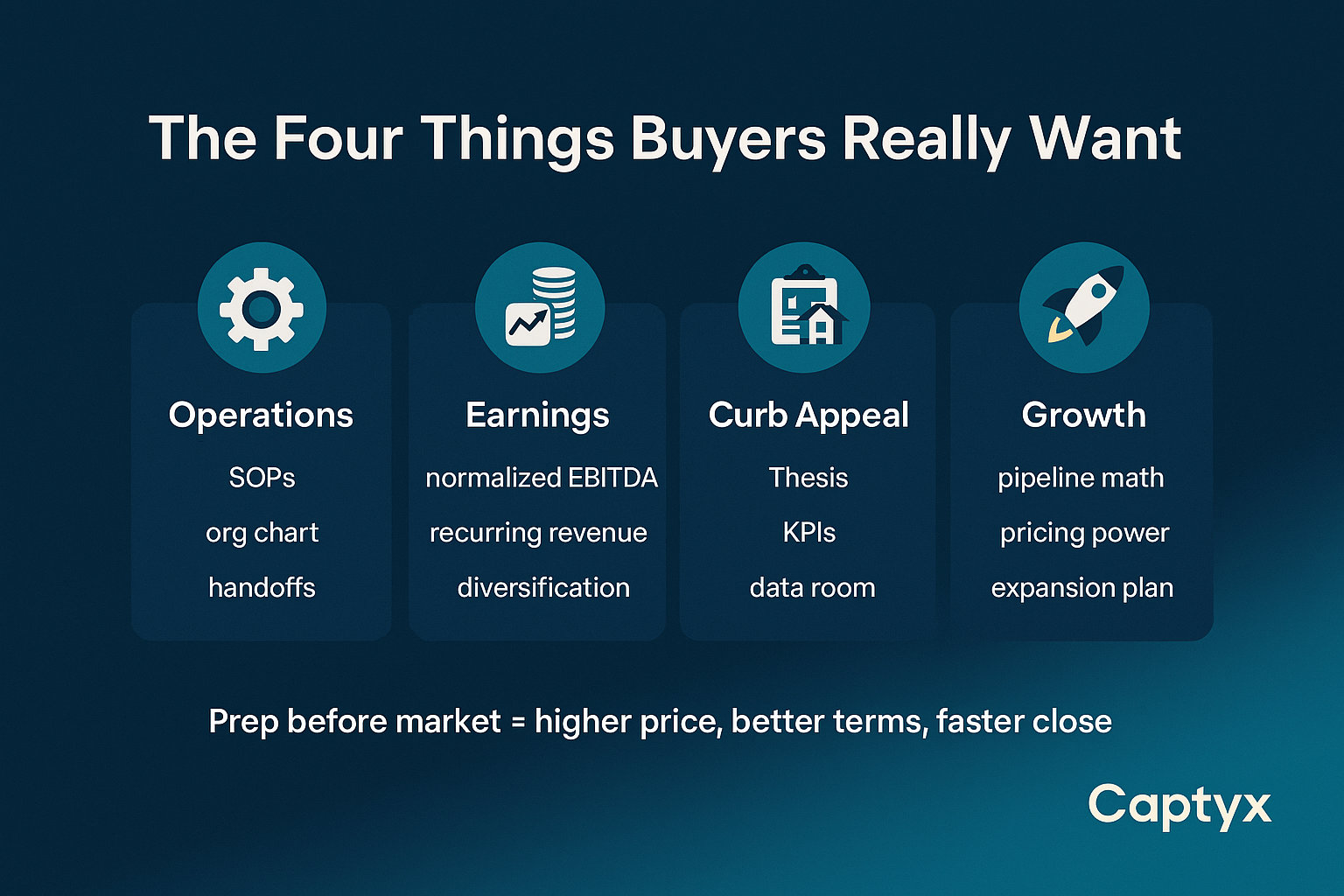
That certainty they’re chasing rests on four simple pillars. Get these right before you even think about going to market, and you’ll cut months off your sale timeline while adding serious zeros to your check.
The Business Has to Run Without You (Yes, Really)
I can’t tell you how many times I’ve watched a promising deal crater because the buyer realized the owner was the business. Every key relationship, every critical decision, every important password—all locked in one person’s head.
Smart buyers see this from a mile away. They’re not buying a job. They’re buying a machine that prints money whether the founder is on a beach in Bali or stuck in bed with the flu.
What does this look like in practice? Your head of sales should be able to close deals without you shadowing every call. Your operations manager should handle the monthly client review without you jumping in to save the day. Your bookkeeper should know where every number comes from without playing twenty questions.
I tell my clients to document their ten most critical processes. Not the sixty things they do, just the ten that would break everything if done wrong. Sales methodology. Customer onboarding. Monthly financial close. The basics that keep the lights on.
Then move three important approvals off your desk. Pick three things only you can approve today and teach someone else to handle them. Watch what happens—usually nothing breaks, and you get your life back.
The buyers who come through my deals light up when they see clean org charts, documented handoffs, and weekly scorecards that run without the owner playing traffic cop. It tells them this business will keep humming after the ink dries.
Your Financials Need to Tell a Clean Story
Here’s where things get interesting. Buyers aren’t just looking at your top line—they’re dissecting the quality of every dollar you make.
Recurring revenue beats project work every time. Diversified customers beat one whale account that could swim away tomorrow. Clean books beat creative accounting that requires a PhD to understand.
I’ve seen too many sellers try to jazz up their numbers with add-backs that would make a fiction writer blush. “Well, if you remove my wife’s salary and the lease on my boat, and adjust for that one weird month…” Stop. Just stop.
Instead, get ahead of this. Recast your financials like a buyer would—conservative, clean, and bulletproof. Document every adjustment with receipts. Extend contracts with your biggest customers before you go to market. Fix that accounts receivable mess that’s been bothering you for two years.
The best deals I’ve closed had sellers who handed over financials so clean you could eat off them. Revenue retention charts going back three years. Margin analysis by product line. Working capital trends that made sense at first glance.
Buyers pay premiums for certainty. Messy books scream uncertainty.
Package It Like You Mean It
This might sound superficial, but presentation matters more than you think.
I’ve watched buyers walk away from solid businesses because the seller couldn’t articulate what they were buying. Scattered materials. Missing contracts. KPIs that hadn’t been updated since Obama was president.
Your investment thesis should fit on two pages. What’s your competitive advantage? Where are the growth levers? What keeps you up at night, and how do you handle those risks?
Build your data room before you need it. All the contracts, properly organized. Financial statements that tie out. Employee records that won’t trigger an HR panic attack. IP documentation that actually exists.
Most important—get your story straight on the metrics that matter. Don’t make buyers hunt for basic numbers like customer acquisition cost or lifetime value. Put together a dashboard they can understand in five minutes, not five hours.
I tell clients to pretend they’re buying their own business. What would you want to see? What would make you confident this wasn’t a house of cards?
The deals that close fast have sellers who make it easy to say yes.
Show Them the Growth Engine
Here’s where most sellers completely whiff. They think buyers want to hear about all the amazing opportunities they never had time to pursue.
“We could expand into seventeen new markets! We could launch six new product lines! We could triple our team!”
Buyers hear this and think: “Great, so you’re selling me a fixer-upper.”
What they actually want is a growth engine that already works—one that just needs more fuel. Show them the sales process that consistently converts prospects. The expansion playbook you’ve already tested. The pricing power you’ve already proven.
Track your funnel metrics like your life depends on it. Know your win rates, your sales cycles, your customer acquisition costs. Not because some consultant told you to, but because these numbers prove your growth story isn’t wishful thinking.
Pick three growth initiatives you could execute in the next eighteen months. Not twenty. Three. With real budgets, real timelines, and real owners. Show buyers exactly how their capital and expertise makes you worth more to them than the next guy.
The most successful exits I’ve managed had sellers who turned their growth story from fiction into math.
The Payoff Is Real
Get these four pillars right, and something magical happens. Instead of begging for one decent offer, you’re managing multiple buyers who actually want what you’re selling.
Your multiple goes up because you’ve eliminated the uncertainty discount. Your terms improve because buyers aren’t afraid of nasty surprises. Your timeline shrinks because diligence becomes a confirmation exercise, not an archaeological dig.
Most important—you sleep better at night knowing you’ve built something worth buying.
Start Now, Thank Yourself Later
If you’re thinking about an exit in the next couple years, start this work today. Not next quarter. Today.
Document one process this week. Clean up one financial mess this month. Update one dashboard this quarter.
This stuff compounds. Every month you wait is money left on the table and stress you don’t need.
The best time to prepare for your exit was five years ago. The second-best time is right now.
Trust me on this one—future you will thank present you for doing the work that turns your business from a story into an investment.
Ready to get serious about your exit? We specialize in helping business owners build these four pillars systematically, with performance guarantees backing our work. Because when you’re ready to sell, there are no do-overs.