


TL;DR:
- A business valuation report reliably determines a company’s worth using standardized methods and professional credentials. It covers purpose, business details, economic context, financial analysis, valuation approaches, discounts, and a final supported value. Such reports are essential for legal, financial, or negotiation purposes, providing credible, defensible evidence in high-stakes transactions.
A business valuation report is a formal, analytical document that determines what a company is worth, and more importantly, explains exactly how that number was reached. It covers the purpose and scope of the engagement, a description of the business, economic and industry context, detailed financial analysis, the valuation methods applied, any applicable discounts, and a final opinion of value. Reports prepared by credentialed professionals follow standards set by the American Society of Appraisers (ASA) and the Uniform Standards of Professional Appraisal Practice (USPAP), which means the IRS, courts, and lenders can scrutinize and rely on them. An informal estimate from a broker or a back-of-napkin multiple is not the same thing. The difference matters most when money is on the line.
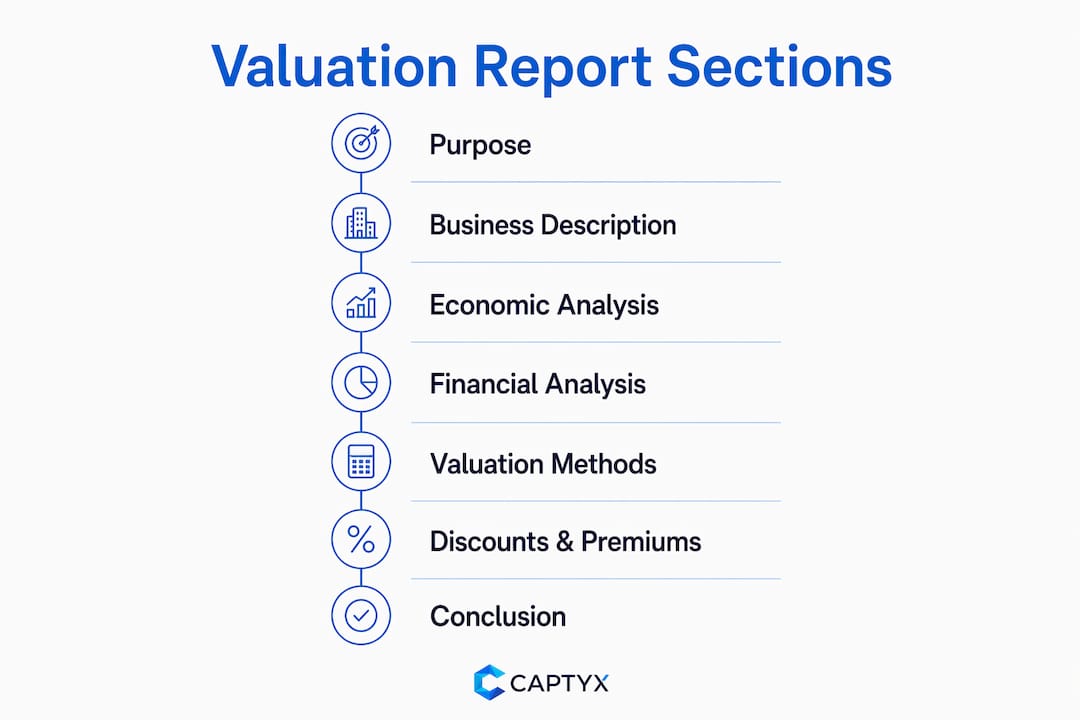
Key elements found in a complete business valuation report:
- Purpose and scope: The standard of value (fair market value, investment value), the valuation date, and the intended use
- Business description: History, ownership, products or services, management, and competitive position
- Economic and industry analysis: Macro conditions and sector trends as of the valuation date
- Financial analysis: Three to five years of historical performance, normalizing adjustments, and benchmark comparisons
- Valuation methodologies: Income, market, and asset approaches with rationale for each selection
- Discounts and premiums: Discount for lack of control (DLOC) and discount for lack of marketability (DLOM) where applicable
- Value conclusion: A final, supported opinion of value with all assumptions stated
Why do you actually need a business valuation report?
The short answer: any time a number carries legal, financial, or negotiating weight, a formal valuation report is the only document that holds up. Gut-check estimates and rule-of-thumb multiples work fine for casual conversations. They fall apart the moment a buyer’s attorney, an IRS auditor, or a bank underwriter starts asking questions.
A formal valuation is an independent, methodology-based determination of value under a specific standard at a specific point in time. “Fair market value,” for example, is the price at which a business would change hands between a willing buyer and a willing seller, neither under compulsion, both with reasonable knowledge of the relevant facts. That definition is not just legalese. It is the standard the IRS, courts, and lenders apply.
Beyond transactions, a valuation acts as a financial health check, surfacing risks like customer concentration and owner dependence that quietly reduce what a buyer will pay. Owners who commission valuations before they need them tend to have more time to fix what they find.
Common situations that require a credible valuation report:
- Selling or buying a business: Establishes a defensible asking price or offer basis
- SBA or bank financing: Lenders require documented value to underwrite loans
- Estate and gift tax planning: The IRS scrutinizes these closely; informal estimates do not qualify
- Shareholder disputes or buyouts: Courts and arbitrators need a methodology-based opinion
- Divorce proceedings: Marital asset division requires a formal, independent determination
- Equity compensation: Issuing stock options requires a defensible 409A valuation
- Strategic planning: Identifies value drivers and risks before making major operational decisions
What does a business valuation report actually contain?
A complete report is not a one-page summary. It is a structured document, often running dozens of pages, where every section builds the case for the final number. Reports following ASA and USPAP standards include a business description, economic context, financial analysis, methodology discussion, discounts, and a final conclusion, and a reader can trace the logic from the first page to the last.
Purpose and scope
Every report opens by defining what is being valued, the ownership interest (100% or a partial stake), the valuation date, the standard of value, and the intended use. These definitions are not boilerplate. They directly shape the analytical approach and the final number. A 30% minority interest valued for gift tax purposes will look very different from a 100% controlling interest valued for a sale.
Business description
This section covers the company’s history, ownership structure, products or services, customer base, management team, and competitive position. A thorough appraiser demonstrates a clear understanding of what makes the business unique and what factors drive or limit its value. This narrative also helps any third party reading the report, whether a lender, a court, or a buyer, understand the context behind the numbers.
Economic and industry analysis
Business value does not exist in isolation. The report analyzes national and local economic conditions as of the valuation date, along with the relevant industry outlook. Interest rates, GDP trends, employment conditions, and sector-specific factors all affect what a buyer would pay. This section shows that the appraiser considered the broader environment, not just the company’s internal financials.
Financial analysis
This is typically the most detailed section. It reviews three to five years of historical financial performance, runs ratio analysis against industry benchmarks, and documents normalizing adjustments. Those adjustments are critical: they remove non-recurring items, adjust owner compensation to market rates, and strip out personal expenses run through the business. The result is a cleaner picture of the company’s true earning power, which becomes the foundation for the valuation methods applied.

Valuation methodologies
Professional reports explain which approaches were applied and why others were set aside, with reasoning specific to the company and the engagement. The three core approaches are:
- Income approach: Capitalizes or discounts expected earnings or cash flows based on risk and growth assumptions
- Market approach: Compares the business to similar publicly traded companies or completed private transactions
- Asset approach: Analyzes the fair value of the company’s underlying assets minus its liabilities
No single method is universally correct. A capital-intensive manufacturing business and a service firm with minimal hard assets call for different weighting. The appraiser’s explanation of that choice is part of what makes the report defensible.
Discounts and premiums
When valuing a minority interest or a stake in a private company, the report addresses discounts for lack of control (DLOC) and lack of marketability (DLOM). These are not arbitrary haircuts. Each discount is supported by market evidence, empirical studies, and case-specific factors. For gift and estate tax valuations, the IRS scrutinizes these figures closely, so thorough documentation is not optional.
Value conclusion
The conclusion synthesizes every section into a final opinion of value. If multiple methods were applied, the appraiser explains how results were weighted or reconciled. The conclusion also states any assumptions, limiting conditions, or hypothetical conditions that apply, so readers know exactly what the number does and does not account for.
| Report section | Primary role in valuation |
|---|---|
| Purpose and scope | Defines the engagement parameters and standard of value |
| Business description | Provides operational context and competitive positioning |
| Economic and industry analysis | Anchors value to market conditions at the valuation date |
| Financial analysis | Normalizes earnings to reflect true earning power |
| Valuation methodologies | Applies and justifies income, market, and asset approaches |
| Discounts and premiums | Adjusts for control and marketability factors |
| Value conclusion | Delivers the final, supported opinion of value |
How to get a credible business valuation report
Getting a credible report starts well before you contact a valuation professional. The quality of the output depends heavily on the quality of the input.
Step 1: Define the purpose. The intended use determines the report type, the standard of value, and the level of documentation required. A calculation of value is a limited estimate, useful for internal planning but not defensible in court or with the IRS. A full valuation report follows professional standards and can withstand scrutiny from lenders, tax authorities, and transaction counterparties.
Step 2: Gather your financial records. The valuation process requires three to five years of tax returns, income statements, balance sheets, and documentation of any discretionary or non-recurring adjustments. Clean, well-organized records reduce the time an appraiser spends reconstructing your financials and improve the accuracy of the normalizing adjustments that reveal true earning power.
Step 3: Select a qualified professional. Look for credentials: Accredited in Business Valuation (ABV) for CPAs, Certified Valuation Analyst (CVA), or Chartered Financial Analyst (CFA). Certified reports prepared by CFAs and CPAs with ABV and CVA credentials use asset, income, and market approaches consistent with IRS Revenue Ruling 59-60. Ask any prospective appraiser which standards they follow, how they handle normalizing adjustments, and whether their reports have been reviewed by the IRS or used in litigation.
Step 4: Understand the cost and timeline. A certified valuation typically runs around $2,500 for a standard report and is usually delivered within one week for straightforward engagements. More complex businesses with multiple entities or unusual asset structures will cost more and take longer. Providers like Experian offer a faster, lower-cost option: their business valuation report covers equity value, asset sale value, enterprise value, liquidation value, and key performance indicators for $149, though that product is a data-driven estimate rather than a full appraisal prepared by a credentialed professional. MoneySoft produces detailed sample valuation reports that illustrate the full structure of a formal appraisal, useful for understanding what a complete document looks like before you commission one.
Key documents to prepare before engaging a valuation professional:
- Three to five years of federal tax returns (business and personal if a pass-through entity)
- Profit and loss statements and balance sheets for the same period
- A list of owner compensation and any personal expenses run through the business
- Contracts with major customers and suppliers
- Lease agreements and any off-balance-sheet liabilities
- Documentation of any non-recurring revenue or expenses
Questions to ask a valuation provider:
- Which professional standards do you follow (USPAP, AICPA SSVS)?
- What credentials do your appraisers hold?
- Have your reports been reviewed by the IRS or used in litigation?
- How do you handle normalizing adjustments for owner compensation?
- What is included in the final deliverable?
Pro Tip: Commission a valuation 12–24 months before you plan to sell. That window gives you time to act on what the report reveals, whether that means reducing customer concentration, cleaning up your books, or adjusting owner compensation, before buyers start their own due diligence.
Common misconceptions and the real strategic value of a valuation report
The most expensive mistake owners make is treating a rough industry multiple as a valuation. It is not. Rule-of-thumb multiples lack defensible methodology, and without documented earnings analysis, sellers are exposed in negotiations. A buyer’s advisor will find every weakness in your financials. If you do not have a formal report, you have no documented basis to push back.
Buyers use valuations defensively. They commission their own reports specifically to justify lower offers by highlighting risks, integration costs, and earnings quality concerns. A seller who walks into that negotiation with only a broker’s opinion of price is at a structural disadvantage. An independent, methodology-based report gives you a documented counter-argument.
Valuations also surface risks that owners often do not see from inside the business. Owner dependence, where the business’s revenue is tied to the owner’s personal relationships, is one of the most common value-reducers. Customer concentration, where one or two clients represent a large share of revenue, is another. A formal report names these risks explicitly, which gives you the chance to address them before they become a buyer’s leverage.
Strategic uses of a formal business valuation report:
- Exit planning: Establishes a baseline value and identifies what needs to improve before going to market
- Financing readiness: Banks and SBA lenders require documented value for loan underwriting
- Shareholder dispute resolution: Provides an independent, methodology-based opinion that courts and arbitrators accept
- Risk mitigation: Identifies customer concentration, owner dependence, and other factors that reduce marketability
- Succession planning: Supports fair transfer pricing for family transitions or management buyouts
- Negotiation leverage: Gives sellers a documented basis to respond to low offers with evidence
Pro Tip: If a buyer or their advisor challenges your asking price, a formal valuation report prepared by a credentialed professional is the only document that shifts the conversation from opinion to evidence. Prepare it before you need it, not after the first offer arrives.
Understanding why valuation matters for sellers goes beyond knowing a number. It is about controlling the narrative in a negotiation, and that requires documentation, not intuition.
Key Takeaways
A business valuation report is the only document that gives your company’s worth legal, financial, and negotiating credibility, and its quality depends entirely on the methodology and credentials behind it.
| Point | Details |
|---|---|
| Reports follow formal standards | ASA and USPAP standards ensure reports hold up with the IRS, courts, and lenders. |
| Seven core sections build the case | From purpose and scope through financial analysis to the value conclusion, each section supports the final number. |
| Credentials determine defensibility | Look for ABV, CVA, or CFA credentials; reports consistent with IRS Revenue Ruling 59-60 carry the most weight. |
| Certified reports start around $2,500 | A standard certified valuation typically costs around $2,500 and is delivered within one week for straightforward businesses. |
| Commission early, act on findings | Getting a valuation 12–24 months before selling gives you time to fix what the report reveals before buyers find it first. |
Captyx has built the systems and processes that most business brokers and M&A advisors rely on, and has applied them across more than 225 completed transactions. If you are preparing to sell, buy, or simply want to know where your business stands, a free valuation estimate is a practical first step before commissioning a full report.

Captyx’s advisory team works with owners to interpret valuation findings, address the risks buyers will flag, and position businesses for the strongest possible outcome. Whether you are 12 months from a sale or just starting to think about exit options, understanding your number early changes what you can do about it. Learn more about Captyx M&A advisory services and how a defensible valuation fits into a broader sale strategy.


