


TL;DR:
- Strategic buyers aim to acquire businesses that offer operational synergies fitting their growth objectives. Preparing early, documenting processes, and building owner-independent management increase acquisition value and premium prospects. Running a competitive sale process with clear synergy value maximizes the final price from strategic buyers.
Strategic buyer positioning is the process of reshaping your business so that a corporate acquirer sees it as a must-have asset, not just a profitable one. To position your company for a strategic buyer, you must align your operations, financials, and growth story with what that buyer needs to accomplish their own goals. Strategic buyers are companies acquiring for operational reasons: cross-selling, geographic expansion, technology acquisition, or competitor elimination. They value the combined entity, not just your standalone numbers. That distinction changes everything about how you prepare.
How to position your company for a strategic buyer
Strategic buyers and financial buyers want fundamentally different things. A financial buyer, such as a private equity firm, targets a 20–25% IRR over a 3–7 year hold period. A strategic buyer evaluates a deal over a 3–5 year integration window, asking how your business makes their existing operations more profitable. That shift in perspective changes your entire preparation strategy.
Strategic buyers fall into several categories:
- Competitors seeking to eliminate a rival, absorb market share, or acquire your customer list
- Adjacent market players looking to expand into your product category or customer segment
- Supply chain buyers such as suppliers moving downstream or distributors moving upstream
- Technology acquirers targeting your proprietary systems, data, or intellectual property
What drives their acquisition decisions is synergy. They want to cross-sell your products to their customers, expand into your geography, absorb your talent, or integrate your technology. Synergy value is calculated as standalone value plus synergy value plus a strategic premium. That formula is why strategic buyers routinely pay more than financial buyers, but only when you give them a clear reason to.
The attributes strategic buyers prize most are a niche market position, demonstrable growth potential, operations that run without the founder, and a customer base that overlaps with or complements their own. If your business checks those boxes, you have real leverage. If it does not, you have work to do before going to market.

What makes your business attractive to strategic acquirers?
The most attractive acquisition targets share a short list of characteristics. Strong, documented financial performance sits at the top. Buyers want to see consistent profitability and healthy EBITDA trends across at least three years. Clean books with no surprises reduce integration risk and support a higher multiple.
Organized systems and documented processes matter just as much as the numbers. Strategic buyers conduct intense operational due diligence covering IT systems, pipeline alignment, and cultural fit, going far beyond the financial review a typical financial buyer performs. If your processes live in your head or in informal spreadsheets, that scrutiny will expose it.
- Documented financials. Three or more years of clean, audited or reviewed financials with clear EBITDA margins.
- Diversified customer base. No single customer representing more than 15–20% of revenue.
- Owner-independent management. A second layer of leadership that can run the business without you.
- Transferable systems. Written SOPs, documented workflows, and organized data that survive a leadership change.
- Aligned growth potential. A credible growth story that maps directly to the buyer’s own expansion goals.
- Clean legal and compliance records. No pending litigation, unresolved regulatory issues, or undisclosed liabilities.
- Early buyer identification. A target list of 20–30 potential acquirers built 12–36 months before sale.
Pro Tip: Start building your buyer list before you think you need it. Relationships with potential acquirers, even informal ones, create “must-have” premiums that cold outreach never achieves.
| Attribute | Why it matters to a strategic buyer |
|---|---|
| Consistent EBITDA | Supports a higher multiple and validates synergy projections |
| Documented processes | Reduces integration risk and shortens post-close transition time |
| Owner-independent team | Signals continuity and eliminates key-person dependency concerns |
| Diversified customers | Lowers revenue concentration risk during integration |
| Clear growth narrative | Justifies paying a strategic premium above financial buyer offers |
Step-by-step strategies to attract and close strategic buyers
Preparing your business for a strategic sale is a deliberate, multi-year process. The steps below reflect what Captyx has refined across more than 225 completed transactions.
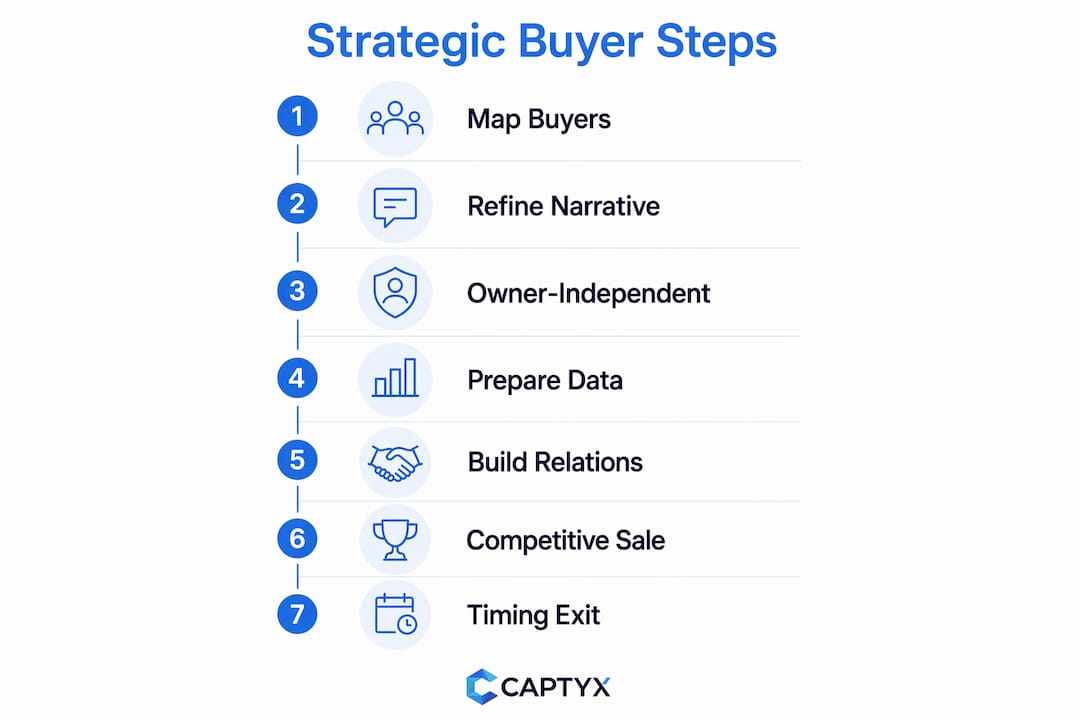
Step 1: Map your strategic buyer universe.
Identify 20–30 companies that would benefit from owning your business. Think beyond direct competitors. Include adjacent market players, suppliers, distributors, and companies in geographies you have not yet entered. Rank them by strategic fit, financial capacity, and likelihood of interest.
Step 2: Refine your synergy narrative.
Every buyer on your list has a different reason to want you. Build a tailored value proposition for each segment. Quantify the revenue synergies they could capture by cross-selling your products to their customers. Estimate the cost savings from consolidating back-office functions. Buyers pay for synergies they can see and measure.
Step 3: Build owner-independent operations.
A capable management team that operates without the founder materially increases value by reducing integration risk. Strategic buyers perform what practitioners call an “integration stress test,” asking what happens if the founder leaves on day one. Your answer must be: nothing changes. Document every critical process. Promote or hire a second layer of leadership before you go to market.
Step 4: Prepare your data room early.
Organize a virtual data room that covers operational, cultural, and technological dimensions, not just financials. Strategic buyers move quickly with cash-heavy deals and expect sellers to be ready. A disorganized data room signals operational immaturity and gives buyers leverage to renegotiate price.
Step 5: Begin relationship-building with target buyers.
Building relationships before a sale with clients, partners, or potential acquirers increases the likelihood of competitive offers and premium valuations. Attend industry conferences where your target buyers are present. Pursue partnerships or vendor agreements that create natural familiarity. The goal is to be a known quantity before you are a deal.
Step 6: Run a competitive sale process.
Never negotiate from a single offer. Competitive bid processes involving both strategic and financial buyers generally increase sale prices. Even if you prefer a strategic buyer, having financial buyers in the process creates urgency and sets a price floor. Captyx structures these processes to maximize tension and final value.
Step 7: Time your exit deliberately.
The best time to sell is when your revenue is growing, your management team is stable, and your industry is attracting acquisition activity. Selling into a down cycle or after a key customer departure costs you multiples. Plan your exit window 12–36 months in advance and use that time to address every known weakness.
Pro Tip: Never disclose your asking price first. Let the buyer’s synergy model drive their offer. Your job is to give them the data to justify paying more, not to anchor them to a number you invented.
Common mistakes that kill strategic deals
Most failed strategic sales share the same root causes. Recognizing them early saves you from losing a deal you should have won.
- Founder dependency. If the business cannot operate without you for 90 days, buyers will price that risk into their offer or walk away entirely.
- No synergy narrative. Presenting your business as a standalone profit machine misses the point. Strategic buyers need to see how you fit into their world.
- Single-offer negotiation. Accepting the first offer without creating competitive tension leaves significant value on the table.
- Shallow due diligence preparation. Strategic acquisition deals require rigorous integration planning and detailed operational disclosures. Sellers who are unprepared for this depth lose credibility and deal momentum.
- Late buyer outreach. Starting conversations with potential buyers after you decide to sell is too late. Relationships built over years produce better outcomes than cold outreach in a sales process.
- Misreading deal timelines. Strategic buyers move faster than private equity firms once they commit, but their internal approval processes can stall unexpectedly. Build timeline flexibility into your plans.
Strategic buyers share only 20–40% of synergy value in the price they pay sellers. The rest stays with the buyer. Your job is to maximize that share by making synergies visible, credible, and easy to model. Every dollar of synergy you can document and defend is a dollar you can negotiate toward your price.
Pro Tip: If a buyer asks for exclusivity early in the process, treat it as a signal that they are serious but also that they want to eliminate competition. Grant exclusivity only after you have a signed letter of intent with a price and terms you are prepared to accept.
How to assess and communicate your synergy value
Synergy value is the gap between what your business is worth alone and what it is worth inside a buyer’s organization. Sellers who can calculate and articulate that gap negotiate from a position of strength.
Revenue synergies come from cross-selling your products to the buyer’s customers, entering new geographies the buyer already occupies, or eliminating a competitor from the market. Cost synergies come from consolidating overlapping functions: finance, HR, marketing, and technology infrastructure. Both types are real, but revenue synergies are harder to guarantee and buyers discount them more heavily.
- Map customer overlap. Identify what percentage of your customers the buyer does not currently serve. That number represents direct cross-sell potential.
- Quantify your unique assets. Proprietary technology, exclusive supplier relationships, and geographic licenses are assets a buyer cannot replicate quickly. Price them accordingly.
- Model integration costs honestly. Buyers will run their own integration cost models. If yours is wildly optimistic, it destroys credibility. A conservative, well-supported model builds trust.
- Build a synergy summary document. A one-page synergy brief, tailored to each buyer segment, gives their internal deal team the ammunition to justify a higher price to their board.
Strategic premiums of 1–3x EBITDA above financial buyer offers are achievable for targets with clear synergy potential. That premium is not automatic. You earn it by doing the analytical work before the buyer does.
Pro Tip: Frame synergies in the buyer’s language, not yours. If they talk about “customer lifetime value,” show them how your customer base improves theirs. If they talk about “gross margin expansion,” show them the cost consolidation math. Buyers pay for stories they already believe.
Key Takeaways
Sellers who prepare deliberately and communicate synergy value clearly capture the largest premiums from strategic buyers.
| Point | Details |
|---|---|
| Start early | Build your buyer list and begin relationship outreach 12–36 months before your target sale date. |
| Document everything | Organized systems, SOPs, and financials reduce integration risk and support higher multiples. |
| Build owner independence | A management team that runs without you eliminates the single biggest concern strategic buyers have. |
| Quantify synergies | A tailored synergy brief for each buyer segment gives their deal team the data to justify a premium. |
| Run a competitive process | Multiple bidders, including both strategic and financial buyers, produce better prices and better terms. |
What I have seen sellers get wrong, every time
Most sellers I work with underestimate how different a strategic sale process is from selling to a financial buyer. They prepare their financials, clean up their books, and assume the numbers will speak for themselves. They do not.
Strategic buyers are not buying your past. They are buying their future. The question they are asking is not “Is this business profitable?” It is “Does this business make us significantly better?” If you cannot answer that question for them, in their language, with data they can take to their board, you will get a financial buyer’s price from a strategic buyer’s process.
The sellers who get the best outcomes start 24–36 months out. They use that time to increase their business valuation systematically, build relationships with potential acquirers, and create a management team that does not need them. By the time they go to market, the business sells itself. The process just determines who pays the most for it.
The other thing I have seen consistently: sellers who run a competitive process with both strategic and financial buyers in the room get better deals. Not because financial buyers win, but because their presence forces strategic buyers to justify their premium or lose the deal. That tension is worth more than any negotiation tactic.
— Tucker
How Captyx helps you attract the right strategic buyers
Captyx has built and refined the systems that most M&A advisors use to prepare businesses for sale, and has applied them across more than 225 completed transactions. That experience means Captyx knows exactly what strategic buyers scrutinize during due diligence and how to position your business to meet that standard before you go to market.

Captyx identifies your strategic buyer universe, builds your synergy narrative, and structures a competitive sale process designed to produce multiple offers. The firm’s access to off-market buyer networks means your business reaches acquirers who are actively looking but not browsing public listings. If you want to know what your business is worth to a strategic buyer today, Captyx’s M&A advisory services are the place to start.
FAQ
What is a strategic buyer in M&A?
A strategic buyer is a company that acquires another business to achieve operational goals such as cross-selling, geographic expansion, or technology acquisition. They value the combined entity, not just the standalone business.
How much more do strategic buyers pay than financial buyers?
Strategic buyers can pay premiums of 1–3x EBITDA above financial buyer offers for targets with clear synergy potential. The actual premium depends on how well the seller documents and communicates synergy value.
How early should I start preparing for a strategic sale?
Start building your buyer list and preparing your business at least 12–36 months before your target sale date. Early preparation gives you time to fix weaknesses, build relationships, and create owner-independent operations.
What do strategic buyers look for in due diligence?
Strategic buyers conduct intense operational due diligence covering IT systems, pipeline alignment, cultural fit, and management depth, going well beyond standard financial review. Sellers must have documented processes and a capable management team in place.
How do I maximize my price from a strategic buyer?
Run a competitive sale process that includes both strategic and financial buyers. Multiple bidders create urgency and force strategic buyers to justify their premium. A tailored synergy brief for each buyer segment also gives their internal deal team the data to support a higher offer.


