


A deal structure in business sales is the contractual framework that governs how a transaction actually gets done. It defines the purchase price, how and when payment flows, which assets or liabilities transfer, who absorbs which risks, and how ownership formally changes hands. Get it wrong and you can lose hundreds of thousands in avoidable taxes or inherit liabilities you never saw coming. Get it right and the structure itself becomes a negotiating tool that shapes your net proceeds as much as the headline price does.
The core components of any deal structure include:
- Purchase price and valuation basis — the agreed total consideration, whether cash, stock, notes, or a combination
- Payment method and timing — upfront cash, seller financing, earnouts, or deferred payments
- Asset vs. equity transfer — whether the buyer acquires specific assets or the entire legal entity
- Liability allocation — which obligations stay with the seller and which transfer to the buyer
- Representations, warranties, and indemnities — the contractual protections each party receives post-closing
- Governance and transition rights — operational control, non-competes, and consulting arrangements
These elements do not exist in isolation. Each one affects the others, and the combination determines the legal and financial reality of the transaction far more than the purchase price alone.
Table of Contents
- What are the main types of deal structures in business sales?
- Why deal structure matters more than most sellers realize
- Due diligence: what you need to check before the structure is set
- How tax strategy and deal structure interact to shape your net proceeds
- Captyx brings deal structure expertise to your transaction
- Key Takeaways
What are the main types of deal structures in business sales?
Most business transactions in the US fall into three structural categories: asset purchases, stock purchases, and mergers. Each carries distinct legal, tax, and operational consequences.
Asset purchases
In an asset purchase, the buyer selects specific assets to acquire — equipment, intellectual property, customer lists, goodwill — while leaving unwanted liabilities with the seller’s legal entity. Buyers love this structure because they get a “step-up” in the tax basis of acquired assets, which translates into larger future depreciation deductions. The IRS treats each asset as sold separately, requiring both parties to allocate the purchase price across asset classes using the residual method.
The tradeoff is operational friction. Contracts, licenses, and leases often require third-party consent to assign to a new entity. Employees may need to be rehired. Permits can lapse. For sellers, the tax hit is steeper: depreciation recapture on equipment is taxed as ordinary income, not at capital gains rates.
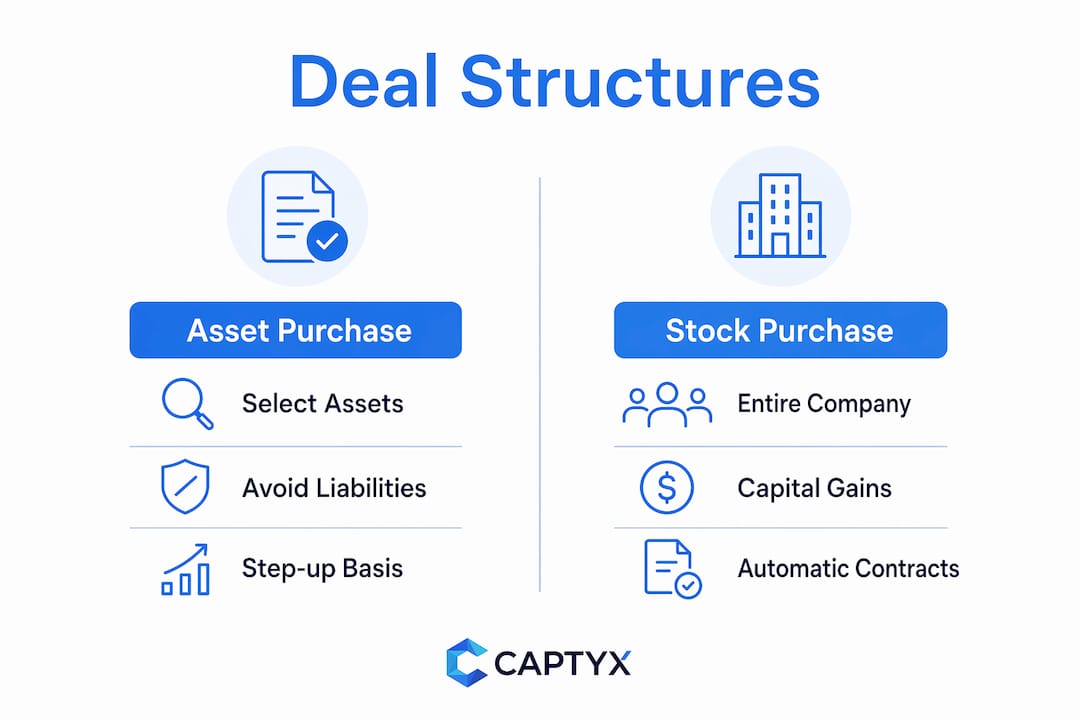
Buyer advantages: Cherry-pick assets, avoid unknown liabilities, get stepped-up basis.
Seller disadvantages: Higher ordinary income tax on recaptured depreciation; more complex closing logistics.
Stock purchases
A stock purchase transfers the entire legal entity. The buyer acquires the company’s equity interests, and everything inside the entity — assets, liabilities, contracts, tax history, pending lawsuits — comes along for the ride. Contracts and licenses typically transfer without consent because the legal entity itself has not changed.

Sellers generally prefer stock sales because the proceeds qualify for long-term capital gains treatment, which carries a lower federal rate than ordinary income. Buyers carry the opposite preference: they inherit all known and unknown liabilities, and they do not get the stepped-up asset basis that makes future depreciation attractive.
Seller advantages: Capital gains treatment, cleaner exit, contracts transfer automatically.
Buyer disadvantages: Full liability exposure, no stepped-up basis, potential hidden risks.
Mergers
Mergers involve two entities combining under state corporate law. Delaware General Corporation Law Section 251 governs statutory mergers, which come in several forms: direct mergers, forward triangular mergers, and reverse triangular mergers.
The reverse triangular merger is the structure most commonly used for acquiring public companies and larger private targets. The buyer forms a subsidiary that merges into the target, leaving the target company alive as a wholly owned subsidiary. Because the target entity survives, its contracts and licenses remain intact without triggering anti-assignment clauses. For public company acquisitions, Legal 500 notes that single-step mergers are most common when stock consideration is involved, while two-step transactions (tender offer followed by a back-end merger) are more typical in all-cash deals.
Why deal structure matters more than most sellers realize
Business owners often underestimate deal structure as a strategic economic lever. The structure is not a formality you sort out after agreeing on price. It determines your after-tax proceeds, your exposure to post-closing claims, and how fast the transaction can actually close.
Tax liability is the most immediate consequence. An asset sale that triggers ordinary income tax on depreciation recapture can result in a significantly higher tax burden to sellers compared to the lower long-term capital gains rate that typically applies in a stock sale. The tax difference can be substantial depending on transaction size.
Risk allocation is the second major variable. In a stock purchase, the buyer inherits everything, which is why buyers negotiate hard for strong representations and warranties — and why representation and warranty insurance has become a standard feature in mid-market deals. In an asset purchase, the seller retains the legal entity and its liabilities, but the buyer still needs indemnification protections for the assets acquired.

Transaction speed depends heavily on structure. Asset purchases require contract assignments, new entity formation, and often regulatory re-approvals. Stock purchases and mergers can close faster because the legal entity continues without interruption.
Pro Tip: Never negotiate price in isolation from structure. A buyer offering $5 million for assets may net you less after tax than a buyer offering $4.5 million for your stock. Model both scenarios before you accept any term sheet.
Earn-outs and contingent payments are another structural tool worth understanding. They bridge valuation gaps when a buyer and seller disagree on future performance, tying a portion of the purchase price to post-closing milestones. They add complexity and risk, but they can make deals happen that would otherwise stall.
Due diligence: what you need to check before the structure is set
Due diligence is not a post-term-sheet formality. It is an active component of deal structuring. What you find during diligence often forces a structural change — or should.
| Due Diligence Area | Key Questions to Answer |
|---|---|
| Financial review | Are financials audited or reviewed? Any off-balance-sheet liabilities? |
| Legal and contracts | Which contracts have change-of-control or anti-assignment clauses? |
| Tax history | Any open IRS audits, unpaid payroll taxes, or state tax exposure? |
| Regulatory compliance | Are licenses, permits, and certifications transferable? |
| Liabilities and contingencies | Pending litigation, environmental exposure, or product liability claims? |
| Intellectual property | Is IP properly registered and owned by the entity being sold? |
| Employee matters | Are there employment agreements, non-competes, or benefit obligations? |
A few areas deserve particular attention:
- Contract assignment is the most common deal-killer in asset purchases. Identify every material contract with an assignment restriction before you choose your structure.
- Tax exposure discovered late in diligence often triggers price adjustments or escrow holdbacks. Sellers who clean up their books before going to market avoid this.
- Representations and warranties need to be grounded in what diligence actually reveals. Overstating the business’s condition in reps and warranties creates indemnification exposure after closing.
- Earnouts require clear, measurable milestones defined in the purchase agreement. Vague earnout language is a reliable source of post-closing disputes.
Understanding how to sell your business before you enter diligence puts you in a far stronger position to control the structural conversation.
How tax strategy and deal structure interact to shape your net proceeds
This is where most sellers leave money on the table. The legal form of a transaction and its tax treatment are not always the same thing, and the gap between them is where sophisticated deal structuring lives.
Asset sales can trigger ordinary income tax of up to 37% on depreciation recapture and inventory, compared to the 20% capital gains rate that typically applies in stock sales. On a meaningful transaction, that differential is not a rounding error.
Pro Tip: Before accepting a buyer’s proposed structure, run a side-by-side tax model for both asset and stock sale scenarios. The after-tax difference often justifies pushing back on structure even when the buyer’s headline price looks attractive.
The IRC Section 338(h)(10) election is the most commonly used hybrid tool. It allows a stock sale of a C or S corporation to be treated as an asset sale for tax purposes, giving the buyer a stepped-up basis while the transaction remains a stock sale legally. The catch: sellers bear ordinary income tax treatment on the deemed asset sale, which is why they almost always require a price gross-up to compensate. The gross-up negotiation is itself a deal structuring exercise, and getting it right requires modeling the exact tax cost to the seller.
F-reorganizations are another structure worth knowing. They allow an S corporation to convert to an LLC taxed as a partnership before a sale, enabling a buyer to acquire membership interests while still achieving an asset-sale tax result. These structures require careful sequencing and IRS compliance, but they can produce better outcomes for both parties than a straight asset or stock deal.
Captyx has worked through this exact analysis across more than 225 completed transactions. The pattern is consistent: sellers who treat tax efficiency in business as a deal structuring input — not an afterthought — consistently walk away with more. The structure you agree to on day one of negotiations shapes every dollar you receive at closing.
One practical example: a seller with significant equipment depreciation recapture may be better served by a stock sale even at a slightly lower headline price, because the tax savings on recapture alone can exceed the price difference. Buyers who understand this can use it as a negotiating point to close faster at a number that works for both sides.
Captyx brings deal structure expertise to your transaction
Most business owners negotiate a deal structure once in their lifetime. Buyers do it repeatedly. That asymmetry costs sellers.

Captyx was built specifically to close that gap. Having sold over 225 businesses, including their own, Captyx brings practitioner-level deal structuring knowledge to every engagement — not generic brokerage advice. The firm built the systems and frameworks that many brokers and M&A advisors rely on, and it applies real-time buyer feedback to sharpen each client’s position before and during negotiations. That means you enter structural discussions knowing exactly how buyers will evaluate your business, which liabilities will draw scrutiny, and which structural concessions are worth making.
If you are preparing to sell and want to know what your business is actually worth before a buyer tells you, start with a free business valuation estimate from Captyx. It is the first step toward negotiating from a position of knowledge rather than guesswork.
Key Takeaways
Deal structure in business sales is an economic decision, not just a legal one — and the structure you choose determines your after-tax proceeds as much as the purchase price itself.
| Point | Details |
|---|---|
| Structure shapes net proceeds | Asset vs. stock sale tax treatment can differ by tens of percentage points, directly affecting what you keep. |
| Three core structure types | Asset purchases, stock purchases, and mergers each carry distinct tax, liability, and operational trade-offs. |
| Due diligence drives structure | Contract assignment clauses, tax exposure, and hidden liabilities discovered in diligence often force structural changes. |
| Hybrid elections change the math | IRC Section 338(h)(10) lets a stock sale be taxed as an asset sale, but sellers typically require a price gross-up to offset the tax cost. |
| Captyx levels the playing field | With 225+ completed transactions, Captyx applies proven deal structuring systems to help sellers negotiate from a position of real knowledge. |


