


Why ESOP exits benefit business owners more than most exit paths
An ESOP exit lets you sell your company to your employees, defer capital gains taxes under Internal Revenue Code Section 1042, preserve everything you built, and leave behind a workforce that actually thinks like owners. No third-party buyer can offer all of that at once.
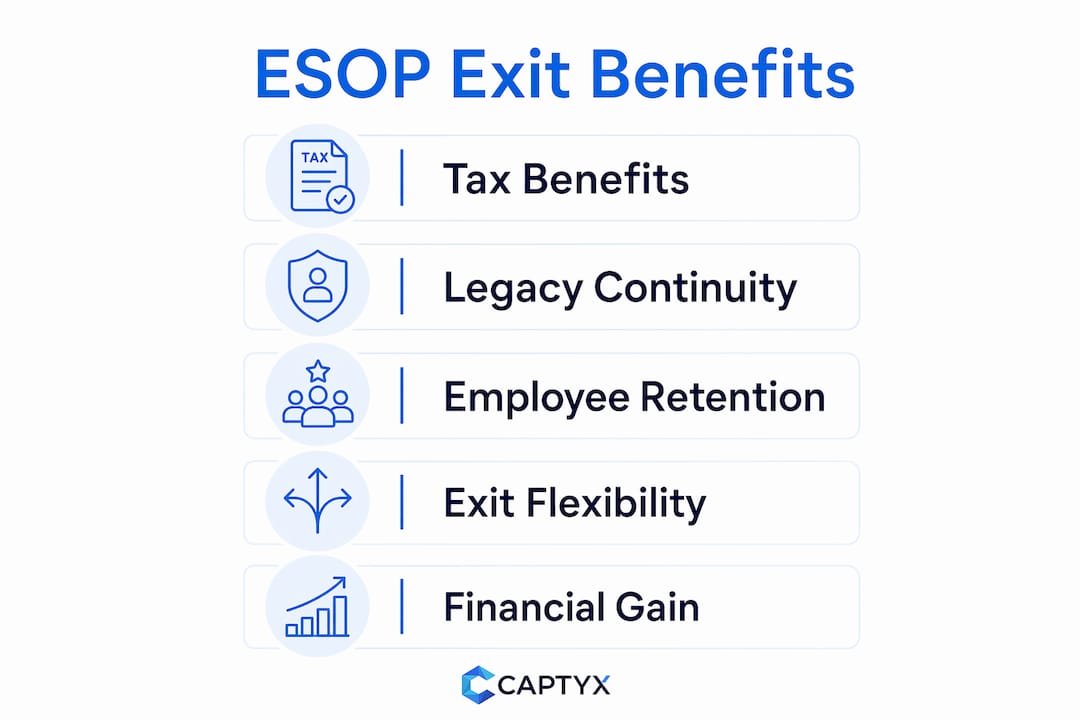
The core advantages break down into three areas:
- Tax advantages: Sellers in qualifying C-corporation transactions can defer capital gains taxes by reinvesting proceeds in Qualified Replacement Property. At the company level, ESOP contributions are tax-deductible, meaning the business effectively buys itself with pre-tax dollars.
- Legacy preservation: Your company name, culture, and values stay intact. Employees, not a private equity firm, become the new owners.
- Employee engagement: Ownership changes how people show up to work. Research from Rutgers CLEO documents the shift from passive employment to active ownership, which drives retention, productivity, and problem-solving long after you exit.
ESOPs are governed by the Employee Retirement Income Security Act (ERISA) of 1974 and recognized by the IRS as qualified retirement plans. They are the most common form of broad-based employee ownership in the United States, and Congress has deliberately stacked incentives to make them attractive to sellers.
Table of Contents
- How an ESOP exit strategy actually works
- Key benefit areas of ESOP exit strategies for business owners
- What are the real downsides of an ESOP exit?
- How do you know if an ESOP exit fits your business?
- What advisors say about getting the most from an ESOP exit
- Steps for preparing your business for an ESOP exit
- Key Takeaways
How an ESOP exit strategy actually works
An ESOP is a qualified retirement plan that holds company stock on behalf of employees. When you sell to an ESOP, a trust purchases your shares, and employees receive allocations to their accounts over time at no cost to them out of their own wages. The company’s future earnings fund the repayment.
The mechanics depend on your corporate structure:
- C-Corporation: Sellers can elect Section 1042 treatment, deferring capital gains by reinvesting proceeds into Qualified Replacement Property within a 12-month window. The company pays corporate income tax but can deduct ESOP contributions.
- S-Corporation: Sellers cannot use Section 1042, but the ESOP’s share of company profits passes through to the tax-exempt ESOP trust, meaning a 100% ESOP-owned S-Corp generally owes no federal income tax on operating income attributable to the trust.
The typical implementation timeline runs 6–12 months from initial feasibility assessment through closing. You will engage an independent ESOP trustee, a valuation firm, legal counsel, and a financial advisor. The ESOP trust may borrow funds from a lender or from you directly via a seller note, with repayment structured over several years.
You also have flexibility in how much you sell. Owners can execute a partial sale, sell tranches over time, or transfer 100% of shares in a single transaction, depending on their exit timeline and personal liquidity needs.
Pro Tip: If you want to stay involved post-sale, a partial ESOP transaction lets you retain an ownership stake and a leadership role while still accessing liquidity and tax benefits today. Kristopher Amplo of J.C. Steel Erectors completed a significant ESOP sale while still in his 40s, specifically to diversify assets without stepping away from the business.
Key benefit areas of ESOP exit strategies for business owners
The ESOP advantages for owners are not just financial. They stack across multiple dimensions that other exit paths simply cannot replicate.

Tax benefits for sellers
Under Section 1042, an owner selling stock to an ESOP can defer capital gains taxes entirely, provided the ESOP owns at least 30% of company stock after the sale and the proceeds are reinvested in Qualified Replacement Property. Consider the math: a seller with substantial stock value and basis faces a significant potential tax bill on their gain. Section 1042 defers that entire obligation as long as the replacement property is held.
Tax benefits for the company
ESOP contributions are tax-deductible, so the company funds the acquisition with pre-tax dollars. A business in a typical tax bracket effectively pays a reduced amount after tax deductions for contributions to the ESOP. For S-Corps, the tax advantage compounds further: the ESOP trust’s share of profits is never taxed at the entity level, freeing up cash for debt service, growth, or employee benefits.
Legacy and culture continuity
Selling to employees means your company name, mission, and culture survive the transaction. Owners who have sold to outside buyers and watched their company get dismantled describe the ESOP as the alternative that preserves what matters. The Blythe family, for example, chose an ESOP in 2022 after a prior sale to a large buyer went badly, specifically to protect their employees and cement their legacy.
Employee engagement and retention
Employee-owners are not just collecting a paycheck. They have skin in the game, and it shows in how they work. This ownership mentality acts as a direct counter to disengagement and quiet quitting, producing a workforce that is more motivated, more curious, and more likely to go beyond the minimum.

Flexibility in exit structure
You can sell a portion now, retain leadership, and sell the remainder later. This accommodates family succession needs, retirement timelines, and personal financial planning in ways a single third-party sale cannot.
What are the real downsides of an ESOP exit?
No exit path is without trade-offs, and ESOPs have genuine constraints worth understanding before you commit.
- Liquidity restrictions: Section 1042 deferral requires reinvesting proceeds into Qualified Replacement Property within 12 months and holding it. Sellers who need immediate, unrestricted cash may find this limiting.
- No future ESOP allocations: Electing Section 1042 permanently prohibits sellers from receiving future stock allocations through the ESOP. You cannot defer taxes on the sale and then participate in the plan as an employee-owner.
- Administrative and legal costs: Setting up and maintaining an ESOP involves meaningful professional fees, including trustee fees, annual valuations, legal compliance, and plan administration. These costs vary by company size but are not trivial, and they recur annually.
- Management transition complexity: Shifting from owner-led to employee-owned governance requires planning. Without a capable management team in place, the transition can create operational uncertainty.
- S-Corp sellers forgo Section 1042: If your business is an S-Corp and you want the personal capital gains deferral, you would need to convert to a C-Corp before the transaction, which carries its own tax and timing considerations.
Understanding these trade-offs is not a reason to avoid ESOPs. It is a reason to plan carefully and engage the right advisors early.
How do you know if an ESOP exit fits your business?
Not every business is a good ESOP candidate. The structure works best when several conditions align.
Business characteristics that favor ESOPs:
- Stable, profitable operations with predictable cash flow to service ESOP debt
- A workforce of at least 15–20 employees who would benefit meaningfully from ownership
- A management team capable of running the business without the founding owner
- C-Corp status, or willingness to convert, if the seller wants Section 1042 treatment
Financial and tax considerations:
- Owners with a low cost basis in their stock gain the most from Section 1042 deferral
- Owners who prefer ongoing tax-free cash flow at the company level may favor S-Corp ESOP structure
- Owners who need full liquidity immediately may find the Qualified Replacement Property requirement restrictive
Cultural and operational factors:
- Owners who care about preserving their company’s name, values, and workforce will find ESOPs align with those priorities
- Businesses with strong employee tenure and loyalty tend to transition more smoothly
Pro Tip: Before you engage an ESOP trustee, get a preliminary business valuation and model your after-tax proceeds under both the ESOP path and a traditional sale. The gap is often larger than owners expect, and seeing the numbers side by side clarifies the decision quickly. Captyx can help you prepare your business to maximize value before any exit.
What advisors say about getting the most from an ESOP exit
The owners who extract the most value from ESOP transactions treat the structural decisions as seriously as the valuation itself.
C-Corp vs. S-Corp is a foundational choice. A seller prioritizing personal tax deferral should be in a C-Corp to access Section 1042. A company prioritizing post-sale cash flow and ongoing tax savings should consider S-Corp status, accepting that the seller pays capital gains at closing. This is not a minor detail. It determines whether the primary benefit flows to you personally or to the company you are leaving behind.
Tax deferral compounds over time. Sellers who reinvest Section 1042 proceeds into a diversified portfolio of Qualified Replacement Property can defer capital gains indefinitely while the property is held. In some cases, if the replacement property passes through an estate, the gain may never be recognized. That is a fundamentally different outcome than any other exit path offers.
Succession planning and ESOP exits reinforce each other. Owners who have already developed strong second-tier management find the ESOP transition smoother and often achieve better valuations, because buyers, including ESOP trustees, pay more for businesses that do not depend on the founder.
“Many think an ESOP is just for the 65-year-old looking to retire, but it’s actually a tremendous opportunity for younger owners like me, too — to take some money off the table and give employees a stake in the business.” — Kristopher Amplo, J.C. Steel Erectors, on completing a 49% ESOP sale in 2025
The workforce shift that follows an ESOP conversion is one of the most underappreciated outcomes. Research on employee ownership documents a consistent pattern: once employees become owners, they stop thinking about their job and start thinking about the business. That cultural shift sustains performance long after the selling owner has exited, which ultimately protects the value of any seller note or earnout tied to post-sale performance.
Steps for preparing your business for an ESOP exit
Preparation determines whether your ESOP transaction closes at full value or leaves money on the table. Work through these steps in sequence.
-
Get a preliminary valuation. An independent valuation gives you a realistic price range and reveals whether the ESOP structure makes financial sense given your basis and tax situation. Understanding business exit value early shapes every decision that follows.
-
Assess your corporate structure. Determine whether your current C-Corp or S-Corp status aligns with your tax priorities. If you want Section 1042 treatment and you are currently an S-Corp, factor in the conversion timeline and costs.
-
Strengthen your management team. ESOP trustees evaluate whether the business can operate without the founder. A capable leadership team increases your valuation and reduces transaction risk.
-
Clean up your financials. Three years of audited or reviewed financial statements, clean books, and documented revenue streams make the trustee’s due diligence faster and support a higher valuation.
-
Engage an ESOP attorney and financial advisor early. The legal and financial complexity of an ESOP transaction requires specialists. Costs vary by company size, but engaging advisors before you are under time pressure gives you more options.
-
Model your personal liquidity needs. Decide how much cash you need at closing versus how much you can defer or accept as a seller note. This shapes whether you do a full sale, a partial sale, or a staged transaction.
-
Communicate with key employees selectively. Before the transaction closes, only a small group should know. After closing, a clear communication plan for all employees drives the cultural shift that makes the ESOP work.
If you are weighing an ESOP against a traditional sale, working with an advisor who has actually sold businesses, not just brokered them, changes the quality of the advice you get. Captyx has sold over 225 businesses and brings that firsthand experience to every exit conversation. Whether you are deciding whether to use a broker or structuring a complex ESOP transaction, the right preparation makes the difference between a good outcome and a great one.

Key Takeaways
ESOP exits give business owners a rare combination of tax deferral, legacy control, and a self-sustaining workforce that no third-party sale can match.
| Point | Details |
|---|---|
| Section 1042 tax deferral | Sellers can defer capital gains taxes by reinvesting proceeds in Qualified Replacement Property, provided the ESOP owns at least 30% post-sale. |
| S-Corp tax shield | A 100% ESOP-owned S-Corp generally owes no federal income tax on operating income attributable to the ESOP trust. |
| Legacy preservation | Selling to employees keeps your company name, culture, and values intact rather than handing them to an outside buyer. |
| Workforce ownership shift | Employee-owners move from passive employment to active ownership, improving retention and performance after the founder exits. |
| Flexibility in exit structure | Owners can sell a portion, sell in stages, or transfer 100% at once, accommodating varied retirement and liquidity timelines. |


