


A mid market M&A transaction is the buying, selling, or merging of mid-sized companies, typically those with an enterprise value between $10 million and $1 billion. These businesses are almost always privately held, often founder- or family-owned, and their deals follow a structured path from a letter of intent through due diligence to a signed purchase agreement and closing. “Middle market” is a market convention, not a legal category, so the exact boundaries shift depending on the investment bank, lender, or fund applying the definition.
The mid market breaks into three distinct segments, each with its own buyer profile and deal dynamics:
- Lower middle market: businesses with annual revenue and EBITDA in ranges typical for smaller mid-sized companies, and enterprise values at the lower end of the middle market spectrum. Owner-operated, less formal processes, financed by regional banks and private credit.
- Core middle market: companies with annual revenue and EBITDA that represent mid-sized enterprises, with enterprise values in the mid-range of the middle market. More institutional management, broader private equity and strategic buyer interest.
- Upper middle market: larger mid-sized companies with revenue and EBITDA figures at the high end of the middle market range. Large PE funds, public strategic buyers, and cross-border acquirers. Formal auction processes led by bulge bracket or top-tier investment banks.
What is a mid market M&A transaction vs. large-cap and lower middle market deals?
The differences between these segments go well beyond deal size. They shape who shows up at the table, how the process runs, and what the final agreement looks like.
Mid market vs. large-cap:
- Large-cap deals involve public companies, institutional investors, and formal auction processes with extensive SEC and antitrust regulatory oversight. Mid market deals are more personal and negotiable, with founders often directly involved in every conversation.
- Bulge bracket banks (Goldman Sachs, Morgan Stanley) dominate large-cap. Mid market transactions rely on boutique investment banks, regional advisors, and business brokers.
- Valuation multiples in the core mid market typically run 8x–12x EBITDA, compared to higher multiples common in large-cap deals driven by public market premiums.
Mid market vs. lower middle market:
- Lower middle market deals are often sourced off-market through relationships, with fewer competing bidders and more creative deal terms like seller financing. Core mid market deals are more formal controlled auctions with multiple bidders and institutional processes.
- Financing sources vary by segment, with lower middle market deals relying more on regional and specialized lenders, and core mid market deals supported by broader national and mezzanine financing options.
- Due diligence timelines differ, generally being more flexible for lower middle market deals and more structured with set durations for core mid market transactions.
What types of M&A transactions happen in the mid market?
Mid market deals take several forms, and the structure often matters as much as the headline price.
- Strategic acquisitions: A competitor or industry player buys the business to capture market share, add capabilities, or enter a new geography. These deals tend to close faster and often come with all-cash offers.
- Financial acquisitions (leveraged buyouts): A private equity firm acquires a controlling stake, typically using a combination of equity and debt. The goal is to grow the business and ultimately achieve a profitable exit within a typical multi-year horizon.
- Partial sales and recapitalizations: The owner sells a minority or majority stake while retaining equity. This lets founders take chips off the table while staying involved in operations.
- Mergers: Two companies of comparable size combine, often to achieve scale or eliminate redundancy. True mergers of equals are less common in the mid market than outright acquisitions.
- Earnouts: A portion of the purchase price is paid post-close based on the business hitting agreed performance targets. Owners may accept a lower total valuation for more cash upfront rather than risk an earnout they cannot control.
- Seller financing: The seller may carry a note for a portion of the purchase price over several years. This is common in lower middle market deals where external financing is insufficient to cover the entire price.
- Equity rollovers: The seller reinvests a portion of their proceeds into the acquiring entity. PE buyers use this to align seller incentives with post-close performance.
Understanding how earnouts work in deals before you negotiate one can save you from a structure that looks attractive on paper but delivers less than you expected.
Why does the mid market matter economically?

The mid market is the backbone of the American private sector, and most people outside of finance underestimate its scale. Middle market companies contribute roughly one-third of US private sector GDP and employ tens of millions of workers, yet most of these businesses are invisible to the broader public because they are privately held.
Deal activity in this segment is sustained by several distinct sourcing channels:
- Proprietary deals: A buyer builds a relationship with an owner long before any formal sale process begins. The best lower middle market transactions happen this way, often 6–18 months before the owner is ready to sell.
- Brokered transactions: A business broker or boutique M&A advisor markets the business to a curated list of buyers. Off-market deal sourcing through brokers is especially common for companies in the $10M–$50M range.
- Investment banker auctions: Standard in the core and upper mid market. A bank contacts dozens or hundreds of potential buyers, runs a structured process, and the company sells to the highest qualified bidder.
Transaction timelines reflect this variation. Brokered deals typically close in 4–8 months from letter of intent to close, while proprietary deals with relationship-driven sourcing often run 8–14 months total from first conversation to closing.
How do strategic and financial buyers differ in mid market deals?
Knowing which type of buyer you are dealing with changes everything about how you negotiate and what you should prioritize.

Strategic buyers are industry players, competitors, or adjacent companies seeking synergies, market share, or operational capabilities. They typically prefer all-cash deals at close and move quickly once they decide to act. The premium they pay often reflects what the acquisition is worth to their existing business, not just the standalone value of yours.
Financial buyers (primarily private equity firms) are investing for returns. They use debt to amplify equity returns, prefer structured deals, and often ask sellers to roll equity into the new entity. Financial buyers prefer structured deals involving earnouts and equity rollovers, while strategic buyers focus on fast, all-cash transactions to capture synergies.
The buyer universe also shifts by segment. Family offices and independent sponsors dominate the lower middle market. Broader PE funds and strategic acquirers target the core mid market. Large PE funds and cross-border players pursue upper mid market assets.
Pro Tip: Before you engage any buyer, define your exit priorities. If you want maximum upfront cash and a clean break, a strategic buyer is usually your best path. If you want to stay involved and participate in future upside, a PE firm offering an equity rollover may serve you better. Misaligning your goals with buyer type is one of the most common and costly mistakes sellers make.
Understanding the full range of investor types and their priorities before you enter a process puts you in a far stronger negotiating position.
What do regulatory review and due diligence look like in mid market M&A?
Mid market deals face fewer regulatory hurdles than large-cap transactions, but they are not without complexity. Most mid market transactions fall below the Hart-Scott-Rodino (HSR) Act filing thresholds, which means mandatory antitrust review with the FTC and DOJ is not required. Deals that do cross those thresholds, typically in the upper mid market, trigger a formal waiting period and potential second requests.
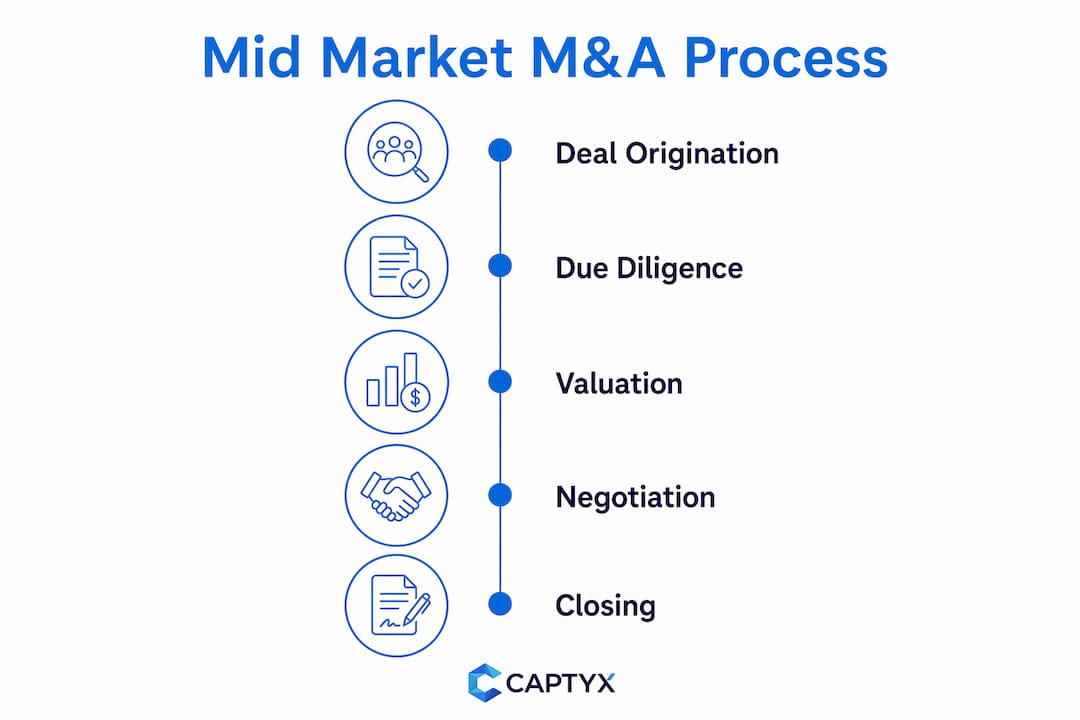
Due diligence in the mid market covers five core workstreams:
- Financial: Review of 3–5 years of financial statements, tax returns, and adjusted EBITDA calculations. Owner compensation above market rates and personal expenses running through the business are common normalization items.
- Legal: Examination of contracts, leases, intellectual property, litigation history, and corporate structure. Representations and warranties in the purchase agreement allocate risk for anything uncovered post-close.
- Tax: Analysis of federal and state tax compliance, deferred liabilities, and the deal’s tax structure (asset sale vs. stock sale carries very different consequences for both parties).
- Operational: Assessment of key employees, customer concentration, supplier dependencies, and systems. Customer concentration risk is one of the most common deal-killers at this stage.
- Commercial: Market position, competitive dynamics, and growth assumptions. PE buyers in particular stress-test revenue projections against realistic market conditions.
Rep and warranty insurance has become standard in core and upper mid market deals, shifting indemnification risk from the seller to an insurer. Lower middle market deals still rely more heavily on seller indemnification escrows held for 12–24 months post-close.
Key Takeaways
Mid market M&A transactions involve privately held companies with enterprise values between $10 million and $1 billion. The mid market breaks into three distinct segments—lower middle market ($10M–$50M revenue), core middle market ($50M–$500M revenue), and upper middle market ($500M–$1B revenue)—each with its own buyer profile and deal dynamics.
| Buyer types by segment | Family offices and small PE dominate the lower mid market; large PE and strategics target the upper tier. |
| Common deal structures | Earnouts, seller financing, and equity rollovers are frequent, especially in lower middle market transactions. |
| Economic weight | Mid market companies contribute roughly one-third of US private sector GDP and employ tens of millions. |
| Deal timelines | Brokered deals close in 4–8 months from LOI; proprietary deals typically run 8–14 months total. |
If you are considering a mid market exit, Captyx has built the systems and processes that most business brokers and M&A advisors rely on. With over 225 businesses sold, including their own, Captyx brings real-world feedback into every engagement to help you position your business for the strongest possible outcome.

Whether you are just starting to think about a sale or actively preparing, how to sell your business starts with understanding what buyers actually look for and how to give it to them. Captyx can show you exactly where your business stands and what it takes to get it where it needs to be.


