


Family business transfers are the planned process of shifting ownership and leadership to the next generation, and most owners underestimate how much work they require. The core elements are straightforward: you transfer ownership rights, transition management responsibilities, execute the legal agreements, and address the financial and tax obligations that come with any related-party transaction. What trips up most families is the assumption that good intentions are enough. They are not.
Here is what the process actually involves:
- Ownership transfer: Shifting legal title through a sale, gift, gradual share transfer, or a combination of all three
- Leadership transition: Moving decision-making authority from the current owner to a designated successor over a defined period
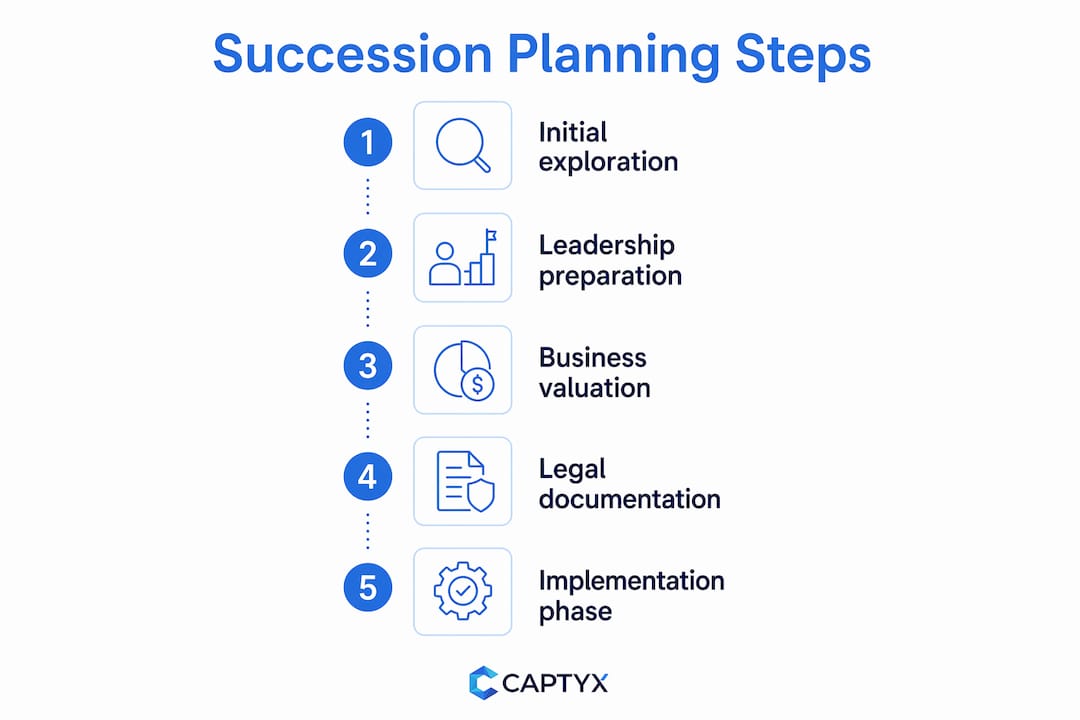
- Legal documentation: Buy-sell agreements, operating agreement amendments, gift deeds, or installment sale contracts
- Financial and tax compliance: Business valuation, gift tax filings, and IRS-compliant pricing for related-party transactions
- Succession planning: The broader process of identifying, preparing, and installing the right person to lead the business forward
Only about 33% of U.S. small businesses have a formal transition plan in place, and up to 30% of business closures trace back to failed succession efforts. The stakes are real, and the process rewards owners who start early and plan deliberately.
1. When should you start succession planning?
The U.S. Department of Labor recommends a 5–10 year lead time for succession planning. That window gives you enough runway to explore all your options, prepare a successor properly, and avoid the kind of rushed decisions that end businesses prematurely.

Most owners wait too long. The day-to-day demands of running a company crowd out planning, and then a health event, a divorce, or a sudden market shift forces a reactive exit. Less than 17% of family business failures follow an orderly transition. The rest are reactive responses to sudden events like death or disability.
Starting early also gives you time to use a timeline to map key milestones: when the successor takes on their first leadership role, when ownership shares begin transferring, when the legal structure gets updated, and when you step back from daily operations. Visual planning tools like a Gantt chart or a simple milestone calendar help the whole family see the plan, not just hear about it.
Key steps to initiate planning:
- Clarify your personal goals: retirement timeline, income needs, and legacy priorities
- Identify one or more potential successors and assess their readiness honestly
- Engage a CPA, an estate attorney, and a certified exit planner early in the process
- Set a formal planning timeline with annual review checkpoints
- Open a structured family conversation about roles, expectations, and the transfer timeline
| Planning Phase | Recommended Timing | Key Actions |
|---|---|---|
| Initial exploration | 5–10 years before exit | Define goals, identify successors, engage advisors |
| Successor development | 5–10 years before exit | Training, mentoring, leadership exposure |
| Ownership structure | 3–5 years before exit | Valuation, legal documents, share transfer begins |
| Transition execution | 1–3 years before exit | Formal handover, management transition, tax filings |
Pro Tip: Set a hard calendar date for your first succession planning meeting with your CPA and attorney. Owners who schedule it as a real appointment are far more likely to follow through than those who treat it as a future task.
2. How do you prepare the next generation for ownership?
Readiness is the single biggest gap in most family successions. A Deloitte survey found that 61% of family members want the CEO role, but only 23% are actually ready for it. That gap does not close on its own.

Preparation has to be deliberate. A successor needs formal leadership development, not just years of working in the business. That means structured mentoring from the current owner, exposure to financial statements and board-level decisions, and ideally some outside work experience before taking the helm. Owners who hand over the keys based on family loyalty alone, rather than demonstrated capability, tend to regret it within two years.
Balancing family expectations with honest readiness assessments is where things get emotionally complicated. A sibling who wants the role but is not ready needs a clear, respectful conversation, not a vague promise. Setting written role descriptions and transition milestones removes ambiguity and reduces the chance of conflict later.
When no family member is ready, professional management is a legitimate bridge. Bringing in an outside CEO for a defined period while a younger family member develops their skills is a common and often effective approach. It keeps the business healthy without forcing an unqualified successor into a role they cannot yet handle.
- Assign the successor real operational responsibilities with accountability, not just a title
- Create a formal mentoring schedule with the current owner
- Expose the successor to outside advisors, industry peers, and leadership training programs
- Address readiness gaps directly and in writing, with a development plan attached
- Communicate role expectations to all family members, not just the designated successor
3. How to value your business and handle the financial side of a transfer
Getting the valuation right is not optional. It protects you legally, satisfies the IRS, and sets a fair foundation for whatever transfer method you choose. The three most common approaches are the income approach (based on future earnings), the market approach (based on comparable sales), and the asset approach (based on the net value of business assets). For most operating family businesses, the income approach carries the most weight.
An independent, third-party appraisal is worth the cost. If the IRS ever questions the transfer price, a documented fair market value from a qualified appraiser is your best defense. You can also increase your business valuation before the transfer by improving financial documentation, reducing owner dependency, and locking in recurring revenue.
The tax rules around family transfers are strict. Under IRS Code Section 2512, selling a business to a family member below fair market value is treated as a taxable gift. That means you must file Form 709 and the difference counts against your lifetime gift and estate tax exemption. Separately, IRS Section 267 disallows the seller from recognizing a loss on a related-party sale, though the buyer may use that disallowed loss to offset future gains.
Common transfer methods and their financial implications:
- Outright sale at fair market value: Clean, immediate, and taxable. The seller reports capital gains; the buyer gets a stepped-up basis.
- Installment sale: The buyer pays over time, often funded by business cash flow. The seller reports gains as payments are received, which can spread the tax burden across years.
- Gifting shares gradually: Uses the annual gift tax exclusion each year to transfer ownership incrementally without triggering a large tax event.
- Combination approach: Many families use a partial sale plus gifting to balance liquidity needs with tax efficiency.
Legal documents you need include a purchase agreement or gift deed, an updated operating agreement or shareholder agreement, any promissory notes for installment sales, and a buy-sell agreement that governs future ownership changes. An estate attorney should draft or review all of them.
Pro Tip: Document every aspect of an installment sale in writing before the transfer closes. Failing to formalize the terms can trigger accelerated tax liabilities and gift tax audits, even years after the transaction.
4. What are the most common challenges in family business transfers?
The failure rate in family business succession is not a mystery. The same patterns repeat across thousands of transfers, and most of them are avoidable with early planning and honest communication.
Family conflict is the most cited barrier. Decisions about who gets what, who leads, and what the business is worth carry decades of family history. Without a formal process, those decisions become personal. A family mediator or a structured family council can depersonalize the process and keep conversations focused on the business rather than old grievances.
Lack of planning is the second major cause of failure. Owners often underestimate the effort required and delay until a crisis forces their hand. By then, the options narrow fast. A rushed sale to an outside buyer, a forced closure, or a family dispute over an undocumented estate are the typical outcomes.
Successor readiness gaps show up when owners assume that time in the business equals readiness for leadership. It does not. A successor who has never managed a P&L, handled a bank relationship, or made a hiring decision is not ready to run the company, regardless of how long they have worked there.
Tax and legal missteps are expensive. Pricing a transfer below fair market value without proper documentation, skipping Form 709, or failing to update the operating agreement can result in IRS penalties, gift tax audits, and legal disputes among heirs.
Pro Tip: Establish a formal family governance structure, such as a family council or an advisory board, before the transfer begins. These structures normalize succession discussions and give every stakeholder a defined voice, which reduces the chance of a conflict derailing the process.
5. What do the experts say about family business succession success?
The data on family business succession is sobering. A Deloitte survey found that 78% of family business executives expect a CEO transition within the next 10 years, but only 57% have a plan in place, and 30% admit they are already behind schedule. Deloitte calls this the “succession paradox”: owners know they need to plan, but most have not done it.
Governance structures make a measurable difference. The same Deloitte research found that boards are present in 76% of companies with $100–500 million in revenue, and those companies address succession formally on an annual basis in roughly half of cases. Family councils serve a similar function at smaller scales: they create a regular forum for ownership and leadership discussions before a crisis forces the conversation.
The generational survival rate for family businesses tells the same story from a different angle. About 40% of U.S. family businesses transition successfully to the second generation, roughly 13% reach the third, and only 3% survive to the fourth generation or beyond. The drop-off is steep, and poor succession planning is a primary driver.
| Metric | Finding | Source |
|---|---|---|
| CEO transitions expected in 10 years | 78% of executives | Deloitte Private Survey |
| Family businesses with a succession plan | 57% | Deloitte Private Survey |
| Businesses reaching second generation | ~40% | Cornell SC Johnson |
| Businesses reaching third generation | ~13% | Cornell SC Johnson |
| Orderly transitions among failures | Less than 17% | Cornell SC Johnson |
The U.S. Department of Labor, Deloitte, and Ohio State University Extension all point to the same best practices: start early, involve outside advisors, build governance structures, and treat the succession plan as a living document that gets reviewed annually, not a one-time exercise.
For owners thinking about the financial planning side of a multigenerational transfer, a family financial plan that integrates the business transition with personal retirement goals is one of the most effective tools available. It connects the business exit timeline to the owner’s income needs, estate plan, and long-term wealth goals in a single framework.
Understanding your business exit strategy options before you commit to a transfer method also matters. Owners who explore all their options, including partial sales, installment structures, and employee ownership, tend to get better outcomes than those who default to the first option that comes to mind.
Key Takeaways
Successful family business transfers require early planning, honest successor assessment, and strict legal and tax compliance, with the U.S. Department of Labor recommending a 5–10 year lead time to avoid forced closures.
| Point | Details |
|---|---|
| Start planning early | The U.S. Department of Labor recommends a 5–10 year lead time to allow full preparation and avoid rushed exits. |
| Successor readiness gap | Only 23% of family members who want the CEO role are actually ready for it, per Deloitte research. |
| Tax compliance is strict | Selling below fair market value triggers gift tax filing under IRS Code Section 2512 and counts against your lifetime exemption. |
| Governance structures help | Boards and family councils normalize succession discussions and reduce the risk of conflict derailing the process. |
| Captyx for transfer preparation | Captyx helps family business owners build valuation, marketability, and exit readiness before any ownership transfer. |
Captyx helps you transfer your business on your terms
Most family business owners spend years building something worth passing on, then lose value in the transfer because the business was never properly prepared for it. That is the problem Captyx was built to solve.

Captyx brings the same systems used to sell over 225 businesses to family business owners who want to transfer ownership at maximum value, whether to a family member, a key employee, or an outside buyer. The process starts with a clear-eyed valuation and a gap analysis: what does the business look like to a buyer or successor today, and what needs to change before the transfer to protect its value? From there, Captyx works with owners to implement the specific improvements that move the needle, based on real buyer and successor feedback, not generic advice.
If you are planning a transfer in the next 3–10 years, the time to prepare is now. Get a free business valuation estimate from Captyx and see exactly where your business stands before you start the succession conversation.


