


TL;DR:
- Business brokers manage smaller, owner-dependent deals valued between $500,000 and $5 million, using public listings. M&A advisors handle middle-market transactions over $5 million through confidential, competitive auctions, often increasing sale prices by 15–30%. Owners should match their deal size, business complexity, and timeline to the appropriate professional to maximize outcomes.
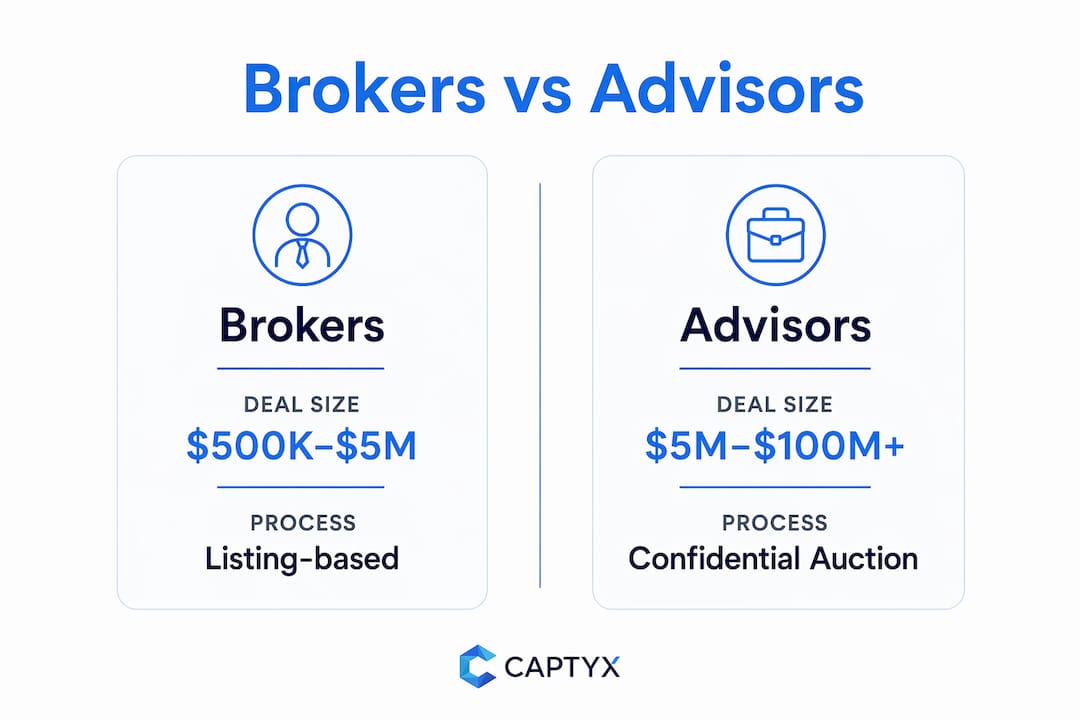
Business brokers and M&A advisors are both deal intermediaries, but they serve fundamentally different markets, use different processes, and produce different outcomes for sellers. The role of brokers vs advisors in M&A comes down to one core variable: deal size. Brokers handle smaller, owner-dependent businesses typically valued between $500,000 and $5 million, using public marketplace listings on platforms like BizBuySell. M&A advisors work the middle market, managing transactions from $5 million to $100 million or more through confidential, competitive auction processes. Choosing the wrong professional for your deal size is one of the most expensive mistakes a business owner can make.
How do deal size and complexity determine broker vs advisor?
Deal size and complexity are the primary filters for choosing between a broker and an M&A advisor. The threshold is not arbitrary. It reflects the depth of work each type of transaction demands.
Brokers typically handle transactions between $500,000 and $5 million, with timelines running 2–6 months and active listing counts of 15–30 deals at once. That volume tells you something important: brokers run a numbers game, not a custom process. They list your business publicly and wait for buyers to come to them.
M&A advisors work 4–8 engagements at a time and run processes lasting 9–18 months. That smaller caseload exists because each deal requires deep financial modeling, management presentations, and structured buyer outreach. The longer timeline is not inefficiency. It reflects the complexity of negotiating with private equity firms and institutional acquirers.
| Factor | Business Broker | M&A Advisor |
|---|---|---|
| Typical deal size | $500K–$5M | $5M–$100M+ |
| Active engagements | 15–30 | 4–8 |
| Process timeline | 2–6 months | 9–18 months |
| Buyer universe | Local individual buyers | Private equity, strategic acquirers |
| Listing approach | Public marketplace | Confidential, targeted outreach |
Business complexity matters as much as size. Brokers serve owner-dependent businesses on Main Street, where the owner is the business. M&A advisors, as recognized by the Association for Corporate Growth and practitioners like Ronnie Hunt, act as strategic quarterbacks for middle-market companies with independent management teams. If your business runs without you, it likely belongs in an advisor-led process.
Pro Tip: Get a formal valuation before you contact any intermediary. Knowing your enterprise value tells you immediately which type of professional you need and prevents you from hiring a broker for a deal that warrants an advisor.
What process differences separate brokers from M&A advisors?
The process gap between brokers and M&A advisors is wider than most owners expect. It is not just a difference in effort. It is a difference in philosophy.

Brokers use a reactive, listing-based model. They post your business on public marketplaces, screen inbound inquiries, and negotiate with whoever shows up. That approach works for straightforward Main Street deals where the buyer pool is local and the financials are simple. The process is fast and low-cost, but it rarely generates competing offers.
M&A advisors run a proactive, confidential process. Advisors contact 50–150 potential buyers, generate 10–20 signed NDAs, and structure a competitive auction that produces multiple formal offers. That outreach is targeted, not broadcast. Advisors identify strategic buyers who will pay a premium because your business fills a gap in their portfolio or geography.
The financial impact of that competition is measurable. Engaging the right M&A professional can increase sale price by 15–30%, with advisors generating 3–5 indications of interest and 2–3 formal offers. A broker negotiating one-on-one with a single buyer leaves that premium on the table.
| Process Step | Business Broker | M&A Advisor |
|---|---|---|
| Buyer sourcing | Public listing on BizBuySell | Targeted outreach to 50–150 buyers |
| Confidentiality | Limited, public exposure | Strict NDA process before disclosure |
| Offer generation | Typically one offer at a time | 3–5 indications of interest |
| Negotiation style | One-on-one | Competitive auction |
| Due diligence support | Basic document sharing | Full data room management |
Pro Tip: Ask any intermediary you interview how many NDAs they generated on their last three deals. That number tells you more about their process than any pitch deck.
The confidential auction process is the single biggest advantage advisors hold. When buyers know they are competing, they sharpen their offers. When a buyer thinks they are the only one at the table, they negotiate down.
How do fees, buyer types, and conflict of interest differ?
Fee structures reflect the depth of engagement each professional provides. Broker fee structures typically run 8–12% success fees with minimal upfront cost. M&A advisors charge retainers plus 1–5% success fees. The retainer covers the months of preparation, financial modeling, and buyer outreach that happen before a single offer arrives.
The buyer type each professional attracts shapes the deal outcome as much as the fee. Brokers primarily connect local individual buyers, often owner-operators looking to buy a job. M&A advisors target private equity groups, strategic corporate acquirers, and institutional investors. Those buyers pay more because they are acquiring cash flow, market share, or operational capability, not just a business to run day-to-day.
Conflict of interest is a real risk with brokers that most owners do not anticipate. Some brokers legally represent both buyer and seller in the same transaction. That dual representation creates an inherent conflict. A broker motivated to close the deal may push you toward a lower offer rather than fight for your price. M&A advisors operate under exclusive seller representation, which means their incentive aligns with yours: maximize the sale price.
- Broker fees: 8–12% success fee, minimal retainer
- Advisor fees: retainer plus 1–5% success fee
- Broker buyer pool: local individuals, owner-operators
- Advisor buyer pool: private equity, strategic acquirers, institutional investors
- Broker representation: sometimes dual (buyer and seller)
- Advisor representation: seller only, exclusive
Understanding how buyers value your business before you enter a process helps you evaluate whether a broker’s buyer pool can actually meet your price expectations.
How should you decide between a broker and an M&A advisor?
The decision framework is straightforward once you know your numbers. Start with enterprise value. If your business is worth under $5 million, a broker is the practical choice. If it exceeds $5 million, an advisor-led process will almost certainly produce a better outcome.
Beyond valuation, ask four questions:
- Does the business run without me? If yes, it likely qualifies for an advisor-led middle-market process. If no, a broker’s Main Street approach fits better.
- Who is my ideal buyer? If you want private equity or a strategic acquirer, you need an advisor with those relationships. Brokers do not operate in that buyer universe.
- How complex are my financials? Multiple revenue streams, earn-out structures, or management carve-outs require advisor-level expertise to structure and present.
- What is my timeline tolerance? Broker processes close in 2–6 months. Advisor processes run 9–18 months. Both timelines are legitimate. Neither is wrong for the right deal.
Hiring both a broker and an advisor simultaneously is a critical mistake. It causes buyer confusion, duplicates fees, and signals to the market that you lack control of your own sale process. Buyers notice. Serious acquirers walk away from disorganized sellers.
For deals in the $3 million to $8 million range, boutique advisory firms often provide the best fit. They bring advisor-level process discipline at fee structures closer to broker rates. Vetting them requires the same rigor: ask for deal references, check their buyer network, and confirm they offer exclusive seller representation.
Pro Tip: Interview at least three intermediaries before signing any engagement letter. Ask each one to name five buyers they would contact for your business in the first 30 days. Vague answers reveal a reactive process dressed up as a proactive one.
Reviewing whether selling without a broker is viable for your situation is worth doing before you commit to any intermediary. For some owners, the answer changes their entire approach.
Key Takeaways
The right intermediary for your M&A transaction depends on deal size, buyer type, and process sophistication, not personal preference or referrals.
| Point | Details |
|---|---|
| Deal size drives the decision | Brokers fit deals under $5M; advisors serve transactions from $5M to $100M or more. |
| Process determines price | Advisor-led competitive auctions can increase sale price by 15–30% over one-on-one broker negotiations. |
| Buyer type shapes outcomes | Advisors access private equity and strategic acquirers; brokers connect local individual buyers. |
| Fee structures reflect engagement depth | Brokers charge 8–12% success fees; advisors add retainers plus 1–5% success fees. |
| Never hire both simultaneously | Dual engagement creates market confusion, duplicated costs, and signals poor process control. |
The thing most owners get wrong before they even start
The most common mistake I see is owners choosing their intermediary based on who called them first, not on what their deal actually requires. A broker who reaches out proactively is not a sign that your business is ready for market. It is a sign that broker is running a volume operation.
The M&A advisors vs brokers debate gets framed as a quality argument, but it is really a fit argument. A great broker on a $1.5 million Main Street deal will outperform a mediocre advisor every time. The problem is when owners with $10 million businesses sign with brokers because the fee looks lower upfront. That decision routinely costs more in lost sale price than the retainer savings ever justified.
What I have found after watching hundreds of transactions is that owners who commit fully to one model, understand why that model fits their deal, and vet their intermediary on buyer network depth consistently get better outcomes. The owners who hedge, hire two firms, or switch intermediaries mid-process almost never recover the momentum they lose.
Align your choice with your deal. Then commit to the process completely.
— Tucker
How Captyx approaches broker and advisor decisions for sellers
Captyx has built the systems and frameworks that many business brokers and M&A advisors use to prepare businesses for sale. With over 225 completed transactions, including businesses Captyx has owned and sold directly, the firm brings practitioner-level insight to every engagement.

Whether your deal calls for a broker-style process or a full M&A advisory engagement, Captyx matches the approach to your deal size, buyer universe, and timeline. The firm runs confidential auction processes, targets private equity and strategic acquirers, and uses real-time buyer feedback to sharpen your business’s position before any offer arrives. If you are not sure which model fits your situation, start with a free valuation estimate to anchor the decision in your actual numbers.
FAQ
What is the main difference between a broker and an M&A advisor?
A broker handles smaller deals, typically under $5 million, using public marketplace listings and reactive buyer outreach. An M&A advisor manages larger, more complex transactions through confidential, competitive auction processes targeting private equity and strategic acquirers.
When should a business owner use an M&A advisor instead of a broker?
Use an M&A advisor when your business is valued above $5 million, has an independent management team, or requires access to private equity and institutional buyers. Advisor-led processes generate multiple competing offers, which brokers rarely produce.
Can a broker represent both the buyer and the seller?
Yes, some brokers legally represent both parties in the same transaction. That dual representation creates a conflict of interest. M&A advisors typically represent only the seller, which protects your negotiation position throughout the deal.
How much more can an M&A advisor get for your business?
Engaging the right M&A professional can increase sale price by 15–30% compared to a one-on-one broker negotiation. Advisors generate 3–5 indications of interest and 2–3 formal offers by running a structured competitive process.
Is it a good idea to hire both a broker and an M&A advisor?
No. Hiring both simultaneously causes buyer confusion, duplicates fees, and signals to the market that the seller lacks process control. Choose one model that fits your deal size and commit to it fully.


