


TL;DR:
- A sellable business features predictable revenue, financial transparency, operational independence, and complete documentation. Addressing these factors reduces buyer risk, increases valuation multiples, and leads to higher sale prices. Owners should start preparing at least 18 to 24 months before selling to maximize value.
A sellable business is defined by predictable revenue, diversified customers, clean financials, and operations that run without the owner. In M&A advisory, the formal term for this readiness is “business transferability,” and it determines not just whether a business sells, but at what multiple. Understanding what makes a business sellable is the difference between a deal that closes at a premium and one that stalls in due diligence. Captyx has sold over 225 businesses and the same four factors appear in every high-value exit: revenue consistency, customer diversification, financial transparency, and documented systems.
What makes a business sellable to serious buyers?
Sellability comes down to one thing buyers can measure: risk. The lower the risk of revenue disruption after the sale, the higher the multiple a buyer will pay. Buyers evaluate sales continuity and predictability as primary valuation drivers, alongside supplier relationships and go-to-market reliability. A business that depends on one client, one process, or one person carries risk that buyers price in immediately.

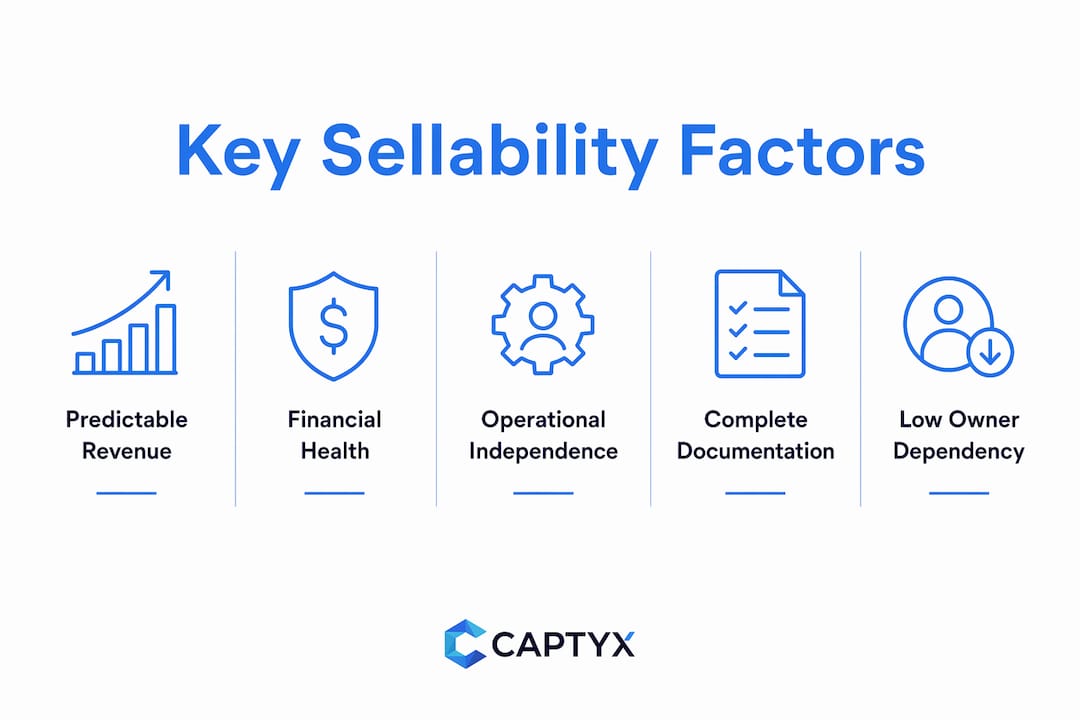
The attributes of a sellable business fall into four categories: revenue quality, financial health, operational independence, and documentation. Each category reduces a specific type of buyer risk. Owners who address all four before going to market consistently achieve better outcomes than those who focus on revenue alone.
How do predictable and diversified revenue streams affect value?
Recurring revenue is the single most valued attribute in any acquisition. Buyers prefer subscription models, retainer contracts, and membership programs because they signal future cash flow before the deal closes. SaaS companies, ecommerce subscription boxes, and professional services firms on retainer all command higher exit multiples than project-based businesses with the same revenue totals.
Customer concentration is the most common deal-killer in small business sales. Losing one client causing more than 15% revenue loss triggers formal buyer concern and often requires a diversification plan as a condition of closing. That threshold is not arbitrary. It reflects the realistic probability that a key client leaves during ownership transition.
Diversification strategies that work before a sale include:
- Adding a recurring revenue product or service tier to a project-based model
- Capping any single client at 10%–15% of total revenue through active new business development
- Building channel partnerships that generate revenue independent of direct sales
- Introducing annual contracts to convert month-to-month clients into committed accounts
Pro Tip: Run a quick revenue concentration analysis before listing. If any single client exceeds 15% of revenue, address it 12 months before going to market. Buyers will find it in due diligence regardless.
Growing your business before a sale is not just about top-line revenue. It is about building a revenue base that a buyer can trust will survive the transition.
Does financial performance really change the sale price?
Financial performance changes the sale price more than any other single factor. Companies with EBITDA margins above 20% typically achieve valuation multiples around 8× EBITDA, compared to roughly 5× for businesses below 15% margins. That gap represents hundreds of thousands or millions of dollars on the same revenue base.
Clean, well-organized financials are the foundation of buyer confidence. Three years of accrual-based financials that clearly separate personal expenses from business expenses are the minimum standard buyers expect. Messy books slow the sale process and reduce valuation multiples because buyers assume hidden problems when records are unclear.
Buyers focus on specific financial KPIs during evaluation:
- Gross margin: Measures how efficiently the business produces revenue
- Churn rate: Signals customer retention and revenue durability
- CAC-to-LTV ratio: Shows whether customer acquisition spending is sustainable
- Normalized EBITDA: Adjusts for owner compensation and one-time expenses to show true profitability
Pro Tip: Hire a CPA to prepare a quality of earnings report before listing. This document normalizes your EBITDA and answers the questions buyers will ask before they ask them. It signals professionalism and speeds up due diligence significantly.
Understanding how buyers value your business starts with these numbers. Owners who track and present KPIs clearly give buyers fewer reasons to negotiate the price down.
How does owner dependency hurt a business sale?
Owner dependency is the most common reason small business sales fall apart or close below asking price. Buyers discount businesses that are heavily reliant on the founder’s operational role because the business value walks out the door with the seller. If the owner handles key client relationships, approves every decision, or holds critical institutional knowledge, buyers see a liability, not an asset.
Businesses that run independently for a full quarter without the owner command higher multiples. That benchmark is practical and testable. Owners who can step away for 90 days without revenue declining have built a transferable business. Those who cannot have built a job.
Reducing owner dependency requires a deliberate sequence:
- Map every owner task. List all responsibilities the owner handles weekly. Categorize each as delegatable, automatable, or eliminable.
- Hire or promote a second-in-command. A general manager or operations director who runs daily decisions removes the owner from the critical path.
- Build a standard operating procedures manual. Document every key process so any competent employee can execute it without asking the owner.
- Test the handoff. Step back for 30 days, then 60, then 90. Measure revenue, customer satisfaction, and team performance during each period.
Pro Tip: Start the owner exit process at least 18 months before your target sale date. Buyers need to see a track record of independent operation, not just a promise that the team can handle it.
What documentation do buyers expect in due diligence?
A comprehensive data room signals a turnkey operation. Well-documented businesses attract higher valuations because they reduce buyer risk perception and shorten the due diligence timeline. Buyers who find gaps in documentation assume the worst and either walk away or reduce their offer.
The documents buyers expect to find include:
- Signed customer and vendor contracts with clear terms and renewal clauses
- Intellectual property registrations, trademarks, and software licenses
- An organizational chart showing reporting structure and key roles
- Technology stack documentation covering all tools, subscriptions, and integrations
- Operational playbooks for sales, delivery, customer service, and finance
The comparison below shows how documentation quality affects buyer perception:
| Documentation state | Buyer perception | Likely outcome |
|---|---|---|
| Complete data room, signed contracts, IP registered | Low risk, turnkey operation | Full price offer, faster close |
| Partial records, verbal agreements, unclear IP | Moderate risk, transition uncertainty | Price reduction, extended due diligence |
| Missing contracts, no SOPs, undocumented processes | High risk, potential deal-breaker | Offer withdrawn or heavily discounted |
Gaps discovered during due diligence are far more damaging than gaps addressed before listing. A missing vendor contract or an unregistered trademark discovered by a buyer’s attorney creates leverage for renegotiation. Addressing these issues in advance removes that leverage entirely.
Key Takeaways
A sellable business requires predictable revenue, clean financials, operational independence, and complete documentation working together to minimize buyer risk and maximize valuation multiples.
| Point | Details |
|---|---|
| Revenue diversification | No single client should exceed 15% of revenue before going to market. |
| Financial transparency | Three years of clean, accrual-based financials are the minimum buyers require. |
| Owner independence | A business that runs for a full quarter without the owner commands higher multiples. |
| Documentation completeness | A full data room with signed contracts and SOPs reduces due diligence risk and price negotiations. |
| EBITDA margin impact | Margins above 20% can push valuation multiples from 5× to 8× EBITDA. |
What most owners get wrong about sale readiness
The owners I see leave the most money on the table share one trait: they start preparing too late. They call an advisor when they are ready to sell, not when they are ready to prepare. Those are two very different timelines.
Starting 18–24 months ahead of a planned sale leads to meaningfully higher proceeds. That window exists because fixing customer concentration, cleaning financials, and building operational independence all take time to show up in the numbers. A buyer buying trailing twelve months of performance needs to see the improved version, not the version you just fixed last quarter.
The second mistake is sequencing. Owners often spend months building an SOP manual while ignoring a single client who represents 40% of revenue. The SOP manual matters, but the concentration risk will kill the deal first. Fix revenue diversification and financial records before touching documentation. Documentation is the last mile, not the first.
Engaging a professional advisor early also changes the outcome. Advisors who have seen hundreds of transactions know what buyers will flag before buyers flag it. Captyx built its process around exactly this: real-time buyer feedback applied to businesses before they go to market, not after a deal falls apart. That feedback loop is what separates a prepared business from one that just happens to be for sale.
Finally, owners underestimate how much their own transition plan matters to buyers. A buyer acquiring a business wants to know the seller will stay for a reasonable handoff period and that the team will remain stable. Owners who plan their exit clearly and communicate it honestly close deals faster and at better prices.
How Captyx helps owners prepare for a high-value exit
Captyx works with small business owners who want to sell at the right price, not just the first offer they receive.

The Captyx advisory process identifies sellability gaps across revenue, financials, operations, and documentation before a business goes to market. With over 225 completed transactions, Captyx applies real buyer feedback to each client’s specific situation, producing a clear roadmap for improving marketability and value. Owners who want to know where they stand can start with a free valuation estimate to get a baseline before making any decisions. For owners ready to explore the full process, Captyx M&A advisory services cover every stage from preparation through closing. If you are weighing whether to use a broker at all, the honest 2026 breakdown lays out exactly what that decision involves.
FAQ
What is the most important factor in making a business sellable?
Predictable, diversified revenue is the single most important factor. Buyers pay the highest multiples for businesses with recurring income and no single client representing more than 15% of total revenue.
How long does it take to prepare a business for sale?
Preparing a business for sale takes 18–24 months when done properly. That timeline allows owners to fix customer concentration, clean financials, and build operational independence before going to market.
What financial records do buyers require during due diligence?
Buyers require at least three years of clean, accrual-based financial statements with personal expenses clearly separated from business expenses. A quality of earnings report prepared by a CPA accelerates the process significantly.
How does owner dependency affect business valuation?
Owner dependency lowers valuation because buyers discount businesses where the founder controls key relationships or decisions. A business that operates independently for a full quarter without the owner commands a materially higher multiple.
What is a business sellability checklist?
A business sellability checklist covers five areas: revenue diversification, three years of clean financials, documented SOPs, a complete data room with signed contracts, and a management team capable of running operations without the owner. Checking all five puts a business in the top tier of buyer attractiveness.


