


TL;DR:
- Business size and financial performance heavily influence valuation multiples, with larger, cleaner businesses commanding higher prices. Owner dependency and revenue quality significantly impact the multiple, as professional management and recurring income boost valuation. Market competition based on buyer type also shapes the multiple, with private equity bids raising the valuation ceiling for bigger businesses.
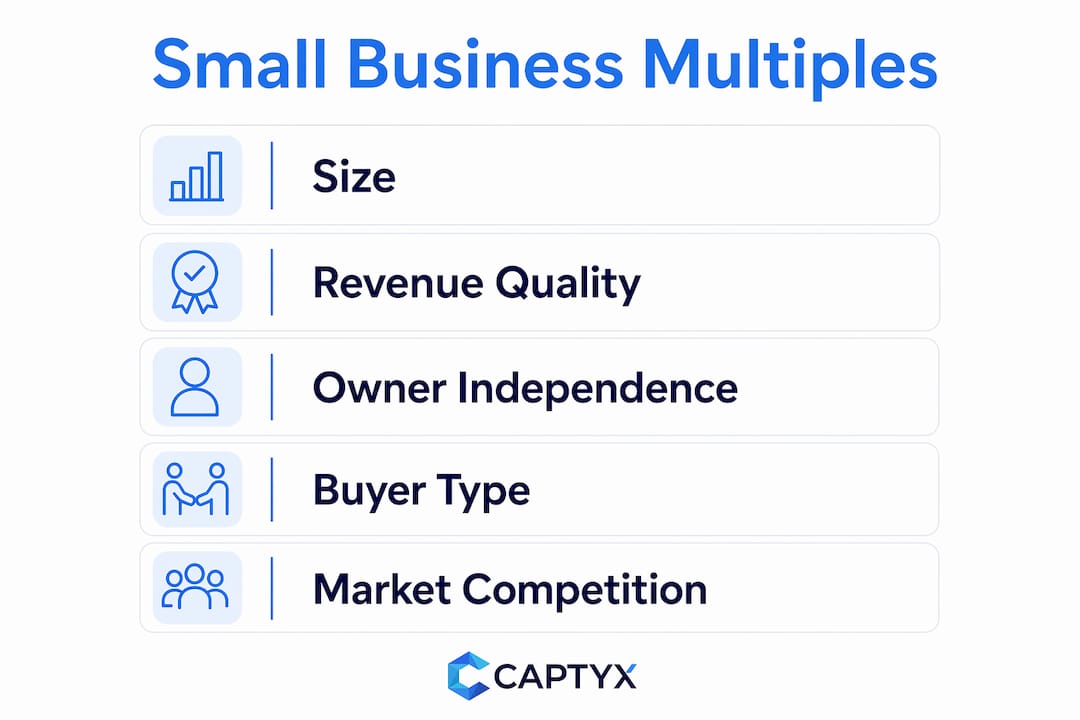
Valuation multiples are the multipliers applied to a business’s earnings, typically Seller’s Discretionary Earnings (SDE) or EBITDA, to determine its sale price. What drives small business multiples comes down to five core factors: business size, financial performance, operational independence, revenue quality, and buyer competition. Owners who understand these drivers before going to market consistently negotiate better outcomes. Platforms like Dealright, ExitValue.ai, and advisory firms like Captyx have documented how these variables shift multiples dramatically from one deal to the next.
What drives small business multiples: size and financial performance
Business size is the single most powerful factor in small business valuation multiples. The relationship is not linear. It compounds. A business generating $50,000 in SDE commands a multiple of 1.0–1.25x, while a business at $1,000,000 SDE reaches 3.25–4.25x. That is not a gradual climb. It is a structural jump driven by what analysts call acquisition arbitrage, where larger businesses attract more buyers with deeper pockets, pushing prices up.

This scaling effect matters because most owners assume their multiple will grow proportionally with earnings. It does not. The jump happens at key thresholds, particularly around $500,000 and $1,000,000 in SDE. Crossing those thresholds opens the door to a different class of buyer entirely.
| SDE Range | Typical Multiple | Buyer Profile |
|---|---|---|
| Under $100K | 1.0–1.5x | Individual buyers, owner-operators |
| $100K–$500K | 1.5–2.5x | Small investors, search funds |
| $500K–$1M | 2.5–3.25x | Experienced operators, small PE |
| $1M+ | 3.25–4.25x | Private equity, institutional buyers |
Financial performance quality matters just as much as the raw number. Clean financials and quality of earnings directly affect buyer confidence. Messy books, aggressive add-backs, or inconsistent reporting reduce the final price even when reported EBITDA looks strong. Buyers discount what they cannot verify.
One trap owners fall into is applying public market multiples to their own businesses. Public companies often trade at 19x earnings or higher. Private market transactions run roughly four times lower for businesses under $10,000,000. Expecting a public-market multiple on a $2,000,000 revenue business leads to failed negotiations and wasted time.
Pro Tip: Get your financials reviewed by a qualified CPA before going to market. Clean, verified numbers remove the discount buyers apply for uncertainty.
How owner dependency and operations affect your multiple
Owner dependency is one of the most overlooked value destroyers in small business sales. When a business cannot function without the current owner’s daily involvement, buyers see a job, not a company. Owner dependency reduces multiples by 20–40% because the buyer is essentially paying for a position they must fill immediately after closing.
Businesses with professional management teams and documented operating systems tell a different story. Professionally managed businesses with documented systems command profit multiples as high as 3.7x compared to 1x for owner-operated businesses. That gap is not a coincidence. It reflects the risk premium buyers assign to businesses that depend on one person.
Operational factors that raise multiples:
- Documented standard operating procedures (SOPs) for all key functions
- A management team that can run daily operations without owner input
- Transferable vendor and supplier relationships
- Systems for sales, customer service, and delivery that do not rely on the owner personally
- Staff retention history showing low turnover
Operational factors that lower multiples:
- Owner holds all key client relationships
- No documented processes for core functions
- Revenue tied to the owner’s personal reputation or license
- High staff turnover or dependence on one or two key employees
The insight from Dealright is direct: owner-operated businesses are often valued as if the business is just a job. Professional management adds perceived sustainability. That perception has a measurable dollar value at closing.
Does revenue quality really move the multiple?
Revenue quality is the factor most owners underestimate until they see a buyer’s due diligence list. Recurring revenue is the gold standard. Businesses with 80% recurring revenue can command 25–40% higher multiples than businesses with equivalent earnings from one-off sales. Predictable, contractually committed revenue removes the buyer’s biggest fear: that revenue disappears after the sale.
Customer concentration is the flip side of that equation. When a single client accounts for more than 20% of revenue, buyers apply a valuation discount of 10–25%. The logic is simple. If that client leaves post-sale, the buyer loses a significant portion of the earnings they paid for. Concentration risk is real, and buyers price it in.
Growth rate also moves the needle. Organic growth above 15–20% annually drives materially higher multiples by extending the perceived future cash flow value. Buyers pay for trajectory, not just current earnings. A business growing at 20% per year is worth more than a flat business with identical current earnings because the buyer’s return improves over time.
Customer diversification reduces risk and demonstrates business resilience. A balanced client base signals that revenue will survive the ownership transition. Owners who actively spread revenue across more clients before going to market consistently receive better offers.
Pro Tip: If one client represents more than 15% of your revenue, start diversifying at least 12–18 months before your planned sale date. Buyers will notice the trend.
How buyer type and market competition shape your multiple
The buyer pool for your business determines the ceiling on your multiple. Individual buyers using SBA loans face financing constraints that cap what they can pay. SBA loan limits and debt service requirements create a practical ceiling on deal size and multiple for businesses under $5,000,000 in EBITDA. That ceiling is real regardless of how well the business performs.
Private equity changes the math entirely. Businesses with EBITDA above $5,000,000 attract institutional buyers with substantial funds and a mandate to deploy capital. Competition among those buyers pushes multiples higher. This is acquisition arbitrage in practice. The same business earning $5,100,000 in EBITDA gets a fundamentally different valuation than one earning $4,900,000, purely because of who shows up to bid.
| Buyer Type | Typical Multiple Range | Key Constraint |
|---|---|---|
| Individual / owner-operator | 1.0–2.5x SDE | Personal financing, SBA limits |
| Search fund / small investor | 2.0–3.0x SDE | Debt service coverage |
| Strategic acquirer | 3.0–5.0x EBITDA | Synergy value, integration cost |
| Private equity | 4.0–7.0x EBITDA | Platform strategy, fund mandate |
Understanding why mid-market businesses attract private equity helps owners set realistic expectations based on their size. Smaller businesses are not less valuable in absolute terms. They simply operate in a different buyer market with different financing dynamics.
The practical takeaway is that growing your business past key EBITDA thresholds before selling is often worth more than any other preparation step. Moving from $900,000 to $1,100,000 in SDE can shift both the multiple and the buyer pool simultaneously. That combination produces a disproportionate increase in total sale price.
Key Takeaways
Business size, revenue quality, operational independence, and buyer competition collectively determine what your multiple will be at closing.
| Point | Details |
|---|---|
| Size drives multiples non-linearly | A $1M SDE business commands 3.25–4.25x; a $50K SDE business gets 1.0–1.25x. |
| Owner dependency destroys value | Businesses reliant on the owner sell at 20–40% lower multiples than managed businesses. |
| Recurring revenue commands a premium | Businesses with 80% recurring revenue earn 25–40% higher multiples than one-off revenue models. |
| Customer concentration triggers discounts | A single client over 20% of revenue reduces valuation by 10–25%. |
| Buyer pool sets the ceiling | Crossing $5M EBITDA unlocks private equity competition and materially higher multiples. |
What most owners get wrong about their multiple
The most common mistake I see is owners anchoring to a multiple they heard from a friend, read in a trade publication, or pulled from a public company comparison. None of those numbers apply to their business. Public multiples are four times higher than private market reality for businesses under $10,000,000. That gap is not a negotiating position. It is a structural fact of how private markets work.
The second mistake is treating the multiple as fixed. Owners assume the market sets the number and they just accept it. That is wrong. The multiple is a direct reflection of how risky the buyer perceives the business to be. Every operational improvement, every new recurring revenue contract, and every client you add to your base directly reduces that perceived risk. Lower risk means a higher multiple. That relationship is mechanical, not subjective.
What I find most owners overlook is growth consistency. A business that grew 18% last year but was flat the two years before that gets a lower multiple than a business that grew 12% every year for three years. Buyers pay for predictability. Consistent growth signals a system, not luck. Erratic growth signals dependency on one campaign, one client, or one person.
The owners who get the best outcomes spend 12–24 months before their sale date actively working on the factors in this article. They reduce owner dependency, diversify their client base, clean up their financials, and build recurring revenue. When they go to market, they are not hoping for a good multiple. They have already built one. Working with experienced advisors like Captyx, who have sold over 225 businesses and understand how buyers actually value your business, gives sellers a real advantage in that preparation process.
— Tucker
How Captyx helps you sell at the right multiple
Captyx has built the systems and frameworks that most business brokers use to prepare businesses for sale. Having sold over 225 businesses, including their own, Captyx brings direct experience to every engagement. The firm uses real-time buyer feedback to identify exactly which factors are suppressing your multiple and what to fix before going to market.

If you are planning a sale in the next one to three years, the right time to start is now. A free business valuation estimate from Captyx gives you a baseline and a clear picture of where your multiple stands today. From there, Captyx’s M&A advisory services guide you through every step, from operational improvements to closing. You can also explore whether using a broker is the right move for your specific situation before committing to any path.
FAQ
What is a valuation multiple in a small business sale?
A valuation multiple is the number applied to your SDE or EBITDA to calculate your business’s sale price. A business earning $500,000 in SDE sold at a 2.5x multiple closes at $1,250,000.
What multiple can I expect for my small business?
Most small businesses sell between 1.0x and 4.25x SDE depending on size, with businesses above $1,000,000 in SDE reaching the higher end of that range.
How does owner dependency affect my sale price?
Owner dependency reduces your multiple by 20–40% because buyers discount the risk of losing the person who runs the business. Documented systems and a management team remove that discount.
Does recurring revenue actually increase my multiple?
Businesses with 80% recurring revenue command 25–40% higher multiples than comparable businesses with one-off revenue. Predictable cash flow reduces buyer risk and justifies a higher price.
How do I know which buyer type will value my business highest?
Businesses under $5,000,000 in EBITDA typically attract individual buyers and search funds. Crossing $5,000,000 in EBITDA opens the door to private equity competition, which drives multiples materially higher.
Recommended
- Should I Use a Broker to Sell My Business? The Honest 2026 Answer – Top Way to Sell a Business | Captyx
- 21 Proven Ways to Multiply Your Exit Before You Ever List It – Top Way to Sell a Business | Captyx
- What Buyers Actually Want (And Why Most Sellers Get It Wrong) – Top Way to Sell a Business | Captyx


