


TL;DR:
- Evaluating a business before buying involves verifying financial health, legal standing, and operational stability.
- Using multiple valuation methods and conducting thorough due diligence helps confirm the true market value and identify risks.
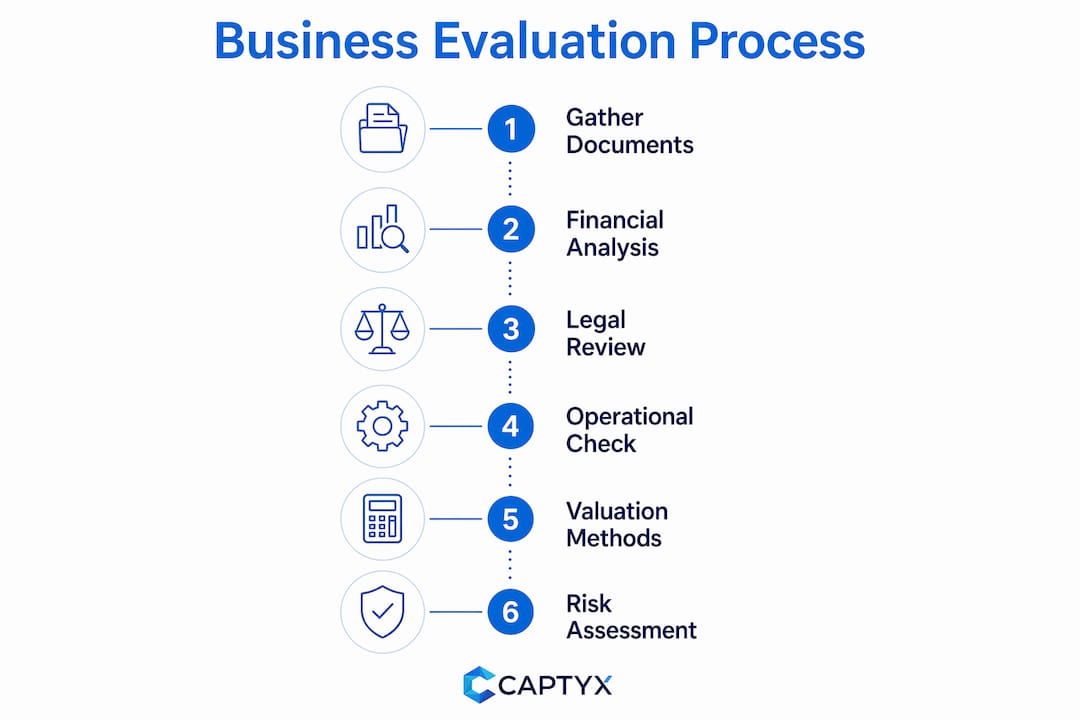
Evaluating a business before buying is the process of verifying its true financial health, legal standing, operational strength, and market position before you commit capital. The industry term for this process is acquisition due diligence, and it covers everything from auditing three years of tax returns to stress-testing customer concentration. Buyers who skip structured due diligence often discover hidden liabilities after closing, when leverage is gone. A disciplined evaluation confirms the seller’s claims, surfaces dealbreakers early, and gives you the data to negotiate a fair price. Captyx has guided buyers through this process across more than 225 transactions, and the patterns of what goes wrong are consistent and avoidable.
What financial analysis should you do to evaluate a business before buying?

Financial analysis is the foundation of any acquisition evaluation. You need to see three years of tax returns, profit and loss statements, balance sheets, and bank statements. Tax returns are the most reliable document because sellers cannot easily inflate them. Verifying tax returns against seller-provided financials is non-negotiable. A gap between a stated $380K in Seller’s Discretionary Earnings and $220K net income on tax returns is a serious red flag that demands explanation.
Normalize earnings before you trust any number
Raw net income is almost never the right number to use for valuation. You need to normalize earnings using either Seller’s Discretionary Earnings (SDE) for businesses under $2M in revenue or EBITDA for larger deals. SDE adds back the owner’s salary, personal expenses, and one-time costs to show what a new owner would actually earn. Every add-back must be documented. Undocumented add-backs are one of the most common ways sellers inflate asking prices.
Cash flow and working capital checks
Consistent cash flow matters more than a single strong year. Review monthly revenue trends to spot seasonality, client churn, or one-time windfalls that won’t repeat. Working capital analysis tells you how much cash the business needs to operate day to day after you take over. Buyers frequently underestimate working capital requirements and face a cash crunch within the first 90 days of ownership.
Customer revenue concentration above 30% from a single client is a major risk unless that client is locked in by a long-term contract. That level of dependency can collapse the business’s value if one relationship ends. Always request a full customer revenue breakdown by client for the past three years.
Pro Tip: Request bank statements directly from the seller and reconcile them against the profit and loss statements line by line. Discrepancies in deposits are the fastest way to catch inflated revenue claims.
| Financial document | What to verify |
|---|---|
| Tax returns (3 years) | Align with P&L; check for large discrepancies |
| Profit & loss statements | Identify add-backs and one-time items |
| Balance sheet | Assess liabilities, debt, and asset values |
| Bank statements | Confirm revenue deposits match reported figures |
| Customer revenue breakdown | Identify concentration risk above 30% |
How to conduct legal and operational due diligence for a business acquisition
Legal due diligence uncovers the liabilities and obligations that do not appear on a balance sheet. Specialized M&A attorneys are required for this work. A generalist attorney will miss deal-risking issues in commercial leases, IP ownership, or pending litigation. Budget for proper legal counsel from the start.
The legal review covers ownership structure, all active contracts, licenses and permits, pending or threatened litigation, and regulatory compliance. Pay close attention to assignability clauses in key contracts. A supplier agreement or commercial lease that cannot be transferred to a new owner can kill a deal or require expensive renegotiation.
Assessing key-person risk
Key-person dependency is one of the top causes of deal failure. When a business’s revenue depends on the seller’s personal relationships, those relationships may not survive the ownership change. Ask the seller to introduce you to key clients and suppliers before closing. Watch how those contacts respond. If they express hesitation or loyalty only to the current owner, you have a structural problem that no contract can fully fix.
Operational due diligence goes beyond legal documents. Review the technology infrastructure, employee retention history, and supplier contracts. A business that runs on outdated systems or has high staff turnover carries real post-acquisition costs. Evaluate whether the business can operate without the seller within 90 days of closing.
- Review all employment agreements and non-compete clauses
- Confirm that licenses and permits transfer to a new owner
- Identify any pending lawsuits or regulatory investigations
- Assess IT systems, software licenses, and data security practices
- Verify supplier contracts for pricing stability and term length
Pro Tip: Ask the seller to step back from daily operations for two weeks during due diligence. Watch what breaks. That exercise reveals key-person risk faster than any document review.
Which business valuation methods should you use to assess purchase price fairness?
Business valuation uses three core approaches to arrive at a defensible purchase price: the income approach, the market approach, and the asset approach. Each method answers a different question about value. Using only one method is a common mistake that leads to overpaying or walking away from a fair deal.
The income approach applies a multiple to normalized earnings (SDE or EBITDA) to estimate what the business is worth based on its earning power. Multiples vary by industry, growth rate, and risk profile. A stable, recurring-revenue service business typically commands a higher multiple than a cyclical, project-based operation.
The market approach compares the target business to similar transactions and public company data. This method grounds your offer in what real buyers have actually paid for comparable businesses. It is especially useful for sanity-checking an income-based valuation.
The asset approach calculates the fair market value of all tangible and intangible assets minus total liabilities. This method is most relevant when buying asset-heavy businesses or when earnings are low relative to the asset base. For service businesses, intangible assets like customer lists, brand reputation, and proprietary processes often carry more weight than physical assets.
Combining valuation methods produces a more defensible purchase price and improves your negotiating position. A single-method valuation is easy for a seller to challenge. A triangulated valuation backed by three approaches is much harder to dispute.
Quality of Earnings reports confirm whether stated earnings are sustainable and whether add-backs are legitimate. These reports are prepared by independent accountants and are standard practice in deals above $1M. They normalize earnings, flag risks, and validate the numbers you are using to build your offer.
Pro Tip: Get a free valuation estimate from Captyx before you make an offer. Knowing the defensible range prevents you from anchoring to the seller’s asking price.
| Valuation method | Best used when | Key input |
|---|---|---|
| Income approach | Business has stable, recurring earnings | Normalized SDE or EBITDA plus industry multiple |
| Market approach | Comparable transactions are available | Recent sale prices for similar businesses |
| Asset approach | Asset-heavy or low-earnings business | Fair market value of assets minus liabilities |
How to manage the due diligence process and evaluate risks before closing
A structured due diligence process protects your time and your capital. Due diligence typically runs 45–90 days depending on deal size and complexity. A $1M service business often completes the process in 45–60 days, while a $4M manufacturing deal can require the full 90 days. Build this timeline into your letter of intent before you start.
Prioritize high-risk areas first. Do not spend week one reviewing marketing materials when you have not yet verified customer concentration or confirmed that add-backs are documented. Prioritizing potential dealbreakers early saves weeks of work if a fatal flaw surfaces.
Categorize every finding into one of three buckets:
- Dealbreakers. Issues that make the acquisition unviable at any price. Undisclosed litigation, fraudulent financials, or a lease that cannot be assigned fall here.
- Price adjusters. Findings that reduce the business’s value but do not kill the deal. Deferred maintenance, customer concentration without contracts, or key-person risk belong in this category.
- Manageable risks. Issues you can address post-acquisition with a clear plan. Staff turnover, outdated software, or supplier pricing gaps are examples.
Set a walk-away price before you start due diligence and commit to it. Overpaying often results from optimistic projections, ignored integration costs, and unsupported earnings adjustments. The sunk cost fallacy is real in acquisitions. Buyers who have spent $30,000 on legal and accounting fees often push forward on bad deals rather than absorb the loss. That decision costs far more in the end.
“A well-managed due diligence process is not just about finding problems. It is about building a complete picture of what you are actually buying, so you can negotiate from facts instead of assumptions.”
Pro Tip: Send document requests in a single organized list at the start of due diligence, not in drips. Sellers who receive piecemeal requests lose confidence in the buyer. A phase-by-phase timeline keeps both sides aligned and reduces delays.
Key Takeaways
Evaluating a business before buying requires financial verification, legal review, operational assessment, and a triangulated valuation to make a defensible, informed acquisition decision.
| Point | Details |
|---|---|
| Verify financials independently | Cross-check tax returns against P&L statements to catch inflated earnings before making an offer. |
| Normalize earnings correctly | Use SDE for smaller deals and EBITDA for larger ones, and document every add-back with evidence. |
| Assess key-person risk early | Test whether the business can operate without the seller within 90 days of closing. |
| Use three valuation methods | Combine income, market, and asset approaches to build a defensible and negotiation-ready purchase price. |
| Set a walk-away price first | Define your maximum offer before due diligence starts to avoid the sunk cost trap during negotiations. |
What most buyers get wrong about business evaluation
The biggest mistake I see buyers make is treating due diligence as a formality after they have already decided to buy. By the time they fall in love with a business, they are looking for reasons to proceed, not reasons to pause. That emotional commitment is the most expensive thing in any acquisition.
The second mistake is relying entirely on seller-provided documents without independent verification. Sellers are not always dishonest, but they are always motivated. Their accountant normalized earnings in the most favorable way possible. Their attorney drafted contracts that protect the seller’s interests. You need your own team reviewing everything from scratch.
I have also seen buyers use a single valuation method and anchor to it. When a seller pushes back, they have no defense. Buyers who combine valuation methods walk into negotiations with three independent data points. That is a fundamentally different conversation.
The buyers who close the best deals treat due diligence as a negotiation tool, not a compliance exercise. Every finding is either a dealbreaker, a price reduction, or a post-closing plan. That framework keeps you objective when the seller gets emotional about their asking price. And they always do.
— Tucker
How Captyx helps buyers evaluate and acquire businesses with confidence
Buying a business is one of the largest financial decisions you will make. Getting the evaluation right requires financial expertise, legal rigor, and a clear framework for assessing risk.

Captyx brings over 225 completed transactions to every buyer engagement. The team provides valuation support, due diligence guidance, and access to off-market acquisition opportunities that never appear on public listing sites. Whether you need help structuring your offer or verifying a seller’s financials, Captyx’s M&A advisory services give you the expertise to move forward with confidence and avoid the mistakes that cost buyers the most.
FAQ
What does it mean to evaluate a business before buying?
Evaluating a business before buying means conducting acquisition due diligence to verify its financial health, legal standing, operations, and true market value. The goal is to confirm the seller’s claims and identify risks before you commit to a purchase price.
How long does the due diligence process take?
Due diligence typically takes 45–90 days depending on deal size and complexity. Smaller service businesses often complete the process in 45–60 days, while larger or more complex deals require the full 90 days.
What business valuation methods should I use?
Use all three core methods: the income approach, the market approach, and the asset approach. Combining all three produces a more defensible purchase price than relying on any single method alone.
What is customer concentration risk?
Customer concentration risk occurs when a single client accounts for more than 30% of total revenue. This level of dependency can significantly reduce a business’s value and stability unless that client relationship is secured by a long-term contract.
Do I need a specialized attorney for a business acquisition?
Yes. Generalist attorneys are not adequate for business acquisitions. You need a specialized M&A attorney to review contracts, identify liabilities, confirm license transferability, and flag any legal issues that could affect the deal.
Recommended
- How to Sell Your Business: A Comprehensive Guide | Captyx
- 21 Proven Ways to Multiply Your Exit Before You Ever List It – Top Way to Sell a Business | Captyx
- RESIDENTIAL & COMMERCIAL PROPERTY MAINTENANCE COMPANY – Top Way to Sell a Business | Captyx
- 30+ YEARS RESIDENTIAL FLOORING COMPANY – Top Way to Sell a Business | Captyx


