


TL;DR:
- Choosing the right business broker is critical to a successful sale, as industry specialization, buyer network, and process discipline determine deal outcome. Verifying credentials like IBBA certification and reviewing their deal history help identify trustworthy, experienced brokers. Success depends more on their process management and communication than on initial valuation estimates or fees.
A business broker is a licensed intermediary who manages the sale or acquisition of a business on behalf of a buyer or seller. Finding the right business broker is the single most consequential decision you will make in a business transaction. The wrong choice costs you time, confidentiality, and money. The right one brings a qualified buyer pool, a disciplined deal process, and negotiating skill that protects your final number. This guide gives you a systematic way to evaluate brokers across five dimensions: industry fit, credentials, fee structure, process discipline, and communication style.
What should you look for when choosing a business broker?
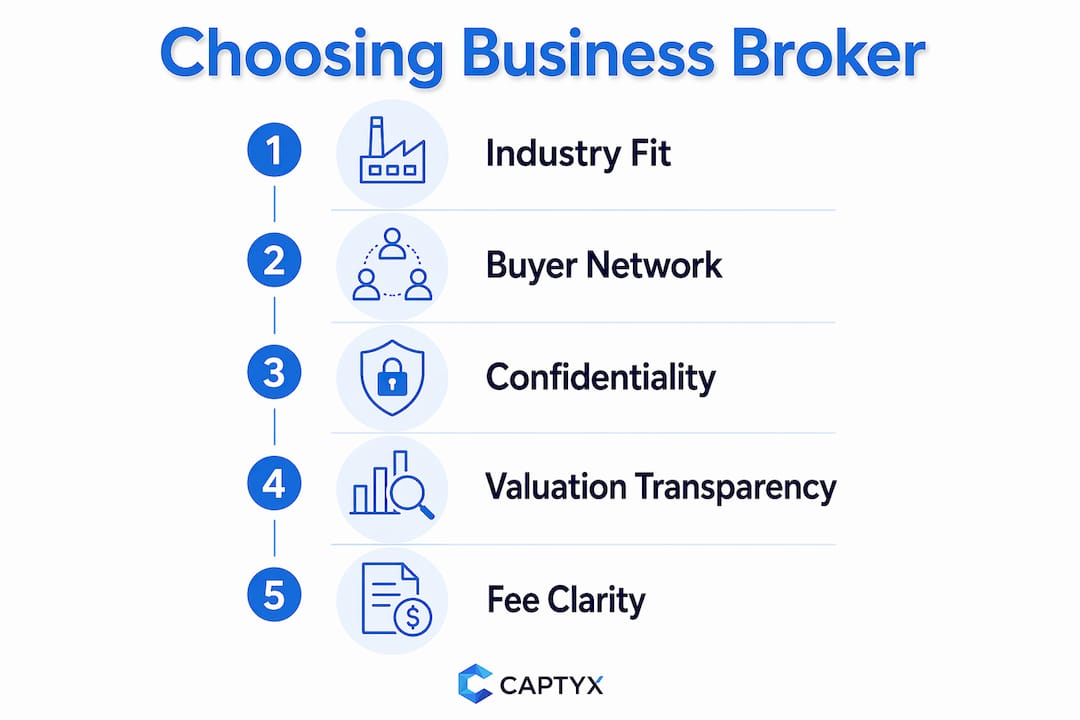
The best business brokerage services share five qualities that separate them from average operators. Knowing what to look for before you start interviewing brokers saves you from costly missteps.

Industry and deal size fit
Industry specialization matters more than most sellers expect. A broker who specializes in restaurants will not have the buyer network or valuation fluency needed to sell a manufacturing or technology business. Ask every broker you interview how many deals they have closed in your specific industry and at your revenue range. If they cannot name three comparable transactions, move on.
Transaction history and buyer network
A broker’s buyer network is their most valuable asset. Ask how many active, pre-qualified buyers they maintain in their database and how they source new ones. Brokers who rely solely on listing platforms like BizBuySell are running a passive strategy. Top performers actively cultivate relationships with private equity groups, strategic acquirers, and individual buyers.
Confidentiality management
Confidentiality and buyer screening are non-negotiable. Every qualified broker should gate access to your financials behind a signed NDA and a buyer qualification call. If a broker cannot explain their screening process in specific terms, your employees, customers, and competitors could learn your business is for sale before a deal closes.
Valuation process transparency
A credible broker explains exactly how they arrive at your asking price. They reference EBITDA multiples, comparable sales data, and industry benchmarks. Vague answers like “we’ll price it to move” signal a broker who lacks the analytical depth to defend your valuation in negotiations.
Fee structure clarity
Fee models vary significantly, and you need to understand every line before signing. The next section covers this in detail.
Pro Tip: Ask each broker for a written marketing plan before you sign anything. A broker who cannot produce one within 48 hours is not prepared to represent your business.
How do you verify a business broker’s credentials?
Credentials are a starting point, not a finish line. Use them to filter out unqualified candidates, then dig deeper into actual deal performance.
-
Check the IBBA directory. The International Business Brokers Association (IBBA) awards the Certified Business Intermediary (CBI) designation to brokers who meet education, experience, and ethics standards. Nearly 500 Certified Business Intermediaries hold this credential as of 2026. That number is small relative to the total broker population, which means CBI holders represent a filtered, accountable group worth prioritizing.
-
Request a closed deal list. Ask for a list of transactions closed in the past 24 months, including industry, deal size range, and time on market. A broker who hesitates to share this data is hiding a thin track record.
-
Review their marketing materials. Ask for a sample Confidential Information Memorandum (CIM) from a past deal. The quality of that document tells you how buyers will perceive your business. A poorly written CIM reduces buyer interest before a single conversation happens.
-
Confirm licensing where required. Several states require business brokers to hold a real estate license to facilitate business sales. Check your state’s requirements through your state real estate commission or use a registered agent service to clarify compliance obligations in your jurisdiction.
-
Search for disciplinary history. Run the broker’s name through the IBBA member directory and your state licensing board. One unresolved complaint is a red flag. Two is disqualifying.
Success in business brokerage is measured by integrity and consistent process management, not just deal volume. The IBBA’s annual awards, including Deal of the Year and Rising Star, recognize brokers who demonstrate qualitative excellence. Look for brokers who have received peer recognition, not just self-reported accolades.
What are the common business broker fee models?
Understanding broker fees before you negotiate protects you from surprises at closing. The table below compares the four most common structures.
| Fee model | How it works | Best for |
|---|---|---|
| Success fee only | Commission paid at closing, typically 8–12% for small businesses | Sellers with clean financials and strong market demand |
| Retainer plus success fee | Upfront monthly fee plus reduced commission at closing | Larger or more complex transactions requiring significant prep work |
| Minimum fee | A floor commission regardless of sale price, often $15,000–$25,000 | Lower-value businesses where standard percentages would undercompensate the broker |
| Expense reimbursement | Separate charges for marketing, travel, and third-party costs | Any deal where the broker incurs significant out-of-pocket expenses |
Fee models include success fees, retainers, minimum fees, and reimbursable expenses. Each structure creates different incentives. A pure success fee aligns the broker’s interest with yours because they only earn if you close. A retainer model gives the broker income regardless of outcome, which can reduce urgency.
Watch the listing agreement carefully. Listing agreement terms often include exclusivity periods, tail clauses that extend commission rights after the agreement ends, and conditions for early termination. Negotiate a 90-day exclusivity period with a 30-day termination notice clause if performance benchmarks are not met.
Pro Tip: Never select a broker based on the lowest commission rate. A broker who charges 10% and closes at your asking price outperforms one who charges 8% and accepts a 20% discount to get a deal done.
How do you interview and select the right business broker?
A structured interview process separates the brokers who sound good from the ones who perform. Follow these steps before signing any engagement letter.
-
Prepare your questions in advance. Write out at least ten specific questions before the first call. Generic conversations produce generic answers. Ask about their pipeline management process, how they handle competing offers, and what their average time on market is for businesses in your category.
-
Evaluate their communication cadence. Ask how often they will update you and through what channel. A broker who cannot commit to weekly written updates is not running a disciplined process. Poor communication is the most common complaint sellers have after a deal closes.
-
Compare engagement terms side by side. Request the listing agreement from every broker you interview. Put the exclusivity period, commission rate, tail clause length, and termination conditions in a spreadsheet. Differences that seem minor in conversation become significant at closing.
-
Ask about their buyer sourcing strategy. The best brokers run a structured buyer qualification process that includes financial verification, NDA execution, and a discovery call before any financials are shared. Ask them to walk you through each step.
Avoid these common selection mistakes:
- Choosing a broker because they gave you the highest valuation estimate. Inflated valuations attract unqualified buyers and waste months.
- Signing a 12-month exclusivity agreement without performance benchmarks. Build in a 90-day review clause.
- Ignoring the tail clause. Some brokers claim commission on buyers they introduced even 12–18 months after the agreement ends.
- Skipping reference checks. Call at least two past clients who sold businesses in your revenue range.
A disciplined pipeline process that includes NDA execution, buyer qualification, letter of intent management, and due diligence coordination is what separates top brokers from average ones. A broker who cannot describe this process in detail is improvising, and improvisation in M&A costs you money.
Avoid common selling mistakes by understanding the broker selection pitfalls that cost sellers the most value before a deal even starts.
Key takeaways
The broker who runs the most disciplined process, not the one who promises the highest price, consistently delivers the best sale outcomes for small business owners.
| Point | Details |
|---|---|
| Industry fit is non-negotiable | Match your broker’s closed deal history to your specific industry and deal size. |
| CBI credentials filter the field | Prioritize IBBA-certified brokers to start with an accountable, vetted candidate pool. |
| Fee structure shapes incentives | Success-fee-only models align broker motivation with your closing outcome. |
| Listing agreement terms matter | Negotiate short exclusivity periods, performance benchmarks, and fair tail clauses before signing. |
| Process discipline predicts performance | Ask every broker to walk you through their pipeline management steps from NDA to closing. |
What I have learned after watching hundreds of broker deals
Most sellers focus on commission rates. That is the wrong number to optimize. I have watched deals fall apart not because the broker charged too much, but because they had no process for managing the buyer pipeline after the first offer came in. A broker who cannot shape deal terms, counter a low LOI, or keep a buyer engaged through due diligence is not worth 1%, let alone 10%.
The brokers who consistently deliver for their clients share one trait: they treat every deal like a project with defined stages, deadlines, and accountability. They send weekly updates without being asked. They tell you when a buyer is losing interest before you find out from silence. They push back on your asking price when the market data does not support it, even when that conversation is uncomfortable.
Credentials like the CBI give you a useful baseline, but the best broker fit also depends on industry specialization and communication style. I have seen CBI-certified brokers underperform and non-certified brokers close exceptional deals. The credential filters out the worst candidates. Your interview process identifies the best one.
One more thing: make sure your business is ready before you engage a broker. A broker cannot fix weak financials, undocumented processes, or customer concentration problems. Check whether your business meets the key sale-readiness signals before you start interviewing brokers. The stronger your business looks on day one, the more leverage your broker has in negotiations.
— Tucker
How Captyx helps you find and work with the right broker
Captyx has sold over 225 businesses and built the systems that many brokers and M&A advisors now use to prepare businesses for sale. That experience means Captyx does not guess at valuation or buyer fit. The firm uses real-time buyer feedback to identify exactly what needs to change before your business goes to market, so your broker starts with the strongest possible asset to represent.

If you are weighing whether to use a broker at all, the honest 2026 answer depends on your deal complexity, buyer network, and negotiating experience. For most small business owners, professional M&A advisory support from a firm like Captyx delivers measurably better outcomes. Explore Captyx’s M&A advisory services or get a free business valuation estimate to understand where your business stands before your first broker conversation.
FAQ
What does a business broker actually do?
A business broker manages the sale or acquisition of a business, including valuation, marketing, buyer sourcing, NDA management, offer negotiation, and due diligence coordination. Their core value is maintaining confidentiality while generating competitive buyer interest.
How do I verify a broker’s credentials?
Search the IBBA directory for the Certified Business Intermediary (CBI) designation and confirm licensing through your state’s real estate commission. Request a closed deal list covering the past 24 months to validate actual transaction experience.
What commission does a business broker charge?
Most business brokers charge a success fee of 8–12% for small business transactions, though fee models also include retainers, minimum fees, and expense reimbursements. The specific structure depends on deal size and complexity.
What questions should I ask a business broker before hiring?
Ask about their closed deal history in your industry, their buyer screening process, how they manage the pipeline from NDA to closing, their communication cadence, and the specific terms of their listing agreement including tail clauses and termination conditions.
Is a higher valuation estimate from a broker a good sign?
No. Selecting a broker based on the highest valuation is a common and costly mistake. Inflated estimates attract unqualified buyers, extend time on market, and often result in a lower final sale price than a realistically priced listing would achieve.


