


TL;DR:
- Timing is the most critical factor in maximizing business sale value and closing success.
- Aligning internal readiness, market conditions, and owner energy allows owners to negotiate from strength.
Timing is the single most powerful variable in determining what your business sells for and whether a deal closes at all. The difference between a planned exit and a forced one can mean hundreds of thousands of dollars in lost value, weaker deal terms, and a buyer who holds all the leverage. Understanding why timing affects business sale outcomes requires looking at three forces simultaneously: your internal business readiness, external market conditions, and your personal circumstances as the owner. Get all three aligned, and you negotiate from strength. Miss the window, and you negotiate from need.
Why timing affects business sale outcomes
The M&A industry uses the term “exit readiness” to describe the state where a business is positioned to attract premium buyers and command strong valuations. Most owners treat it as a destination. The best outcomes come when owners treat it as an ongoing discipline.
Buyers prioritize EBITDA and recurring revenue quality over top-line revenue growth when valuing a business. That single fact reshapes how you should think about timing. Selling during a year of rapid revenue growth but thin margins often produces a lower valuation than selling after two years of steady, margin-rich performance. The business that looks exciting on a pitch deck is not always the business that closes at the highest multiple.
The impact of timing on sales goes beyond the numbers. Buyers read context. They assess whether you are selling from a position of confidence or from a position of pressure. That perception directly shapes the offer they put on the table.
How internal factors shape your optimal sale timing
Your business’s internal condition is the most controllable timing variable you have. Market cycles shift without warning. Buyer sentiment changes. But your revenue quality, management depth, and operational systems are things you can build deliberately before you go to market.

Business readiness is a stronger predictor of sale value than market timing. A business with predictable, recurring revenue backed by a management team that can run operations without the founder commands premium multiples regardless of economic conditions. That is the standard worth building toward before you list.
Here is what buyers actually examine when they assess internal readiness:
- Revenue quality: Recurring contracts and diversified customers outperform lumpy, project-based revenue every time.
- EBITDA margins: Chasing revenue growth at the expense of EBITDA creates valuation risk and timing traps for owners.
- Management independence: A business that runs without you is worth significantly more than one that stops when you leave.
- Clean financials: Three years of audited or reviewed financials remove buyer doubt and accelerate due diligence.
- Customer concentration: No single customer should represent more than 20% of revenue if you want to avoid valuation discounts.
Founder fatigue is the internal factor most owners underestimate. Buyers are sensitive to signs of founder fatigue, reading it as evidence that the business is past its peak or dangerously dependent on the owner’s personal energy. When a buyer detects burnout during diligence, they renegotiate terms. They lower offers. They add earn-out provisions that shift risk back to you.
Pro Tip: Start tracking your own energy and enthusiasm for the business quarterly. If you notice a sustained decline over two or more quarters, treat that as a timing signal, not just a personal problem.
How market conditions and buyer behavior shape sale timing
External market dynamics create windows of opportunity that open and close independent of your business’s internal condition. Knowing how to read those windows is a core part of any business sale timing strategy.
Economic cycles and consumer purchasing power directly impact company profitability and buyer demand, which in turn shapes what buyers are willing to pay. In expansion cycles, strategic buyers have capital to deploy and private equity firms face pressure to put money to work. Both conditions increase competition for quality deals and push valuations higher.
Here is how to think about the four key external timing signals:
- Interest rate environment: Lower rates reduce the cost of acquisition financing, which expands the buyer pool and supports higher multiples.
- Industry-specific demand cycles: Buyers in your sector may be consolidating aggressively during certain periods. Selling into that wave produces better outcomes than selling after it crests.
- Comparable transaction multiples: Track what similar businesses in your industry are selling for. When multiples are high, the market is telling you something.
- Buyer readiness windows: Aligning your sale timing with buyer readiness moments greatly increases sale success compared to forced timing or market speculation.
The risk most owners face is trying to time the market perfectly. That strategy almost always fails. Waiting for the ideal confluence of low rates, peak industry multiples, and personal readiness creates indefinite deferral. The better approach is to be ready when conditions are favorable, not to predict when conditions will be perfect.
| Timing Approach | Typical Outcome |
|---|---|
| Planned exit with strong internal readiness | Premium valuation, competitive buyer pool, strong deal terms |
| Market-timed exit without internal preparation | Average valuation, limited buyer interest, slower close |
| Forced exit due to personal circumstances | Discounted valuation, single buyer leverage, unfavorable terms |
| Indefinite deferral waiting for perfection | Missed windows, operational stagnation, eventual forced exit |
What forced sales cost you versus planned exits
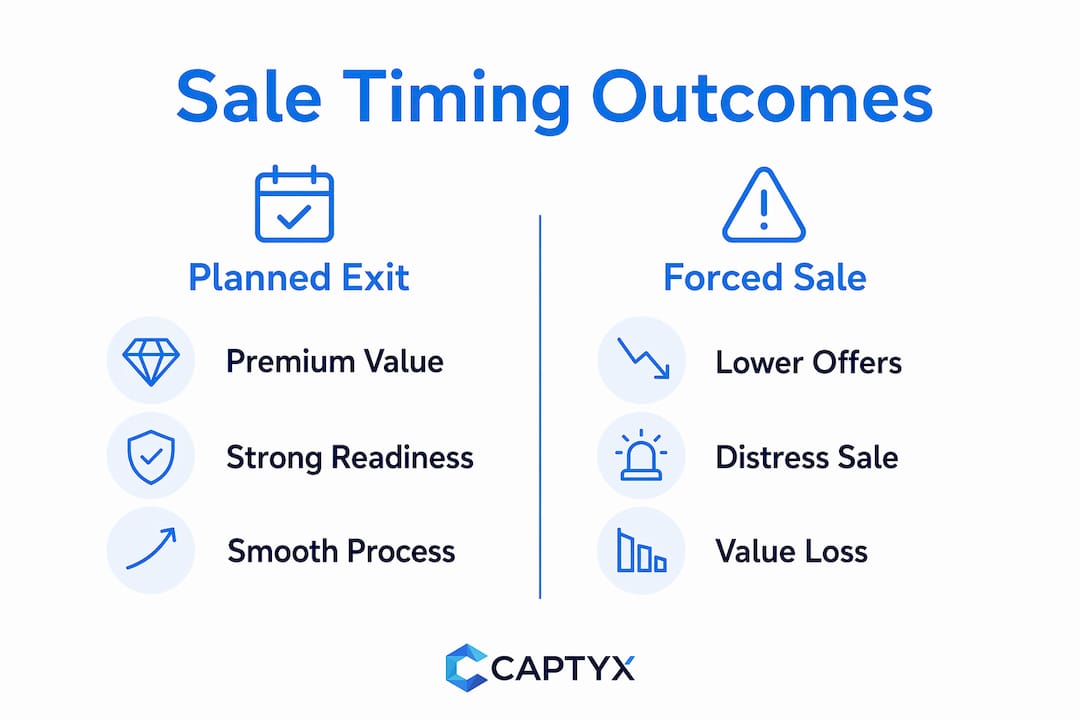
The gap between a forced sale and a planned exit is where the most value is destroyed. Health events, burnout, partnership disputes, and family pressures often force business sales, compressing timelines and handing negotiation leverage directly to buyers.
Buyers are not passive in this dynamic. They actively assess the circumstances behind a sale. When they detect urgency, they adjust their offers downward. When they sense desperation, they add contingencies, extend timelines, and re-trade terms during due diligence. Impulsive exits driven by personal urgency erode negotiation leverage because buyers deduce desperation and adjust offers accordingly.
The contrast with a planned exit is stark. Consider two owners selling similar businesses at similar revenue levels:
- Owner A decides to sell after a health scare. The business has been running on his personal relationships for years. He needs to close within six months. He accepts the first serious offer at a 3.5x EBITDA multiple.
- Owner B spends 18 months building a management team, cleaning up customer concentration, and documenting systems. She goes to market with three qualified buyers competing. She closes at a 5.8x EBITDA multiple.
Same industry. Dramatically different outcomes. The difference is timing treated as a discipline versus timing as a reaction.
“The best sale outcomes occur when owners treat timing as a data-driven discipline, closing the gap between operational state and exit readiness deliberately.” — Why Business Owners Get Exit Timing Wrong
Owners also fall into the opposite trap: indefinite deferral. Waiting for a perfect time that never arrives leads to missed operational investments and suboptimal exits. The business stagnates. The owner’s energy fades. And eventually, the sale happens anyway, under worse conditions.
Pro Tip: Set a specific 12-month target date for going to market and work backward from it. Concrete deadlines force the preparation that vague intentions never produce.
How to optimize your sale timing for maximum value
Optimizing how timing influences sale success requires a structured approach that combines financial analysis, personal assessment, and market awareness. Here is a practical framework for small business owners:
- Run a business readiness audit 18–24 months before your target sale date. Assess EBITDA quality, customer concentration, management depth, and system documentation. Identify the three biggest gaps and build a plan to close them.
- Set financial performance targets for your final two years. Buyers value trailing twelve-month and three-year averages. Strong performance in the 24 months before sale directly lifts your valuation.
- Get a professional valuation before you go to market. Owners consistently overestimate or underestimate their business’s value. A professional business valuation anchors your expectations and informs your timing decision.
- Monitor your industry’s M&A activity. When consolidation is active in your sector, qualified buyers are already in acquisition mode. That reduces your marketing effort and accelerates timelines.
- Assess your personal readiness honestly. Ask yourself whether you have the energy and motivation to run the business for another 12–18 months at full capacity. If the answer is no, accelerate your preparation rather than delay your exit.
The value created over a delayed sale period must exceed the risks and opportunity costs to justify waiting. If you are holding on hoping for one more year of growth, calculate whether that growth will actually move your multiple or just add revenue without improving EBITDA quality.
| Preparation Timeline | Key Actions | Expected Impact |
|---|---|---|
| 24 months before sale | Readiness audit, gap identification, management hiring | Builds buyer confidence and valuation floor |
| 12–18 months before sale | Financial cleanup, system documentation, customer diversification | Removes diligence risk and supports premium pricing |
| 6–12 months before sale | Engage advisor, prepare CIM, identify target buyers | Creates competitive process and negotiation leverage |
| 0–6 months before sale | Active marketing, buyer meetings, LOI negotiation | Converts preparation into maximum sale value |
Reviewing the common mistakes when selling a business before you begin this process is worth your time. Many of the most expensive errors are timing-related and entirely avoidable with early awareness.
Key takeaways
Optimal sale timing is the product of internal business readiness, personal owner energy, and favorable market conditions working together, not any single factor in isolation.
| Point | Details |
|---|---|
| EBITDA quality drives valuation | Buyers pay multiples on sustainable earnings, not top-line revenue growth. |
| Founder fatigue signals risk | Visible burnout triggers renegotiations and valuation discounts during diligence. |
| Forced sales destroy leverage | Urgency-driven exits hand buyers the power to lower offers and add contingencies. |
| Preparation window is 18–24 months | Starting early closes readiness gaps and creates a competitive buyer process. |
| Indefinite deferral is a real cost | Waiting for perfection leads to operational stagnation and worse eventual outcomes. |
Timing is personal before it is financial
I have watched owners make the same mistake repeatedly: they treat timing as a market question when it is really a self-awareness question first. The owners who get the best outcomes are not the ones who called the market cycle perfectly. They are the ones who knew exactly what their business needed to look like before a buyer walked in the door, and they gave themselves enough time to build it.
The hardest conversation I have with owners is about founder fatigue. Most will not admit it until it is already visible to buyers. By then, the damage is done. Buyers are not just buying your business. They are buying their confidence that the business will perform after you leave. If you look exhausted, that confidence erodes fast.
The quantitative side of timing, EBITDA, multiples, market cycles, matters enormously. But the qualitative side matters just as much. Are you still the best advocate for your business? Can you run a six-month sale process with full energy and conviction? If not, that is your real timing signal.
Treat your exit like a product launch. You would not launch a product before it was ready. Do not take your business to market before it is ready either. The preparation you do in the 18 months before you sell will almost always return more value than any market timing decision you make.
— Tucker
How Captyx helps you sell at the right time
Timing a business sale correctly is not guesswork. Captyx has built the systems and frameworks that most brokers and M&A advisors rely on, refined across more than 225 completed transactions.

Whether you are 18 months from a planned exit or trying to understand what your business is worth today, Captyx provides the structure to get you there. From professional M&A advisory to a free business valuation, the firm gives you the data and guidance to make your timing decision from a position of strength, not pressure. If you are serious about maximizing your sale outcome, start the conversation before you think you need to.
FAQ
What is the best time to sell a business?
The best time to sell is when your business shows strong, recurring EBITDA, your management team can operate without you, and market conditions support competitive buyer interest. Internal readiness consistently outperforms market timing as a value driver.
How far in advance should i prepare to sell?
Start your preparation 18–24 months before your target sale date. That window gives you time to close financial gaps, document systems, and build the management depth buyers pay premiums for.
How does founder fatigue affect my sale price?
Buyers detect burnout during due diligence and treat it as a risk signal. Visible founder fatigue leads to lower offers, added earn-out provisions, and renegotiated deal terms before closing.
Does waiting longer always produce a higher sale price?
Not necessarily. The value created during a delay must exceed the risks and opportunity costs of waiting. Indefinite deferral often leads to operational stagnation and a worse eventual exit than selling at the right moment of readiness.
What is the difference between a forced sale and a planned exit?
A forced sale happens under personal pressure, such as health events or burnout, compressing timelines and giving buyers negotiation leverage. A planned exit is built over 12–24 months of deliberate preparation, producing competitive offers and stronger deal terms.


