


TL;DR:
- A business buyer profile is a factual, seller-facing document that verifies a buyer’s financial capacity, experience, and acquisition goals to establish credibility and protect confidentiality. It helps sellers screen qualified buyers efficiently, enabling faster deals and higher-quality offers in M&A transactions. Building a clear, tailored profile with specific financial and professional details is essential to gaining access to confidential information and closing successful deals.
A business buyer profile is a structured document that captures a prospective buyer’s financial capacity, professional background, and acquisition goals to help sellers evaluate fit and establish trust before sharing confidential business information. In M&A and business brokerage, this document serves as the buyer’s first credibility signal. Sellers and brokers use it to screen out unqualified inquiries and protect sensitive financials from reaching the wrong hands. Understanding what a business buyer profile contains, how it differs from a business buyer persona, and how to build one effectively gives you a measurable edge in any acquisition or sale process.
What is a business buyer profile and what does it include?
A business buyer profile is a seller-facing document, not a marketing tool. It exists to answer one question for the seller: “Is this buyer credible enough to receive confidential information about my business?” According to BizBuySell, a buyer profile captures background, financial capability, and acquisition interest to demonstrate seriousness and build trust with sellers. That trust function is the profile’s primary job.

The document is factual and specific. It does not tell a story about ambitions. It presents proof. Sellers reviewing dozens of inquiries will prioritize buyers who remove doubt immediately over those who require follow-up to establish basic qualifications.
Core components every buyer profile must contain
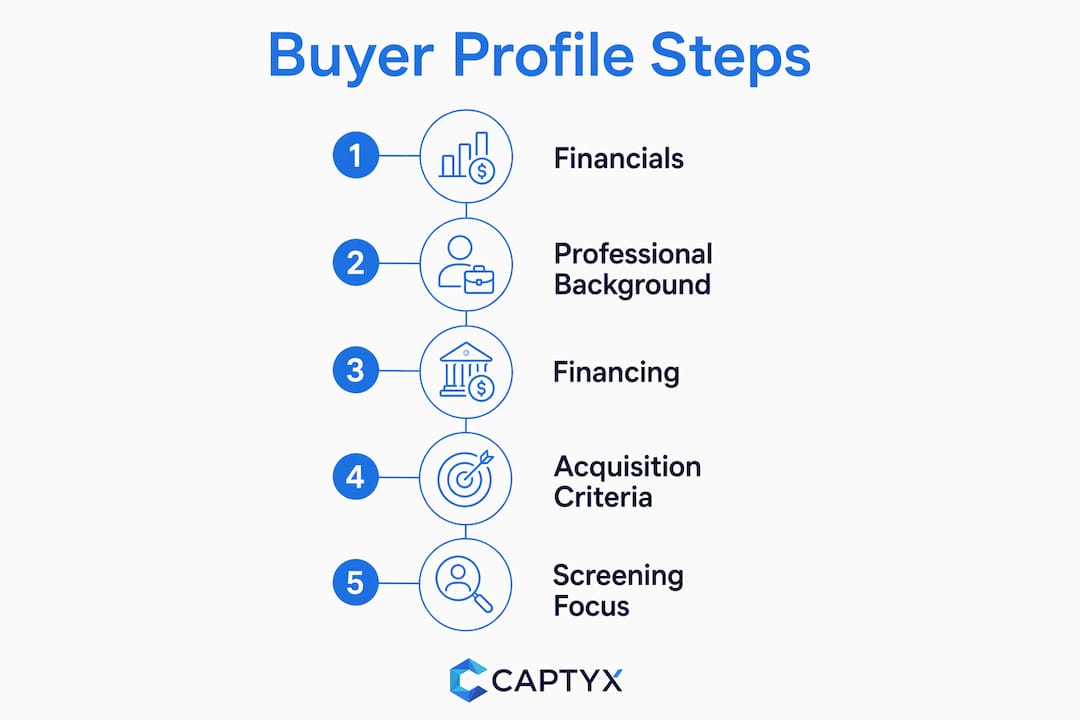
BizBuySell identifies the key elements of a buyer profile as professional experience, financial plans, acquisition goals, and any partners involved. Each element serves a distinct screening function for the seller:
- Professional background: Industry experience, management roles held, and any direct operational experience running a business of similar size or type.
- Financial capability: Available down payment, credit standing, access to bank financing, and willingness to consider seller financing.
- Acquisition criteria: Target business size by revenue or EBITDA, preferred industries, geographic preferences, and deal structure expectations.
- Timeline and involvement: Whether the buyer intends to operate the business directly, hire management, or integrate it into an existing portfolio.
- Partners and backers: Names and roles of any co-investors, silent partners, or financial sponsors participating in the acquisition.
Pro Tip: Never submit a buyer profile without a clear financing section. Sellers and brokers treat missing financial details as a disqualifying red flag, not a minor omission.
Sellers use these components to assess whether a buyer can close, not just whether they are interested. A buyer who documents $500,000 in liquid capital and 12 years managing a distribution company will advance past a buyer who lists “strong entrepreneurial drive” with no financial specifics.
Buyer profile vs. buyer persona vs. ideal customer profile
These three terms are frequently confused, and treating them as interchangeable creates real strategic errors. Each concept belongs to a different context and serves a different audience.
A buyer persona is a fictional, research-based profile representing an ideal customer’s motivations, goals, and pain points. HubSpot and Salesforce both emphasize that personas capture decision-making psychology and behavior, not just demographics. Marketing and sales teams use personas to craft messaging that resonates with specific roles. A persona for a SaaS product might be “Operations Manager Maria,” a 38-year-old who prioritizes workflow efficiency and fears vendor lock-in.
An Ideal Customer Profile (ICP) operates at the company level. ICP defines firmographic characteristics such as company size, industry, revenue range, and technology stack to identify which accounts are worth targeting. Close.com and Salesforce note that ICP answers “which companies should we pursue,” while buyer personas answer “who inside those companies do we talk to.” The two work together in B2B sales but address different layers of targeting.
A business acquisition buyer profile is neither of these. It is a factual, seller-facing screening document used in M&A transactions. It does not represent a fictional archetype. It documents a real individual or entity’s actual financial position and acquisition intent.
| Concept | Purpose | Audience | Nature |
|---|---|---|---|
| Business buyer profile | Screen and qualify real buyers in acquisitions | Sellers, brokers, M&A advisors | Factual, individual-specific |
| Buyer persona | Guide marketing and sales messaging | Marketing and sales teams | Research-based, fictional archetype |
| Ideal customer profile (ICP) | Define target account characteristics | Sales and revenue teams | Firmographic, company-level |
Combining ICP and buyer personas improves targeting and sales effectiveness in B2B contexts. That layered approach has no equivalent in acquisition buyer profiles, where the goal is verification rather than personalization. Knowing the difference prevents you from applying a marketing framework to a transaction context where it does not belong.
How to create an effective buyer profile
Building a buyer profile that opens doors requires discipline. The goal is not to impress. The goal is to remove doubt. Effective buyer profiles prioritize proof of financial capacity and relevant operating experience over aspirational narratives. Every section should answer a seller’s unspoken question before they ask it.
Follow these steps to build a profile that earns access to serious opportunities:
-
Document your professional background with specificity. List industries you have worked in, businesses you have managed or owned, and the scale of those operations. “Managed a 45-person manufacturing company with $8M in annual revenue” is more persuasive than “experienced business operator.”
-
State your financial position clearly. Include liquid capital available for a down payment, your credit profile, and whether you have pre-approval from a lender such as an SBA-approved bank. Buyers who transparently document financing plans including down payments, bank financing needs, and seller financing willingness reduce seller hesitation significantly.
-
Define your acquisition criteria precisely. Specify revenue range, EBITDA targets, preferred industries, geographic limits, and deal structure preferences. Vague criteria signal an unfocused buyer. Specific criteria signal a buyer who has done the work.
-
Clarify your timeline. State when you intend to close and how much time you can dedicate to due diligence. Sellers managing confidential processes value buyers who respect their timeline.
-
Disclose partners and advisors. If a financial backer, business partner, or M&A advisor is involved, name them and describe their role. Undisclosed partners discovered late in a deal damage trust irreparably.
-
Tailor the profile to the business type. A profile submitted for a professional services firm should emphasize client relationship management experience. A profile for a manufacturing business should highlight operational and supply chain background. Generic profiles get generic responses.
Pro Tip: Update your buyer profile every time your financial position or acquisition criteria changes. A profile that reflects stale information is worse than no profile at all because it creates contradictions during due diligence.
Common pitfalls include omitting credit information, using vague language about financing (“I have access to capital”), and writing a personal essay instead of a structured document. Sellers and brokers read dozens of profiles. Clarity and structure signal professionalism.
Why buyer profiles matter to your sales strategy
For sellers, buyer profiles protect confidentiality by establishing buyer seriousness early, which enables sensitive information sharing later. A seller who receives a detailed, credible buyer profile can share financials, customer concentration data, and operational details with confidence. Without that screening step, confidential information reaches competitors, tire-kickers, and unqualified parties.
The benefits extend beyond confidentiality:
- Faster deal timelines. Qualified buyers who present complete profiles move through due diligence faster because sellers spend less time verifying basic credentials.
- Better deal quality. Sellers who attract credible buyers through profile screening negotiate from a position of strength, not desperation.
- Stronger broker relationships. M&A advisors and business brokers prioritize buyers with complete profiles when matching opportunities. A weak or missing profile means missing the best off-market deals.
- Reduced seller uncertainty. Sellers who understand a buyer’s financial structure and operational background can structure deals, including earn-outs and seller financing, with greater confidence.
When buyer profiles are integrated with a broader sales strategy, they also inform how sellers position their businesses. Understanding the characteristics of business buyers who have successfully acquired similar companies allows sellers to prepare their business for sale in ways that directly address buyer concerns. That alignment between buyer expectations and seller preparation is where deal value is created or destroyed.
B2B buyer personas must represent multiple decision-making roles in complex buying committees, according to ZoomInfo. That principle applies to acquisition contexts too. When a private equity firm or family office is the buyer, the profile must account for the investment committee, the operating partner, and the deal lead. Each stakeholder has different concerns, and a thorough buyer profile addresses all of them.
Key takeaways
A business buyer profile is the single most important credibility document a buyer submits in any acquisition process, and sellers who require one protect both their confidentiality and their deal quality.
| Point | Details |
|---|---|
| Core definition | A buyer profile documents financial capacity, professional background, and acquisition goals for seller screening. |
| Profile vs. persona | Buyer profiles are factual and seller-facing; buyer personas are fictional archetypes used for marketing messaging. |
| Financial transparency | Documenting down payment capacity, credit standing, and financing plans is the highest-impact section of any profile. |
| Tailored presentation | Customizing the profile to match the target business type increases credibility and broker access. |
| Strategic value | Sellers who screen buyers via profiles close faster, protect confidentiality, and attract higher-quality offers. |
The detail most buyers skip that costs them the deal
After working through hundreds of acquisitions, the pattern I see most often is buyers who treat the buyer profile as a formality rather than a sales document. They fill it out quickly, leave the financing section vague, and submit it expecting the seller to ask follow-up questions. Sellers do not ask follow-up questions. They move to the next profile.
The buyers who consistently access the best opportunities treat their profile the way a strong candidate treats a resume. Every line is deliberate. The financial section is specific enough that a seller can mentally model the deal structure before picking up the phone. The professional background section connects directly to the type of business being acquired. There is no gap between what the profile claims and what due diligence will confirm.
The other mistake I see constantly is buyers who update their criteria verbally during conversations but never update the written profile. By the time a broker has introduced that buyer to three sellers with mismatched expectations, the buyer’s reputation in that broker’s network is damaged. Profiles are living documents. Treat them that way.
Working with an experienced M&A advisor to review and sharpen your buyer profile before submitting it is one of the highest-return preparation steps available to any buyer. The cost is minimal. The access it unlocks is not.
— Tucker
How Captyx helps buyers and sellers get transactions right
Captyx has advised on and closed over 225 business sales, and buyer profile quality is one of the most consistent factors separating deals that close from deals that stall. Whether you are preparing to sell or positioning yourself as a credible buyer, the documentation you present at the start of a transaction sets the tone for everything that follows.

Captyx’s M&A advisory services include hands-on support for both buyers and sellers navigating the profile and qualification process. If you are a seller trying to understand what a qualified buyer looks like, or a buyer working to present your strongest possible profile, Captyx brings the systems and real-world experience to get it right. You can also start with a free business valuation to understand what buyers will see when they evaluate your business.
FAQ
What is a business buyer profile used for?
A business buyer profile is used by sellers and brokers to screen prospective buyers before sharing confidential business information. It establishes buyer credibility by documenting financial capacity, professional experience, and acquisition goals.
How is a buyer profile different from a buyer persona?
A buyer profile is a factual document submitted by a real buyer in an acquisition process, while a buyer persona is a research-based fictional archetype used by marketing and sales teams to personalize messaging. The two concepts serve entirely different functions.
What financial information should a buyer profile include?
A buyer profile should include available down payment capital, credit standing, bank financing pre-approval status, and willingness to consider seller financing or equity partners. Vague financial disclosures reduce a buyer’s chances of advancing in any competitive sale process.
How long should a business buyer profile be?
A buyer profile should be concise and structured, typically one to two pages. Length matters less than completeness. Every required section, including financials, professional background, and acquisition criteria, must be present and specific.
Do sellers always require a buyer profile?
Most experienced sellers and M&A brokers require a buyer profile before sharing a Confidential Information Memorandum (CIM) or detailed financials. Confidential business sales depend on early trust-building, and the buyer profile is the primary mechanism for establishing that trust.
Recommended
- Should I Use a Broker to Sell My Business? The Honest 2026 Answer – Top Way to Sell a Business | Captyx
- Buy a Business with Captyx – Top Way to Sell a Business | Captyx
- How to Sell Your Business: A Comprehensive Guide | Captyx
- Retiring Business Owners: Find the Right Buyer | Top Way to Sell a Business | Captyx


