


TL;DR:
- Many small business owners neglect early exit planning, which can reduce their sale value and options. A well-structured exit strategy clarifies goals, valuation, and timing, reducing emotional decision-making. Implementing thorough documentation, building management teams, and reviewing plans annually improve marketability and business resilience.
A business exit strategy is a formal plan for how an owner will transfer, sell, or close their business to achieve a specific financial outcome, whether that means maximizing sale value or minimizing losses. Every small business owner needs one, yet most wait too long to build it. The SBA, Bank of America, and Shopify all treat exit planning as a core business discipline, not an afterthought. Understanding what is a business exit strategy, and acting on that understanding early, is the single biggest factor separating owners who exit on their terms from those who don’t.
What is a business exit strategy and why does it matter?
A business exit strategy is a documented roadmap that defines who will take over your business, at what valuation, on what timeline, and under what conditions. The US Chamber of Commerce treats it as a living document that should be reviewed annually to stay aligned with market conditions and owner goals. Without that document, decisions get made under pressure, and pressure rarely produces the best price.

Exit strategy importance goes beyond the sale itself. A well-built plan removes emotion from the process and gives you negotiating leverage. Investopedia defines exit strategies as tools that help owners remove emotion from decisions and support smooth transitions toward long-term goals. That framing matters because most owners are deeply attached to their businesses, and attachment clouds judgment at exactly the wrong moment.
Exit planning also reframes how you run your business day to day. When you know you want to sell in five years at a specific multiple, every operational decision, every hire, every system you build, points toward that outcome. The US Chamber describes this as treating exit planning as a long-term directional plan that shapes your business structure and stakeholder relationships well before any sale conversation begins.
What are the common types of small business exit strategies?
Bank of America identifies seven primary exit paths: selling to a strategic buyer, selling to a financial buyer, a management buyout (MBO), transferring to a family member, an employee stock ownership plan (ESOP), an initial public offering (IPO), and liquidation. Each serves a different owner priority. The right choice depends on whether you want to cash out completely, stay involved, protect your employees, or preserve the business legacy.
| Exit type | Best for | Key trade-off |
|---|---|---|
| Strategic buyer sale | Owners seeking maximum price | Less control post-sale |
| Financial buyer sale | Owners wanting clean exit | Buyer focuses on returns, not legacy |
| Management buyout (MBO) | Owners who trust their team | Lower price, longer timeline |
| Family succession | Legacy-focused owners | Requires capable family members |
| ESOP | Employee-focused owners | Complex setup, tax benefits available |
| IPO | High-growth businesses | Expensive, regulatory-heavy |
| Liquidation | Closing with no buyer | Lowest financial return |
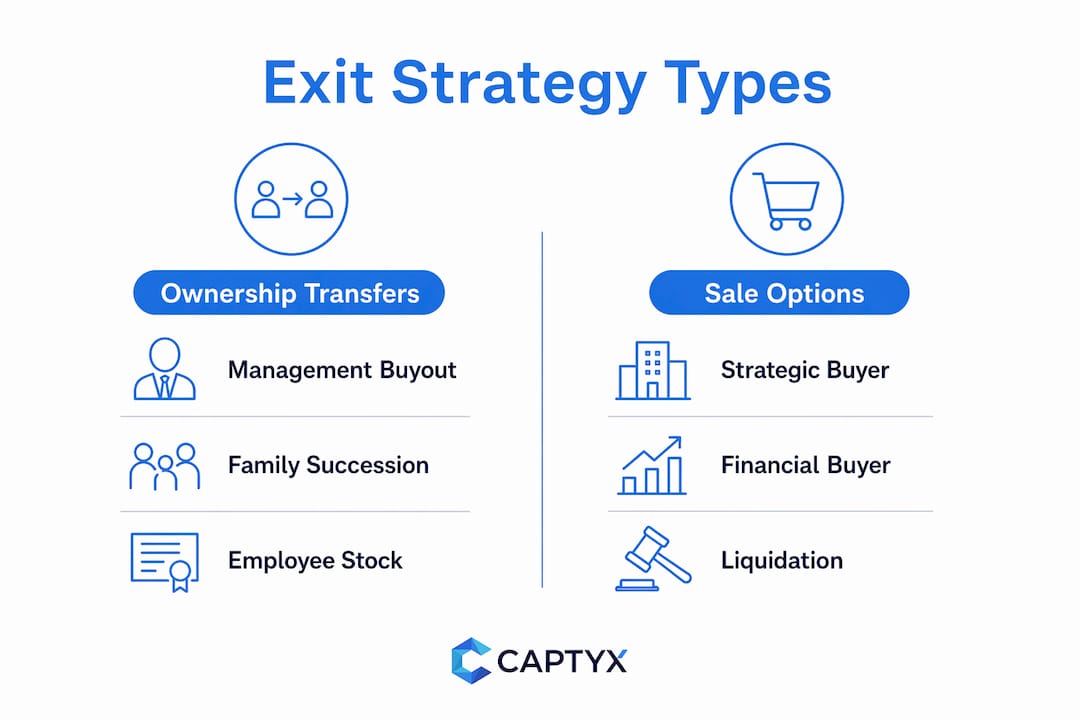
The SBA notes that ownership transfer options range from outright sales to gradual sales with payment plans and lease agreements. Liquidation is a last resort but still requires planning, including inventory counts, asset appraisals, and negotiated sales agreements. Treating liquidation as a non-plan is a costly mistake.
Shopify points out that internal transitions like MBOs and ESOPs require the business to operate without the owner before the deal closes. That means documenting procedures and building a capable management team well in advance. Owners who skip that step often find their valuation drops during due diligence.
Pro Tip: Choose your exit type based on your personal goals first, then your financial goals second. An owner who wants employees protected will make different decisions than one who wants the highest possible check.
Why is creating a business exit plan important?
The core elements of a solid business exit plan include defining your goals, establishing a fair market valuation, addressing tax and estate planning, identifying successors or buyers, and preparing your operations and management team. Regions Bank recommends building an advisory team that includes an accountant, an attorney, and a wealth advisor before you finalize any exit path. Each advisor covers a blind spot the others miss.
Tax and estate planning are not later considerations. Regions Bank is direct on this point: estate tax exemption thresholds and valuation methods affect which exit path makes financial sense. Choosing your exit method before running the tax numbers is like signing a lease before checking the rent. The sequence matters.
A successful exit strategy is developed early and revisited as owner goals and market conditions change. Owners who built their plan during growth phases have more options than those who start planning during a downturn or health crisis. Time is the most underrated asset in exit planning.
Key steps to create a business exit plan:
- Define what you want from the exit: money, control, intellectual property, or business continuity
- Get a formal fair market value appraisal from a qualified business valuator
- Identify your most likely buyer pool or successor candidates
- Consult a CPA and an M&A attorney on tax structure and deal format
- Build or update your advisory team before you need them
- Set a target timeline and review the plan every year
Pro Tip: Write your exit goals down before you talk to any advisor. Advisors optimize for what you tell them you want. If you haven’t decided, they’ll decide for you.
How do you determine business value and prepare for exit?
Fair market value is the price a willing buyer and a willing seller agree on when neither is under pressure. For ESOP transactions and third-party sales alike, a formal appraisal sets the baseline for every negotiation that follows. Owners who skip the appraisal step often accept the first offer they receive because they have no anchor to push back from. Understanding how buyers value your business before you enter any conversation is a significant advantage.
Shopify’s research on operational continuity introduces a concept worth understanding: “two-layer continuity.” The first layer is operational stability during due diligence, meaning the business runs normally while buyers inspect it. The second layer is post-sale continuity, meaning the business keeps running after you leave. Buyers pay more for businesses that demonstrate both layers clearly.
Preparation actions that directly improve valuation:
- Document all repeatable processes in written standard operating procedures
- Build a management team that can run daily operations without you
- Clean up financial records for at least three years prior to sale
- Resolve any outstanding legal, tax, or compliance issues
- Identify and reduce customer concentration risk before going to market
- Check whether your business meets sale readiness criteria before engaging buyers
Timing also affects value. A business sold during a period of strong revenue growth commands a higher multiple than the same business sold during a flat or declining period. Buyers pay for trajectory, not just history.
What practical factors affect your exit strategy execution?
Tax implications shape every exit decision from structure to timing. The difference between an asset sale and a stock sale, for example, can mean a significant gap in after-tax proceeds for the seller. An M&A attorney and a CPA working together can model both scenarios before you commit to a deal structure. Skipping that step costs owners real money.
Emotional factors are equally real. Decision fatigue sets in during long sale processes, and owners sometimes accept worse terms just to end the process. Knowing this in advance lets you build in decision checkpoints and rely on your advisory team to hold the line when you’re tired.
Execution best practices for a clean exit:
- Assemble your advisory team at least 12 months before your target exit date
- Run a pre-sale financial audit to identify and fix issues before buyers find them
- Set a realistic valuation range based on comparable sales in your industry
- Decide on your non-negotiables before any offer arrives
- Keep the business performing at full capacity throughout the sale process
- Plan for a transition period where you support the new owner post-close
Building the right team is not optional. Bank of America’s framework makes clear that exit choice depends on owner priorities around influence, employee protection, and wealth goals. No single advisor covers all three. You need specialists who work together.
Key Takeaways
A business exit strategy is a documented plan that must be built early, reviewed annually, and aligned with your personal goals, valuation targets, and tax structure to produce the best possible outcome.
| Point | Details |
|---|---|
| Define your exit type early | Choose from sale, MBO, ESOP, family transfer, or liquidation based on your goals. |
| Tax planning comes first | Structure your exit path around tax implications before selecting a buyer or method. |
| Valuation anchors negotiation | Get a formal fair market value appraisal before engaging any buyer or advisor. |
| Operational continuity raises value | Document processes and build management depth to support two-layer continuity. |
| Review the plan annually | Market conditions and owner goals change; your exit plan must keep pace with both. |
The exit plan most owners build too late
The most common mistake I see is owners treating exit planning as a finish-line activity. They build a business for 15 years, then spend six months scrambling to make it look presentable to buyers. That scramble costs them money, time, and in some cases, the deal itself.
The owners who exit well treat their exit plan the same way they treat their financial statements: as a living document they update every year. They know their target valuation range. They know which buyer type fits their goals. They’ve already reduced their personal dependency on daily operations. When a buyer shows up, they’re ready.
The other thing most articles won’t tell you: your exit strategy should make your business better right now, not just at sale time. When you document your processes, build your management team, and reduce customer concentration, you’re not just preparing for a buyer. You’re building a more resilient business. The exit plan and the growth plan are the same plan, written from different directions.
Align your exit goals with your personal financial picture before you talk to any broker or advisor. Know what number you need, what timeline works for your life, and what you want the business to look like after you leave. That clarity is what separates owners who get the deal they want from those who take whatever they can get.
— Tucker
How Captyx helps owners exit on their terms
Captyx has sold over 225 businesses, including businesses the Captyx team owned themselves. That experience shapes every valuation, every preparation strategy, and every buyer conversation the firm runs for clients.

Captyx builds the preparation systems that most brokers and M&A advisors use as their baseline. For owners who want to go beyond baseline, Captyx applies real-time buyer feedback to sharpen marketability before any deal goes live. The result is a business that enters the market positioned to attract serious buyers at strong multiples. If you’re ready to understand what your business is worth and what it would take to sell it well, the Captyx M&A advisory team is the right starting point. You can also explore whether using a broker fits your situation before committing to any path.
FAQ
What is a business exit strategy in simple terms?
A business exit strategy is a plan for how an owner will sell, transfer, or close their business to reach a specific financial or personal goal. It covers the exit method, timeline, valuation target, and tax structure.
When should I start planning my business exit?
Exit planning should start years before your target exit date, ideally during a period of business growth. Early planning gives you more exit options and stronger negotiating leverage with buyers.
What are the most common types of small business exit strategies?
The most common types include third-party sales, management buyouts, family succession, ESOPs, and liquidation. Bank of America identifies seven total paths, each suited to different owner priorities around wealth, legacy, and employee protection.
How does valuation affect my exit strategy choice?
Your fair market value determines which exit paths are financially viable and sets the floor for buyer negotiations. Owners who get a formal appraisal before going to market consistently achieve better outcomes than those who rely on informal estimates.
Do I need an advisor to create a business exit plan?
An advisory team including a CPA, an M&A attorney, and a wealth advisor is the standard recommendation from Regions Bank’s exit planning framework. Each specialist addresses a different risk area that the others are not equipped to handle alone.
Recommended
- ELECTRICAL CONTRACTOR FOCUSING ON DATA CENTER CONSTRUCTION – Top Way to Sell a Business | Captyx
- RESIDENTIAL LANDSCAPING COMPANY FOCUSING ON XERISCAPING – Top Way to Sell a Business | Captyx
- COMMERCIAL LANDSCAPING MAINTENANCE COMPANY – Top Way to Sell a Business | Captyx
- IT CONSULTING & MANAGED SERVICES PROVIDER – Top Way to Sell a Business | Captyx


